
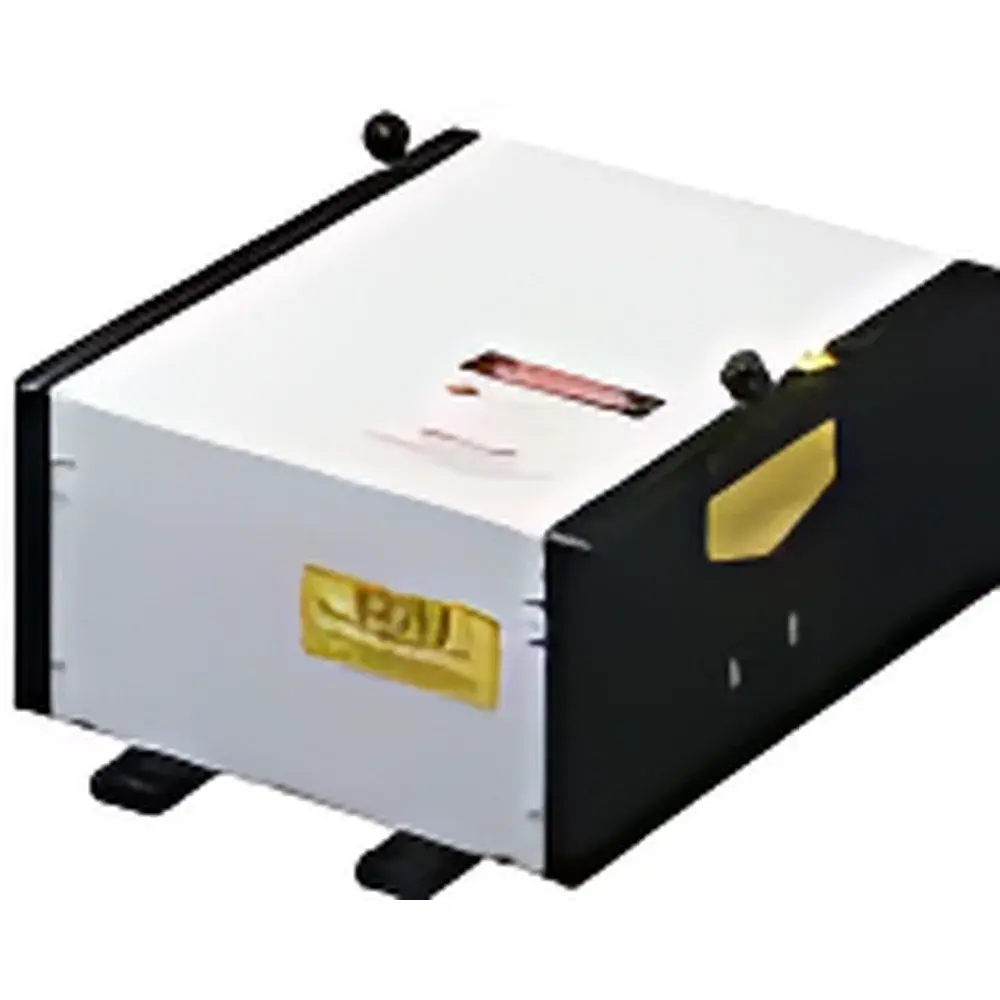
Ekspla PG142C Series Narrowband Nanosecond Optical Parametric Oscillator
| Brand | Ekspla |
|---|---|
| Origin | Lithuania |
| Manufacturer Type | Authorized Distributor |
| Origin Category | Imported |
| Model | PG142C |
| Core Component | Solid-State Laser System with Integrated OPO and SHG Stages |
| Tuning Range | 420–709.9 nm & 710–2299 nm |
| UV Extension via SHG | 210–419.9 nm |
| OPO Linewidth | <6 cm⁻¹ |
| SHG Linewidth | <9 cm⁻¹ |
| Repetition Rate | 10 Hz |
| Pulse Energy | >60 mJ @ 450 nm, >8 mJ @ 260 nm |
| Nonlinear Crystal | Type-II BBO |
| Control Interface | RS232 + LabVIEW-compatible PC software + Front-panel Remote Operation |
| Optional Pump Outputs | 1064 nm and 532 nm |
Overview
The Ekspla PG142C Series is a high-stability, narrowband nanosecond optical parametric oscillator (OPO) engineered for precision wavelength-tunable laser spectroscopy, time-resolved fluorescence studies, and nonlinear optical characterization. Based on optical parametric generation in a type-II beta-barium borate (BBO) crystal, the system delivers tunable output across two broad spectral regions—420–709.9 nm (visible) and 710–2299 nm (near- to mid-infrared)—with optional second-harmonic generation (SHG) extending coverage into the deep ultraviolet (210–419.9 nm). Its fundamental design adheres to the principles of collinear, singly resonant OPO operation under nanosecond-pumped conditions, ensuring high pulse-to-pulse reproducibility and spectral fidelity. The integrated 10 Hz Nd:YAG pump laser (1064 nm) provides consistent energy delivery, while built-in beam walk-off compensation in both OPO and SHG stages maintains spatial mode quality and conversion efficiency across the full tuning range.
Key Features
- Narrow spectral bandwidth: <6 cm⁻¹ in OPO output and <9 cm⁻¹ after SHG—enabling high-resolution absorption and Raman spectroscopy.
- Full spectral coverage from 210 nm to 2299 nm via combined OPO tuning and harmonic generation modules.
- Integrated tripling stage delivering stable 355 nm pump output alongside primary OPO signal and idler beams.
- Built-in calibrated pump energy monitor and motorized attenuation system for precise control of OPO threshold and conversion efficiency.
- Beam walk-off compensation optics in both OPO and SHG cavities to preserve beam pointing stability and M² factor over wide wavelength sweeps.
- RS232 interface compliant with standard SCPI command syntax; fully compatible with LabVIEW™, MATLAB®, and Python-based automation frameworks for integration into automated measurement platforms.
- Front-panel controls and status indicators support standalone operation without external PC dependency during alignment or rapid testing protocols.
Sample Compatibility & Compliance
The PG142C is routinely deployed in laboratories requiring traceable, repeatable excitation sources for photophysical analysis of organic dyes, quantum dots, biological chromophores, and semiconductor nanostructures. Its UV–NIR tunability supports compliance with common spectroscopic test methods defined in ASTM E275, ISO 13406-2 (for UV source calibration), and IEC 61000-4-3 (radiated immunity testing of optical sensors). While not a medical device, its stable pulse energy and spectral purity meet preconditions for use in GLP-compliant analytical workflows where instrument qualification (IQ/OQ/PQ) is required. All electronic subsystems conform to CE marking directives (EMC Directive 2014/30/EU and Low Voltage Directive 2014/35/EU).
Software & Data Management
Control firmware supports bidirectional communication via ASCII-based RS232 protocol, enabling full parameter scripting—including wavelength setpoint, attenuator position, and SHG activation state. Ekspla-provided LabVIEW VIs include waveform logging, energy monitoring dashboards, and automated wavelength scanning routines with user-defined step size and dwell time. Audit trails are generated for all parameter changes when connected to networked PCs running Windows OS with NTFS journaling enabled. Although native support for FDA 21 CFR Part 11 electronic signatures is not embedded, the system architecture permits integration with third-party ELN/LIMS platforms that enforce role-based access control and electronic record retention policies.
Applications
- Time-resolved fluorescence lifetime imaging (FLIM) using tunable picosecond/nanosecond excitation pulses.
- Resonance Raman spectroscopy of heme proteins and transition metal complexes with excitation line selection below 300 nm.
- Photoacoustic spectroscopy in gas-phase trace detection systems operating at 1–2 µm wavelengths.
- Nonlinear susceptibility measurements (χ⁽²⁾, χ⁽³⁾) in novel 2D materials and perovskite thin films.
- Calibration of monochromators, spectroradiometers, and CCD/CMOS array detectors across UV–NIR bands.
- Pump–probe transient absorption experiments requiring synchronized, wavelength-matched pump and probe beams.
FAQ
What is the typical warm-up time before achieving spectral stability?
The system reaches thermal equilibrium within 30 minutes of power-on; wavelength drift remains below ±0.1 nm over 4-hour continuous operation at fixed tuning points.
Can the PG142C be synchronized with external delay generators or streak cameras?
Yes—TTL-compatible trigger outputs (rising edge, 5 V, 50 Ω) are provided for both pump laser firing and OPO cavity dumping, with jitter <1 ns RMS relative to master clock input.
Is vacuum or purged operation required for deep-UV output below 220 nm?
Operation below 240 nm requires nitrogen purging of the SHG module path to minimize ozone-induced absorption; no vacuum enclosure is necessary.
Does the system support custom firmware modifications for OEM integration?
Ekspla offers limited-scope firmware adaptation services under NDA for volume OEM partners, subject to hardware revision compatibility assessment.
What maintenance intervals are recommended for optimal long-term performance?
Optical alignment verification every 6 months; BBO crystal inspection and cleaning every 12 months; pump laser rod replacement typically required after ≥2 × 10⁶ shots (subject to usage profile).




