
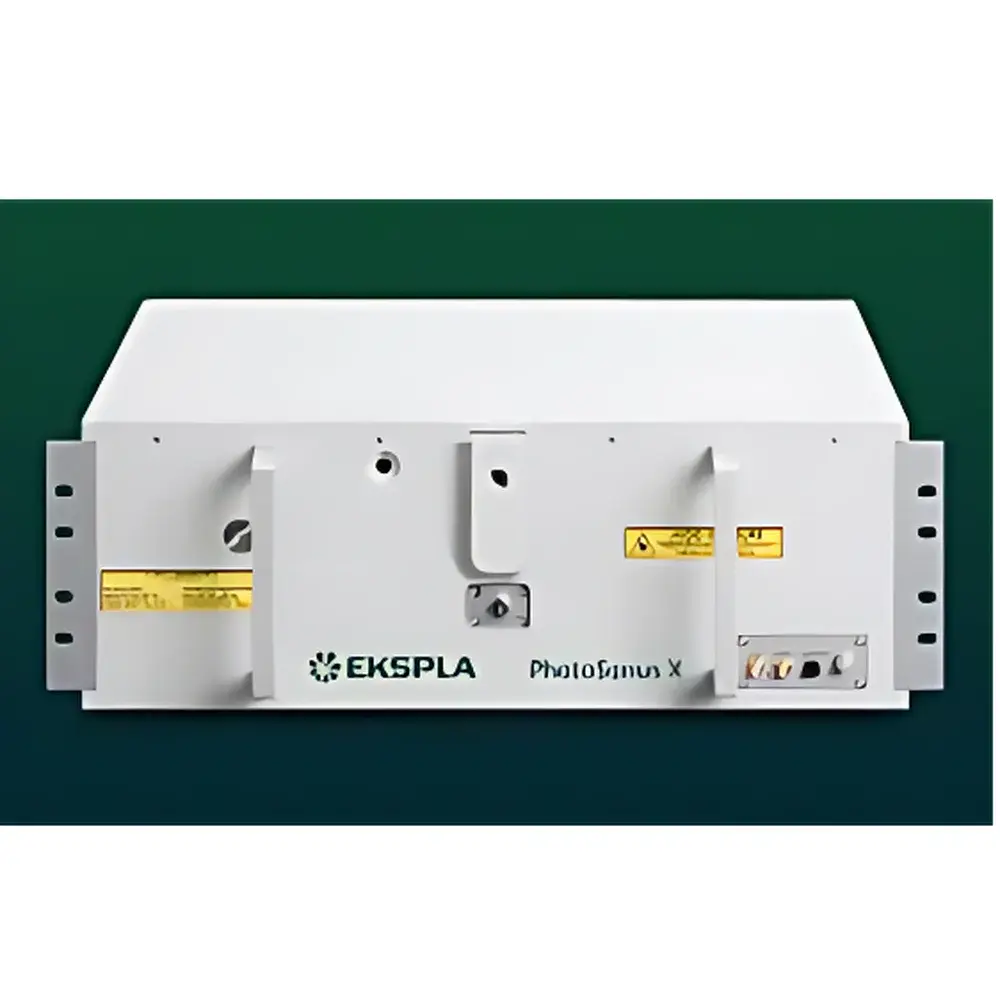
Ekspla PhotoSonus X High-Power DPSS Tunable Laser System for Photoacoustic Imaging
| Brand | Ekspla |
|---|---|
| Origin | Lithuania |
| Manufacturer Type | Original Equipment Manufacturer (OEM) |
| Product Category | Imported |
| Model | PhotoSonus X |
| Core Technology | Diode-Pumped Solid-State (DPSS) Laser with Integrated Optical Parametric Oscillator (OPO) |
| Output Configuration | Free-space and fiber-coupled options |
| Pulse Energy | Up to 90 mJ (Signal, 650–1300 nm), >50 mJ (Idler, 1065–2600 nm) |
| Pulse Repetition Rate | 50 Hz or 100 Hz |
| Tuning Range | Signal: 650–1300 nm |
| Idler (optional) | 1065–2600 nm |
| Wavelength Resolution | 0.1 nm (Signal), 1 nm (Idler) |
| Pulse Duration | 2–5 ns (FWHM) |
| Signal Linewidth | <15 cm⁻¹ (X-50), <10 cm⁻¹ (X-100) |
| Beam Diameter (1/e²) | 6 ± 1 mm |
| Cooling | Closed-loop air–water |
| Power Consumption | <2 kW |
| Operating Temperature | 18–27 °C |
| Relative Humidity | 20–80 % non-condensing |
| Control Interfaces | LAN, RS232 |
| Acoustic Noise Level | <60 dB(A) |
| Compliance Readiness | FDA 21 CFR Part 11, IEC 60825-1, ISO 13485-aligned design |
Overview
The Ekspla PhotoSonus X is a fully integrated, diode-pumped solid-state (DPSS) tunable laser system engineered specifically for high-fidelity photoacoustic imaging (PAI) in both preclinical research and clinical translation environments. At its core, the system combines a high-stability DPSS pump laser with a synchronously pumped optical parametric oscillator (OPO) in a single, thermally optimized housing—eliminating alignment drift and enabling robust, long-term operation. The PhotoSonus X operates on the fundamental principle of pulsed-laser-induced thermoelastic expansion: short-duration, wavelength-tunable laser pulses are absorbed by endogenous chromophores (e.g., hemoglobin, melanin, lipids) or exogenous contrast agents, generating broadband ultrasonic waves that are detected by ultrasound transducers to reconstruct spatially resolved optical absorption maps. With a signal tuning range spanning 650–1300 nm and an optional idler output extending to 2600 nm, the system supports multispectral PAI across key biological windows (NIR-I, NIR-IIa, and partial NIR-IIb), facilitating spectral unmixing of overlapping absorbers and quantitative functional imaging.
Key Features
- Ultra-broad, motorized signal tuning from 650 nm to 1300 nm with 0.1 nm step resolution—enabling precise targeting of oxy-/deoxy-hemoglobin, water, lipid, and melanin absorption peaks
- Integrated OPO architecture delivering up to 90 mJ pulse energy at 700 nm (PhotoSonus X-50) or >50 mJ at 100 Hz (X-100), ensuring sufficient acoustic pressure generation for deep-tissue imaging with high signal-to-noise ratio
- Fast, software-controlled wavelength switching (<50 ms between adjacent wavelengths), critical for real-time multispectral scanning protocols and dynamic functional studies
- Low acoustic noise emission (<60 dB[A]) achieved via silent diode pumping and active thermal management—essential for quiet operation in clinical suites and behavioral imaging setups
- Factory-aligned free-space output with 6 ± 1 mm (1/e²) beam diameter and optional fiber coupling (3 mm bundle compatible), supporting flexible integration into commercial and custom PAI platforms
- Electromechanical output shutter with built-in laser self-test functionality, providing hardware-level safety interlocks and audit-ready status logging per IEC 62304 and ISO 13485 requirements
- Optional integrated pyroelectric energy meter for real-time pulse-by-pulse energy monitoring and closed-loop stability feedback
Sample Compatibility & Compliance
The PhotoSonus X is designed for compatibility with diverse photoacoustic detection modalities, including single-element focused transducers, linear/curved arrays, and interferometric fiber-optic hydrophones. Its stable TEM₀₀ output and low pointing instability (<25 µrad) ensure consistent illumination across heterogeneous biological samples—from murine models and ex vivo tissue sections to human finger and breast phantoms. The system meets Class 4 laser safety requirements per IEC 60825-1:2014 and incorporates redundant hardware interlocks, key-switched operation, and emission indicators compliant with EN 60825-1. For regulated clinical deployment, the PhotoSonus X platform supports configuration for FDA 21 CFR Part 11 compliance—including electronic signature support, audit trail logging, and role-based access control when paired with validated PAI acquisition software. Its mechanical and thermal architecture adheres to ISO 13485 design controls, and the closed-loop cooling system eliminates reliance on facility chillers—reducing infrastructure dependencies during GLP/GMP-compliant studies.
Software & Data Management
Control is implemented via Ethernet (LAN) or RS232 using Ekspla’s cross-platform LaserControl GUI, which provides full parameter scripting, wavelength calibration import/export, and synchronization triggers (TTL input/output). The API supports integration with MATLAB, Python (PyVISA), and LabVIEW environments for custom pulse sequencing, adaptive scanning, and real-time spectral feedback loops. All operational parameters—including pulse energy, wavelength, repetition rate, and shutter state—are logged with timestamps and user identifiers, forming a complete electronic record traceable to individual imaging sessions. Optional firmware upgrades enable automated wavelength sweeps synchronized to ultrasound frame acquisition, minimizing temporal misregistration in dynamic PAI applications such as tumor perfusion mapping or oxygen saturation kinetics.
Applications
- Preclinical longitudinal studies: Real-time photoacoustic tomography (PAT) of rat kidney inflammation, tumor angiogenesis, and cerebral hemodynamics
- Clinical prototype development: Integration into hybrid photoacoustic/ultrasound (PAUS) tomographs for real-time finger joint imaging and peripheral vascular assessment
- Quantitative biomarker imaging: Spectral unmixing of hemoglobin species, lipid accumulation, and exogenous contrast agents (e.g., indocyanine green, gold nanorods)
- Fiber-optic PA probe development: Coupling to interferometric fiber-optic ultrasound transducers for minimally invasive endoscopic and intravascular applications
- Algorithm validation: Generation of high-SNR, spectrally diverse ground-truth datasets for training deep learning reconstruction models and active contour filtering techniques
FAQ
What is the minimum pulse energy stability over 8 hours of continuous operation?
Typical RMS energy fluctuation is ≤3% (measured at 700 nm, 100 Hz, ambient 22 °C), verified per ISO 21254-1 for laser stability certification.
Can the PhotoSonus X be operated in Q-switched mode without OPO conversion?
No—the system is configured exclusively as a DPSS-pumped OPO; the fundamental 1064 nm output is not accessible as a standalone beam.
Is external chiller required for standard operation?
No. The integrated closed-loop air–water cooler operates autonomously; only mains power and ambient airflow are required.
How is wavelength calibration maintained over time?
Motorized grating positioning is referenced to internal HeNe wavelength standards; factory calibration is traceable to NIST, with optional annual recalibration services.
Does the system support synchronization with external ultrasound scanners?
Yes—TTL-compatible trigger inputs and outputs enable precise master–slave timing with commercial US platforms (e.g., Verasonics Vantage, Siemens ACUSON Sequoia) down to ±5 ns jitter.



