
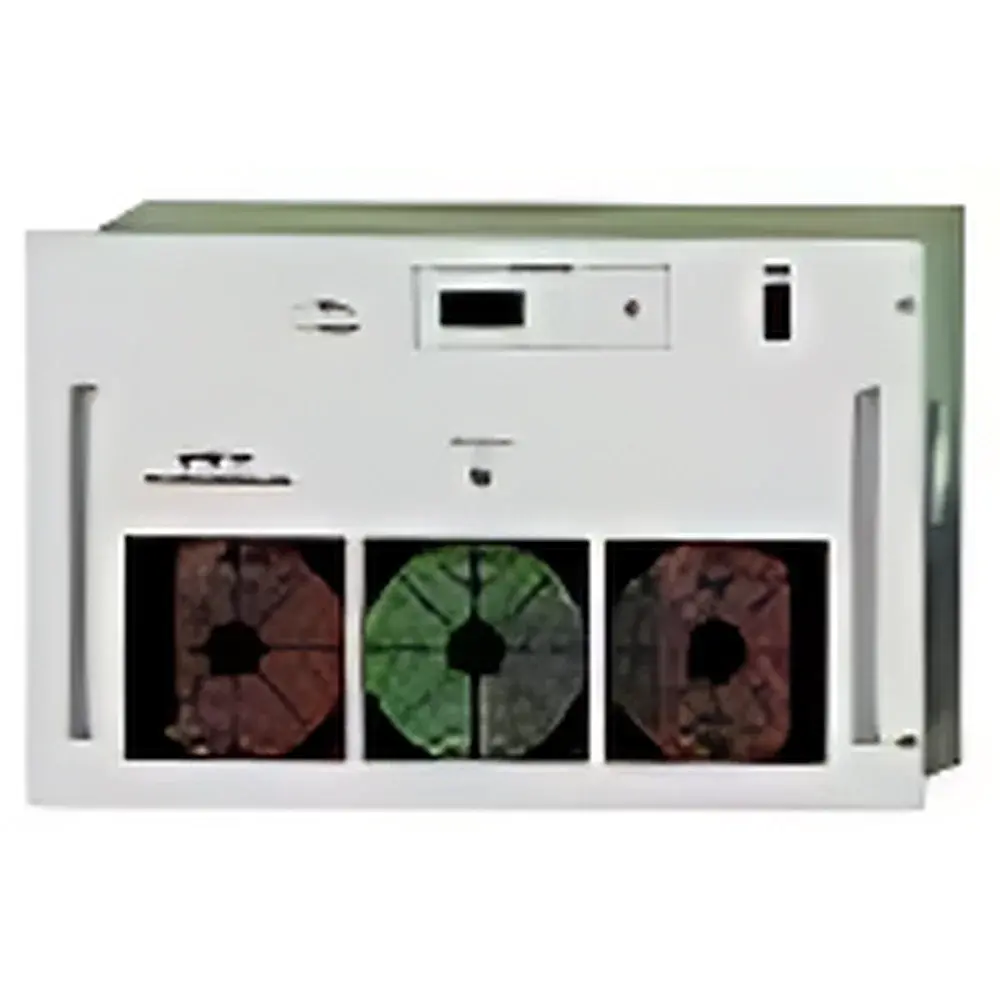
Ekspla PS1245CO Water-to-Air Laser Cooling Unit
| Brand | Ekspla |
|---|---|
| Origin | Imported (Lithuania) |
| Model | PS1245CO |
| Cooling Capacity | 0.5–2 kW (selectable) |
| Max Coolant Flow Rate | 7 L/min |
| Max Operating Pressure | 3.5 bar |
| Coolant Temperature Range | 25–45°C (adjustable via 10-turn potentiometer) |
| Coolant Conductivity Requirement | 1–20 µS/cm (deionized/distilled water) |
| Cabinet Format | 19″ rack-mountable, 7U height |
| Integrated Functions | Real-time coolant temperature & level indication, overheat/low-pressure/low-level interlock protection, inline deionization & particulate filtration |
Overview
The Ekspla PS1245CO is a precision-engineered water-to-air cooling unit specifically developed for flashlamp-pumped solid-state lasers. It operates on the principle of forced-convection heat transfer between a closed-loop deionized water circuit and ambient air via high-efficiency finned heat exchangers and regulated axial fans. Unlike generic chillers, the PS1245CO is optimized for the thermal dynamics of high-energy pulsed laser rods—delivering stable coolant temperature control (±0.3°C typical stability under steady-state load) to minimize thermal lensing, reduce rod stress, and maintain consistent beam quality and pulse energy reproducibility over extended operational cycles. Its architecture supports continuous-duty operation at rated loads, making it suitable for industrial marking systems, scientific pump sources, and OEM laser integrations where long-term thermal equilibrium directly impacts system uptime and optical performance consistency.
Key Features
- Rack-mountable 19″ × 7U chassis compliant with IEC 60297-3-100 mechanical standards, enabling seamless integration into laser power supply cabinets or centralized equipment racks.
- Selectably rated cooling capacity (0.5, 1.0, 1.5, or 2.0 kW) allows matching to specific laser head thermal dissipation profiles without oversizing or efficiency penalty.
- Integrated dual-stage coolant conditioning: depth-type particulate filtration (≤5 µm retention) followed by mixed-bed deionization (1–20 µS/cm output conductivity), preventing flashlamp electrode corrosion and quartz envelope scaling.
- Digital front-panel interface with LED indicators for real-time monitoring of setpoint temperature, actual coolant temperature, fluid level, loop pressure status, and overtemperature alarm.
- Hardware-based safety interlock system featuring independent sensors for low coolant level, loss of loop pressure, and thermal runaway—each capable of asserting a TTL-compatible interrupt signal to the laser’s master interlock port (IEC 61508 SIL1-compliant signaling path).
- Brushless DC coolant pump with flow-rate feedback and automatic shutdown logic upon detection of dry-run or pressure drop exceeding 0.3 bar threshold.
Sample Compatibility & Compliance
The PS1245CO is compatible with Nd:YAG, Nd:YLF, and alexandrite-based flashlamp-pumped laser heads requiring closed-loop water circulation at pressures up to 3.5 bar and flow rates up to 7 L/min. It meets CE marking requirements under the EU Machinery Directive 2006/42/EC and Electromagnetic Compatibility Directive 2014/30/EU. The unit’s coolant loop design conforms to ISO 8502-9 for non-corrosive aqueous media handling in optical instrumentation. While not certified to FDA 21 CFR Part 11, its analog temperature setpoint control and hardware interlocks support audit-ready operation in GLP environments when paired with external logging systems. No refrigerants are used; thermal rejection occurs solely via forced-air convection, eliminating F-gas compliance obligations.
Software & Data Management
The PS1245CO operates as a standalone, microcontroller-driven subsystem with no embedded firmware update capability or network interface. All operational parameters—including temperature setpoint, alarm thresholds, and pump enable/disable state—are configured manually via front-panel controls. For integration into automated test benches or facility-wide monitoring networks, optional analog (0–10 V / 4–20 mA) and digital (RS-485 Modbus RTU) I/O modules are available as factory-installed accessories. These enable remote readout of coolant temperature, pressure, level, and fault status—supporting traceability workflows aligned with ISO/IEC 17025 calibration management protocols. No proprietary software is required; third-party SCADA or LabVIEW drivers may be deployed using standard Modbus register maps provided in the technical manual.
Applications
- Thermal stabilization of high-repetition-rate Q-switched Nd:YAG lasers used in LIBS (Laser-Induced Breakdown Spectroscopy) and time-resolved fluorescence lifetime measurement systems.
- Cooling infrastructure for industrial DPSS (Diode-Pumped Solid-State) laser pump cavities where flashlamp redundancy or hybrid pumping architectures demand robust thermal management.
- OEM integration into turnkey laser machining platforms requiring compact, rack-mountable cooling with deterministic safety interlocking for Class IV laser enclosure compliance (IEC 60825-1).
- Research-grade laser laboratories maintaining multiple pulsed laser sources on shared utility racks, where modular cooling units reduce infrastructure complexity versus centralized chilled water plants.
FAQ
What type of coolant is required for the PS1245CO?
Deionized or distilled water with electrical conductivity between 1 and 20 µS/cm must be used. Addition of glycol or corrosion inhibitors is strictly prohibited, as they compromise deionizer cartridge life and risk dielectric breakdown in high-voltage flashlamp environments.
Can the temperature setpoint be controlled remotely?
Yes—via optional RS-485 Modbus RTU interface or analog voltage/current input (0–10 V or 4–20 mA), subject to factory configuration. The standard unit uses only the front-panel 10-turn potentiometer.
Is the PS1245CO compatible with lasers requiring higher than 3.5 bar loop pressure?
No. It is engineered for flashlamp-pumped lasers operating within 1.0–3.5 bar nominal loop pressure. For high-pressure diode-laser arrays or fiber-coupled systems, consult Ekspla’s PS1260 series.
How often must the deionization cartridge be replaced?
Under typical lab use (2 kW load, 8 hrs/day), replacement is recommended every 6–9 months. Actual service interval depends on initial water quality and total volume processed—monitoring conductivity drift via the front-panel display is essential for predictive maintenance.
Does the unit include a built-in flow meter?
No. Flow rate is inferred from pump speed and system backpressure; direct volumetric measurement requires an external ultrasonic or turbine flow sensor installed in the laser head return line.





