
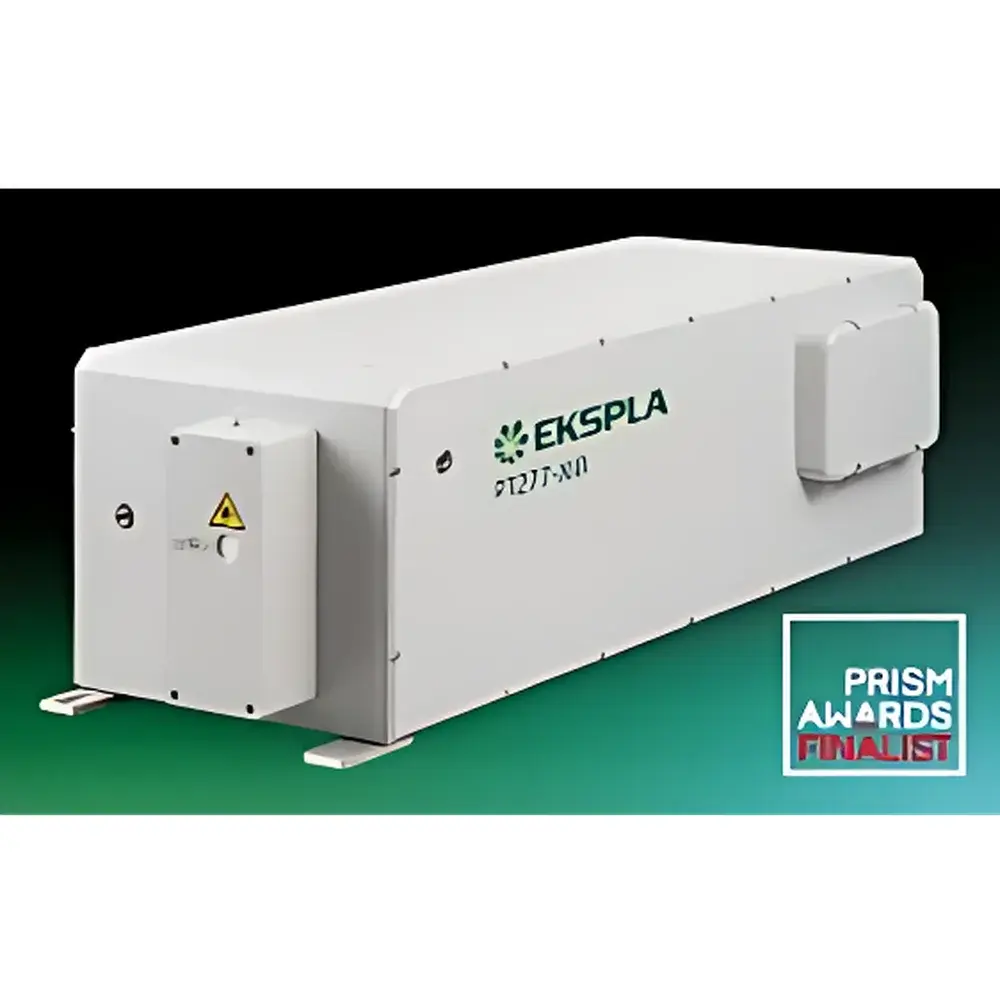
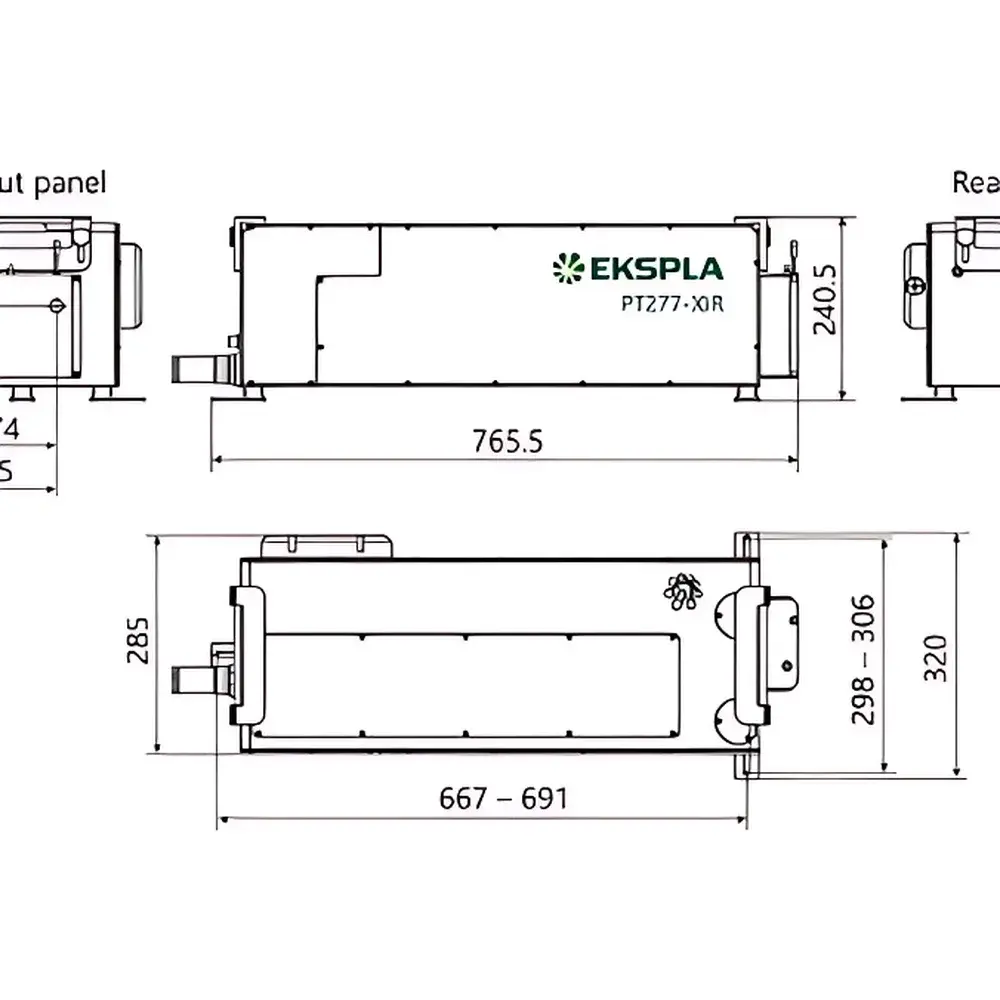
Ekspla PT277-XIR Integrated Mid-IR Tunable Picosecond Laser System
| Brand | Ekspla |
|---|---|
| Origin | Lithuania |
| Manufacturer Type | OEM Manufacturer |
| Product Category | Imported Instrument |
| Model | PT277-XIR |
| Core Technology | Synchronously Pumped Optical Parametric Oscillator (OPO) with Diode-Pumped Solid-State (DPSS) Pump Laser |
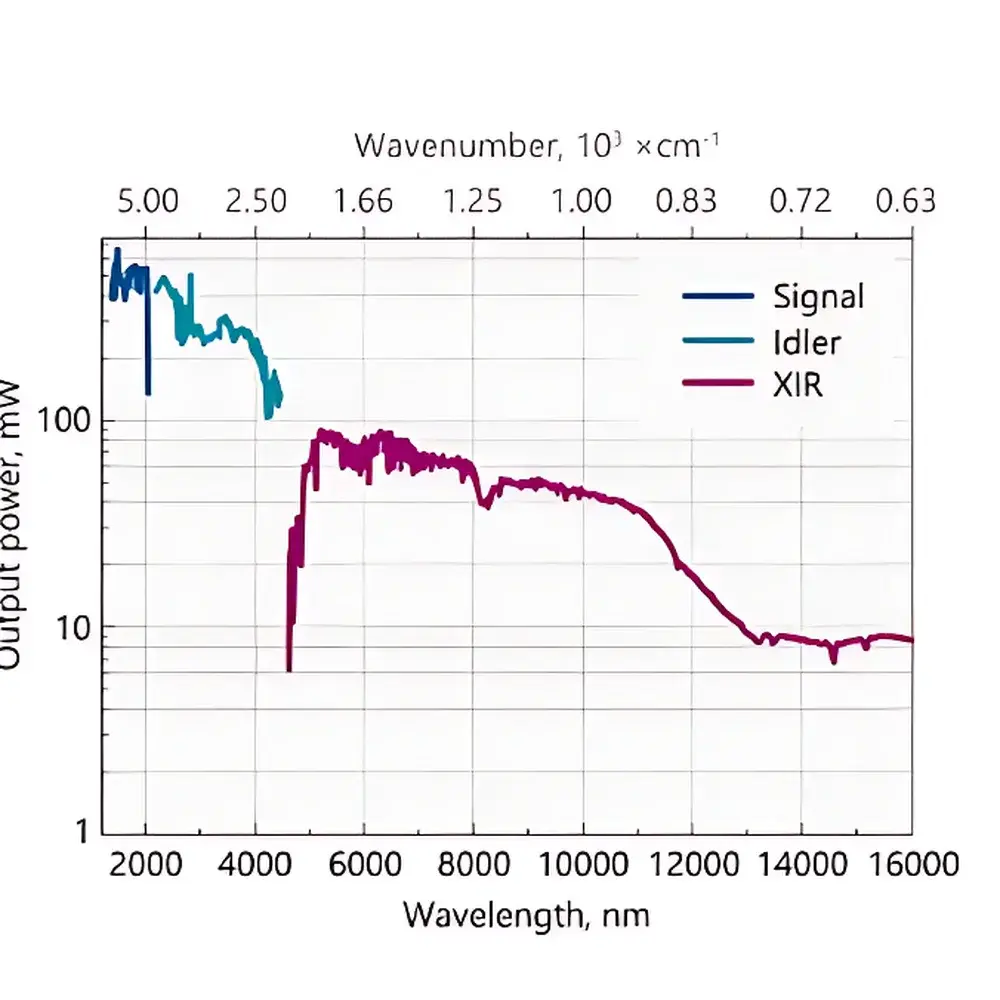
| Tuning Range | 1405–2020 nm (signal), 2250–4400 nm (idler), 5000–16000 nm (mid-IR) |
| Spectral Linewidth | < 5 cm⁻¹ (full tuning range) |
| Pulse Repetition Rate | 87 MHz |
| Pulse Duration (pump) | ~8 ps |
| Output Power | >100 mW @ 2200–4000 nm |
| Beam Diameter (1/e²) | ~3 mm |
| Beam Divergence (full angle, FWHM) | < 5 mrad (signal) |
| Wavelength Tuning Resolution | 0.1 nm (signal), 1 nm (idler/mid-IR) |
| Control Interfaces | USB (virtual COM), RS232, LAN, optional WLAN |
| Remote Control Protocol | REST API compliant |
| Cooling | Active water-to-air chiller required |
| Operating Ambient | 22 ± 2 °C, ±1 °C stability, 20–80% RH (non-condensing) |
| Power Supply | 100–240 VAC, 50/60 Hz, <1 kVA |
| Cleanroom Class | ISO Class 9 or better |
Overview
The Ekspla PT277-XIR is a fully integrated, synchronously pumped optical parametric oscillator (OPO) laser system engineered for high-stability mid-infrared spectroscopy applications. It combines a mode-locked diode-pumped solid-state (DPSS) picosecond pump laser and a precision-tuned OPO cavity within a single monolithic mechanical platform—eliminating alignment drift and reducing thermal sensitivity. The system delivers tunable output across three distinct spectral bands: near-infrared signal (1405–2020 nm), short-wave idler (2250–4400 nm), and broadband mid-infrared (5000–16000 nm), covering vibrational transitions critical to molecular fingerprinting in gas-phase, liquid, and solid-state samples. Its sub-5 cm⁻¹ linewidth ensures high spectral resolution for quantitative absorption measurements, while the <5 mrad beam divergence and <50 µrad RMS pointing stability support long-path configurations and coupling into multipass cells or external interferometers. Designed for laboratory integration rather than benchtop prototyping, the PT277-XIR operates at a fixed 87 MHz repetition rate with ~8 ps pump pulses—enabling time-resolved pump-probe experiments when synchronized with external detectors or delay stages.
Key Features
- Monolithic integration of DPSS pump laser and OPO cavity in a rigid aluminum frame—minimizing thermal drift and mechanical misalignment over extended operation.
- Three-band wavelength coverage: 1405–2020 nm (7115–4950 cm⁻¹), 2250–4400 nm (4444–2253 cm⁻¹), and 5000–16000 nm (2000–625 cm⁻¹), enabling access to fundamental C–H, N–H, O–H, C=O, and metal–ligand vibrational modes.
- Microprocessor-controlled, closed-loop motorized tuning with 0.1 nm step resolution in signal band and 1 nm in mid-IR—ensuring reproducible wavelength selection across thousands of cycles.
- Precise non-linear crystal temperature stabilization via PID-controlled thermoelectric coolers—maintaining phase-matching conditions over ambient fluctuations.
- Full remote operability via RESTful API, supporting Python, LabVIEW, MATLAB, and custom SCADA systems—facilitating automated spectral acquisition and integration into GLP/GMP-compliant workflows.
- Dual-stage active cooling architecture: integrated water-to-air chiller with flow and temperature monitoring—meeting stringent thermal load requirements without external chillers.
Sample Compatibility & Compliance
The PT277-XIR is routinely deployed in Fourier-transform infrared (FTIR) spectroscopy, cavity-enhanced absorption spectroscopy (CEAS), photoacoustic detection, and laser-induced breakdown spectroscopy (LIBS) of trace gases and condensed-phase analytes. Its narrow linewidth and stable power output meet ASTM E1421–22 requirements for spectrometer calibration source performance. The system complies with IEC 60825-1:2014 Class 4 laser safety standards and includes interlock-ready connectors for integration into certified laser enclosures. All firmware and control software support audit trail logging per FDA 21 CFR Part 11 when used with validated host systems. No optical realignment is required during routine operation—supporting ISO/IEC 17025-accredited laboratories seeking minimal maintenance intervals and documented instrument stability.
Software & Data Management
Ekspla provides the proprietary PT277 Control Suite—a cross-platform application (Windows/Linux/macOS) offering real-time wavelength scanning, power monitoring, and hardware diagnostics. The suite exports spectral metadata in HDF5 and CSV formats, including timestamped wavelength, pump energy, crystal temperature, and AOM modulation status. REST API endpoints expose all low-level parameters (e.g., /api/oPO/wavelength, /api/system/status), enabling direct integration with LIMS platforms or custom Python-based data pipelines. Firmware updates are delivered via signed binary packages with SHA-256 verification. Internal EEPROM stores calibration coefficients per crystal orientation, ensuring traceable wavelength accuracy across device lifetimes. Optional MATLAB Instrument Control Toolbox drivers and LabVIEW VIs are available under NDA for regulated environments.
Applications
- High-resolution gas-phase spectroscopy of greenhouse gases (CH₄, N₂O, CO, NO₂) and industrial process contaminants.
- In situ monitoring of catalytic reactions using mid-IR transmission through high-pressure reaction cells.
- Time-resolved vibrational dynamics studies in photoactive proteins and organometallic complexes.
- Calibration source for FTIR spectrometers requiring NIST-traceable line positions and intensities.
- Mid-IR pump source for difference-frequency generation (DFG) setups targeting THz generation.
- Standoff detection systems leveraging atmospheric transmission windows between 3–5 µm and 8–12 µm.
FAQ
What is the minimum warm-up time required before stable operation?
The system requires ≥2 hours of continuous power-on time after cold start to achieve thermal equilibrium; operation below this threshold may result in wavelength drift exceeding ±0.5 nm.
Can the PT277-XIR be operated in a standard laboratory without a cleanroom?
Yes—ISO Class 9 (equivalent to typical office air) is sufficient, provided particulate ingress is minimized via enclosure sealing and HEPA-filtered airflow near the beam path.
Is the output polarization state fixed or adjustable?
The laser emits linearly polarized light with vertical orientation relative to the baseplate; polarization rotation is achievable via external half-wave plates but not integrated into the OPO cavity.
Does the system support external triggering for pump-probe experiments?
Yes—the 87 MHz pulse train is accessible via SMA sync output, and the internal timing controller accepts external TTL triggers for gated acquisition or burst-mode operation.
How is wavelength accuracy verified and maintained over time?
Each unit undergoes factory calibration against a stabilized HeNe reference and includes an on-board wavemeter option (PT277-WM) for real-time feedback; recalibration is recommended annually or after major environmental relocation.



