
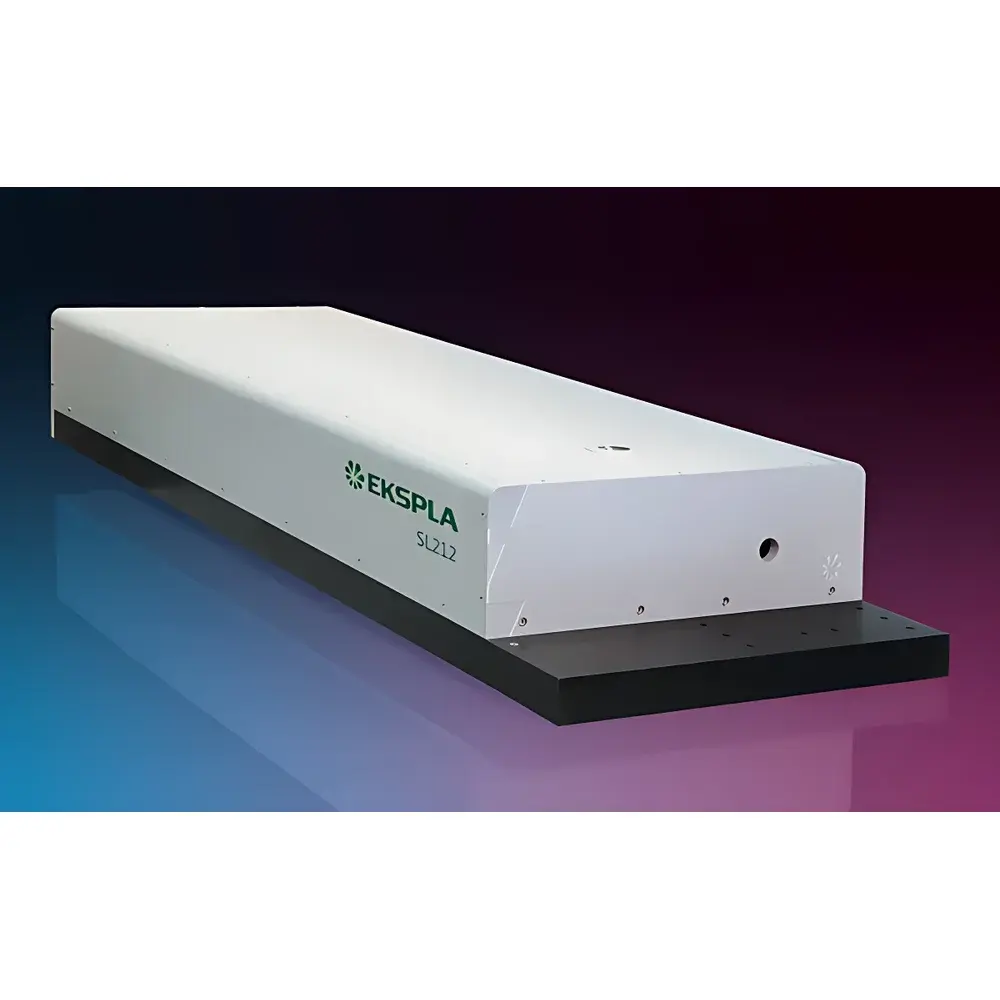
Ekspla SL212 SBS-Compressed Picosecond Laser System
| Brand | Ekspla |
|---|---|
| Origin | Lithuania |
| Manufacturer Type | Original Equipment Manufacturer (OEM) |
| Product Category | Imported Scientific Laser System |
| Model | SL212 |
| Pulse Duration | <150 ps |
| Wavelength | 1064 nm (fundamental), with optional harmonic generation (532 nm, 355 nm, 266 nm) |
| Pulse Energy | Up to 250 mJ @ 1064 nm |
| Pumping Scheme | Diode-pumped Q-switched oscillator + flashlamp-pumped power amplifier |
| Pulse Contrast Ratio | High pre-pulse suppression (>10⁸:1 typical) |
| Thermal Stabilization | Active temperature control for harmonic generators |
| Control Interface | PC-based via USB/Ethernet, LabVIEW™ drivers included, front-panel keypad for remote operation |
Overview
The Ekspla SL212 is a high-energy, SBS-compressed picosecond laser system engineered for demanding scientific and industrial applications requiring ultrashort pulses with exceptional temporal contrast and energy stability. At its core, the SL212 integrates a diode-pumped, actively Q-switched Nd:YAG oscillator with stimulated Brillouin scattering (SBS) pulse compression technology—enabling sub-150 ps pulse durations at 1064 nm while preserving beam quality and spectral integrity. A flashlamp-pumped Nd:YAG power amplifier stage delivers up to 250 mJ per pulse, making the system uniquely suited for nonlinear optics, laser-induced breakdown spectroscopy (LIBS), and high-fluence material interaction studies. Unlike conventional passively mode-locked or grating-compressed systems, the SBS compression architecture provides intrinsic pulse cleaning, resulting in a superior pre-pulse contrast ratio exceeding 10⁸:1—critical for minimizing prepulse-induced target modification in ablation and plasma generation experiments.
Key Features
- Sub-150 ps pulse duration achieved via stimulated Brillouin scattering (SBS) compression—no external pulse compressors or dispersion compensation required
- Diode-pumped Q-switched oscillator ensures long-term timing jitter stability (<100 ps RMS) and high shot-to-shot reproducibility
- Flashlamp-pumped power amplifier optimized for energy scalability and thermal management under high-repetition-rate operation (up to 10 Hz standard, configurable)
- Thermally stabilized harmonic generator modules (SHG, THG, FHG) with active crystal temperature control ensure wavelength conversion efficiency stability over extended duty cycles
- Integrated PC control architecture with Ethernet and USB 2.0 interfaces; full command set compliant with SCPI standards
- Native LabVIEW™ driver suite supporting custom experiment automation, synchronization with external diagnostics (e.g., streak cameras, photodiodes), and real-time parameter logging
- Front-panel keypad and status display enable standalone operation and rapid parameter adjustment without host PC dependency
Sample Compatibility & Compliance
The SL212 is compatible with a broad range of solid, liquid, and gaseous targets used in laser-matter interaction research. Its high peak power (>1 GW), low temporal pedestal, and excellent beam pointing stability (≤5 µrad rms over 8 hours) meet stringent requirements for laser-induced damage threshold (LIDT) testing per ISO 21254. Harmonic output options comply with IEC 60825-1:2014 Class 4 laser safety standards when properly enclosed. The system’s control firmware implements hardware-enforced interlocks and emergency stop protocols aligned with EN 61511 for functional safety in integrated laboratory environments. While not certified for medical use out-of-the-box, the 1064 nm fundamental output meets optical parameter specifications referenced in ASTM F2798–19 for non-ablative dermatological laser source characterization.
Software & Data Management
Ekspla provides the proprietary “LaserControl” software suite, supporting Windows 10/11 (64-bit) and offering intuitive GUI-based configuration of repetition rate, Q-switch delay, harmonic selection, and amplifier flashlamp trigger timing. All operational parameters—including pulse energy (monitored via internal calibrated photodiode), cavity alignment status, and coolant temperature—are logged with timestamp resolution ≤1 ms. Audit trails are exportable in CSV and HDF5 formats for GLP/GMP-aligned documentation. The LabVIEW™ driver package includes VI libraries for integration into NI TestStand sequences and supports FDA 21 CFR Part 11-compliant electronic signatures when deployed with validated IT infrastructure. Remote monitoring via SNMP or Modbus TCP is available upon request for facility-wide laser fleet management.
Applications
- Tattoo removal and selective pigment targeting—enabled by precise pulse width control and high contrast ratio minimizing epidermal thermal diffusion
- High-precision laser ablation for thin-film deposition (PLD), micro-machining of transparent dielectrics, and semiconductor scribing
- Remote sensing applications including atmospheric LIDAR and stand-off LIBS, leveraging high pulse energy and narrow spectral bandwidth (<0.1 cm⁻¹)
- Satellite laser ranging (SLR) and time-of-flight metrology, where pulse timing stability and low timing jitter are essential for millimeter-level range resolution
- Pump-probe spectroscopy and ultrafast plasma diagnostics requiring synchronized, high-contrast picosecond triggers
- Nonlinear frequency conversion seeding for OPCPA systems and THz generation setups
FAQ
What is the typical pulse-to-pulse energy stability of the SL212 at maximum output?
Energy stability is ≤±1.5% RMS over 1 hour at 1064 nm, 10 Hz operation, measured with an NIST-traceable calorimeter.
Can the SL212 be operated in single-shot mode with external TTL triggering?
Yes—external TTL input accepts negative or positive edge-triggered signals with adjustable delay (0–100 ms, 10 ns resolution) relative to Q-switch firing.
Is vacuum-compatible harmonic generation available?
Custom UHV-compatible harmonic modules (CF-63 flanged) can be supplied upon technical review; standard units are rated for ambient air operation only.
Does the system support automated wavelength switching between harmonics?
Yes—motorized harmonic selector with position feedback enables software-controlled switching between 1064 nm, 532 nm, 355 nm, and 266 nm outputs within <500 ms.
What cooling method is required for continuous operation?
Closed-loop chiller system with deionized water, flow rate ≥12 L/min, temperature stability ±0.2°C recommended; ambient air cooling is insufficient for >5 Hz operation.




