
Ekspla SL330 SBS-Compressed Picosecond Laser System
| Brand | Ekspla |
|---|---|
| Origin | Lithuania |
| Manufacturer Type | Original Equipment Manufacturer (OEM) |
| Product Category | Imported High-Energy Picosecond Laser System |
| Model | SL330 |
| Pulse Energy | Up to 500 mJ @ 1064 nm |
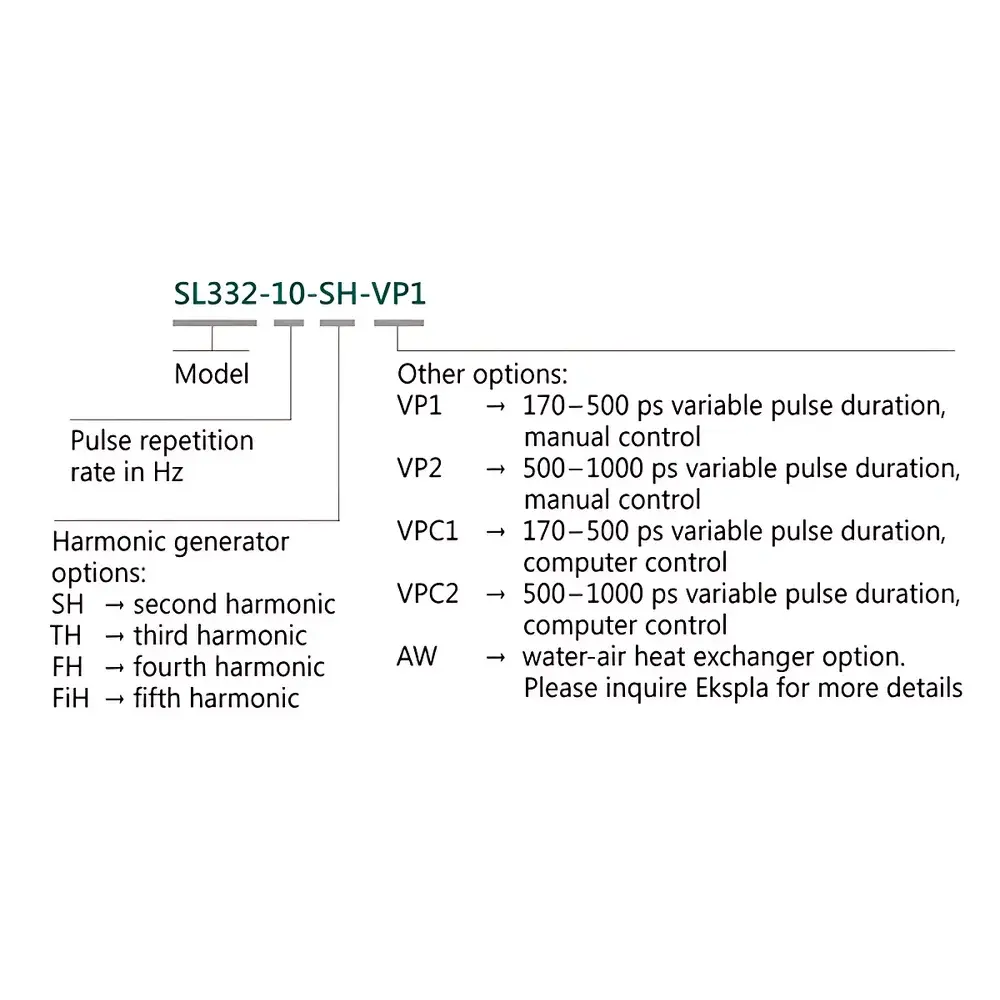
| Pulse Duration | 150 ps (standard), tunable down to 170 ps or up to 1500 ps with optional -VPx module |
| Pre-pulse Contrast Ratio | >10:1 |
| Timing Jitter | <100 ps (rms) relative to Q-switch trigger |
| Output Wavelengths | 1064 nm (fundamental), with optional harmonics generation at 532 nm, 355 nm, and 266 nm via temperature-controlled KD*P/KDP crystals |
| Control Interface | RS232 + LabVIEW™ drivers |
| Cooling | Integrated closed-loop chiller system |
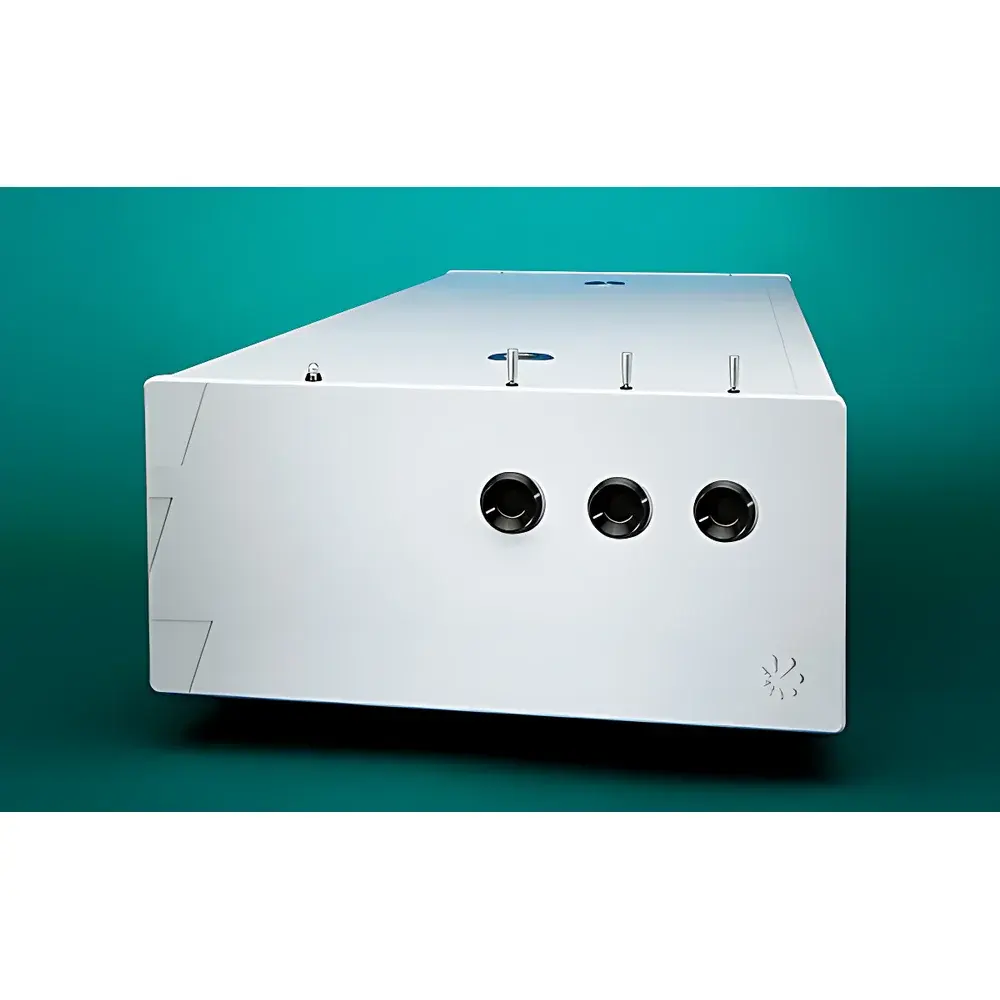
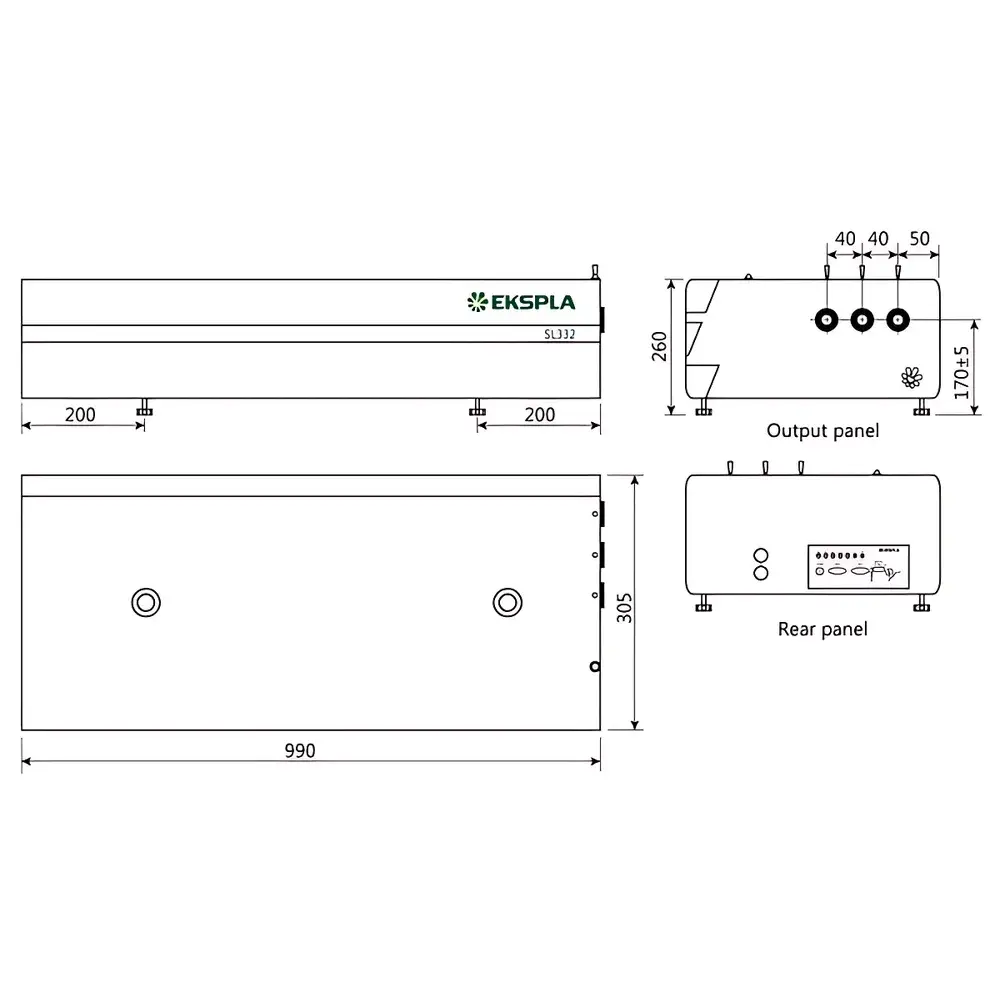
| Form Factor | Compact laser head + 19″ rack-mounted power supply & thermal management unit |
Overview
The Ekspla SL330 is a high-energy, solid-state picosecond laser system engineered for scientific and industrial applications demanding precise temporal control, excellent pulse-to-pulse stability, and scalable energy output. It employs backward-stimulated Brillouin scattering (SBS) pulse compression—a robust, alignment-insensitive technique that avoids complex grating-based compressors while enabling discrete tuning of pulse duration across the 170–1500 ps range. At its core lies an electro-optically Q-switched, single longitudinal mode (SLM) master oscillator utilizing a self-seeding configuration based on a Fabry–Pérot etalon integrated within the resonator cavity. This architecture eliminates reliance on external narrow-linewidth seed diodes and delivers smooth, transform-limited temporal pulse envelopes essential for coherent nonlinear interactions. The compressed pulses are amplified in a multi-pass Nd:YAG amplifier chain to energies up to 500 mJ at 1064 nm, with harmonic generation modules providing spectrally pure outputs at 532 nm, 355 nm, and 266 nm through angle-tuned, temperature-stabilized KD*P and KDP crystals.
Key Features
- Backward-SBS pulse compression delivering stable 150 ps pulses (standard), with optional variable pulse duration (-VPx) for discrete tuning between 170 ps and 1500 ps
- Self-seeded SLM oscillator ensuring high spectral purity, low phase noise, and superior temporal coherence without external seeding lasers
- High pre-pulse contrast ratio exceeding 10:1—critical for plasma initiation, ablation threshold studies, and EUV source development
- Sub-100 ps RMS timing jitter between Q-switch trigger and optical pulse output, enabling reliable synchronization with pump-probe setups, streak cameras, and RF-driven diagnostics
- Modular harmonic generation with independent output ports per wavelength; all nonlinear crystals actively temperature controlled for long-term conversion efficiency stability
- Integrated RS232 interface and native LabVIEW™ drivers for automated experiment control, data logging, and integration into larger testbed architectures
- Compact, ergonomic design: laser head optimized for optical table mounting; 19″ rack-mounted power supply and closed-loop chiller occupy minimal floor space
Sample Compatibility & Compliance
The SL330 is compatible with standard optical tables, vacuum chambers, and ultra-high vacuum (UHV) target chambers used in plasma physics and laser-matter interaction experiments. Its beam profile (M² < 2.5, near-diffraction-limited) supports tight focusing for high-intensity applications such as laser-induced breakdown spectroscopy (LIBS), EUV plasma generation, and OPCPA front-end pumping. Harmonic outputs comply with ISO 11146-1:2019 for beam propagation measurements and meet requirements for Class 4 laser safety per IEC 60825-1:2014. All firmware and control software support audit trail functionality required under GLP-compliant laboratory environments. While not FDA-cleared, the system’s deterministic triggering and repeatable pulse parameters make it suitable for preclinical research instrumentation where traceability and reproducibility are mandated.
Software & Data Management
Control is facilitated via two primary interfaces: a dedicated backlit keypad with intuitive menu navigation (usable with laser safety eyewear), and a Windows-compatible PC application supporting real-time parameter monitoring, script-based sequencing, and export of timestamped pulse energy, repetition rate, and harmonic selection logs. LabVIEW™ drivers include VIs for full hardware abstraction—including Q-switch delay adjustment, harmonic selector actuation, and internal photodiode calibration readouts. All communication protocols implement CRC error checking and command echo confirmation to ensure integrity during remote operation. Firmware updates are performed via secure USB interface with version rollback capability and checksum validation—essential for maintaining instrument qualification status in regulated R&D labs.
Applications
- Plasma diagnostics and high-energy-density physics experiments requiring synchronized, high-contrast picosecond pulses
- Laser-induced material ablation, thin-film deposition, and micromachining of metals, dielectrics, and wide-bandgap semiconductors
- Pump-probe absorption spectroscopy of transient plasmas and excited-state dynamics
- Satellite laser ranging (SLR) systems requiring low-jitter, high-energy pulses for precise time-of-flight measurement
- Development of extreme ultraviolet (EUV) light sources for next-generation photolithography mask inspection tools
- Optical parametric chirped-pulse amplification (OPCPA) front-end seeding with tunable pulse duration to match gain narrowing characteristics
- Holographic interferometry and digital holography requiring high spatial and temporal coherence
FAQ
What pulse duration ranges are achievable with the SL330, and how is tuning implemented?
Standard configuration delivers 150 ps pulses. With the optional -VPx module, discrete tuning steps allow selection from 170 ps to 1500 ps by adjusting the SBS cell geometry and acoustic wave propagation path.
Does the SL330 support automatic wavelength switching between harmonics?
Yes—motorized harmonic selectors enable software-controlled switching among 1064 nm, 532 nm, 355 nm, and 266 nm outputs, each routed to a dedicated port with calibrated energy monitoring.
Is the system compliant with 21 CFR Part 11 for electronic records and signatures?
While the base firmware does not include Part 11-specific audit trails, the LabVIEW™ driver package supports integration with third-party validated electronic lab notebook (ELN) platforms meeting Part 11 requirements.
What cooling infrastructure is required for continuous operation?
The integrated closed-loop chiller operates autonomously; only standard 230 VAC / 50 Hz power and ambient air circulation are needed—no external water supply or chilled water loop is required.
Can the SL330 be synchronized with femtosecond laser systems for hybrid pump-probe experiments?
Yes—its low-jitter external trigger input accepts TTL or NIM signals, and the optical output jitter (<100 ps rms) ensures sub-picosecond synchronization fidelity when paired with stabilized fs oscillators.




