
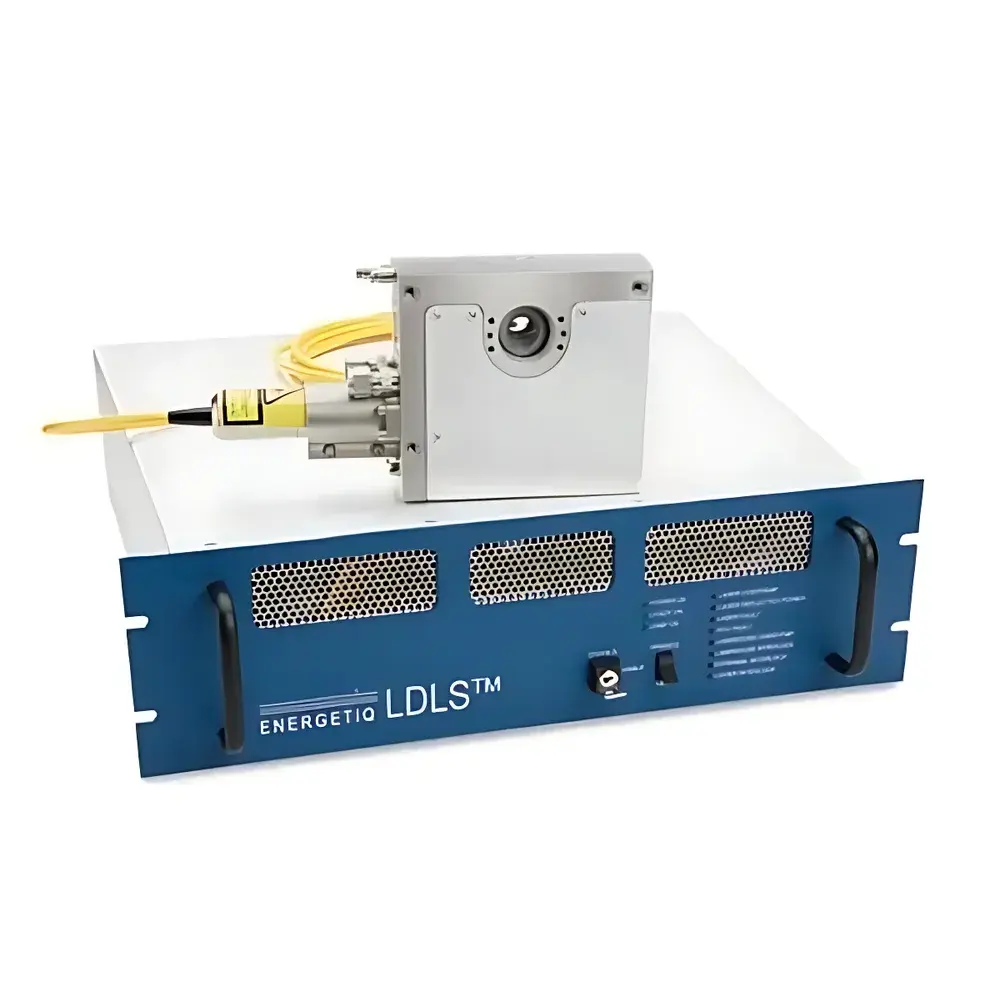
Energetiq EQ-400 Laser-Driven Light Source (LDLS™)
| Brand | Energetiq |
|---|---|
| Origin | USA |
| Model | EQ-400 |
| Light Source Type | Xenon-based Laser-Driven Plasma |
| Spectral Range | 170–2100 nm |
| Output Power | ~15 W |
| Spectral Radiance | ~100 mW/mm²·sr·nm |
| Numerical Aperture | 0.5 NA |
| Lifetime | >9,000 hrs (10% output degradation) |
| Cooling | Water-cooled |
| Beam Configuration | Selectable dual-beam or single-beam (with rear reflector) |
| Lamp Chamber Dimensions | 136 × 145 × 56 mm |
| Lamp Chamber Weight | 2.7 kg |
| Controller Dimensions | 133 × 483 × 584 mm |
| Controller Weight | 18.8 kg |
Overview
The Energetiq EQ-400 Laser-Driven Light Source (LDLS™) is a high-brightness, broadband continuum source engineered for demanding applications in optical metrology, spectroscopy, and space-based instrumentation. Unlike conventional electrode-driven arc lamps—such as deuterium, tungsten-halogen, or xenon short-arc lamps—the EQ-400 employs a fundamentally distinct physical mechanism: a focused high-power laser sustains a stable, high-temperature xenon plasma in a sealed fused-silica chamber without electrodes. This laser-driven plasma operates at temperatures exceeding 10,000 K, enabling exceptional spectral continuity from deep ultraviolet (170 nm) through visible to near-infrared (2100 nm), with minimal line emission artifacts. The absence of electrodes eliminates cathode sputtering, thermal drift, and catastrophic failure modes inherent to traditional lamps—directly translating into superior radiometric stability, spatial coherence, and operational lifetime. With a peak spectral radiance of ~100 mW/mm²·sr·nm and total output power of ~15 W, the EQ-400 delivers over two orders of magnitude higher brightness than standard xenon arc lamps at UV wavelengths, making it the highest-brightness non-laser broadband source commercially available.
Key Features
- Laser-driven xenon plasma technology eliminates electrodes, ensuring no filament degradation, arc wander, or gas consumption—enabling >9,000 hours of continuous operation with <10% total radiant flux decay
- Ultra-stable spatial emission profile: plasma size ≈ 370 µm × 800 µm, enabling efficient coupling into monochromators, fiber optics, off-axis parabolic mirrors, and micro-optical systems
- Low temporal noise: peak-to-peak irradiance fluctuation < 0.1% over 10-second integration windows; long-term drift < 0.05%/hr under stabilized thermal conditions
- Compact lamp chamber (136 × 145 × 56 mm; 2.7 kg) designed for OEM integration into vacuum chambers, ellipsometers, and satellite payload subsystems
- Configurable optical output: factory-selectable dual-beam symmetric ports or single-beam mode with integrated rear reflector—no external optics required
- Water-cooled architecture maintains plasma stability under sustained high-power operation; compatible with standard laboratory chiller systems (flow rate ≥ 1.5 L/min, ΔT ≤ 3°C)
Sample Compatibility & Compliance
The EQ-400 is compatible with a broad range of optical interfaces, including SMA905, FC/PC, and custom vacuum feedthroughs. Its continuous spectrum meets calibration requirements defined in ASTM E275, ISO/IEC 17025, and NASA GSFC-STD-6001 for radiometric reference sources. As deployed in the PACE (Plankton, Aerosol, Cloud, ocean Ecosystem) mission’s Ocean Color Instrument (OCI), the EQ-400 satisfies stringent spaceflight qualification standards—including thermal cycling (−20°C to +50°C), shock/vibration per MIL-STD-810G, and outgassing compliance (ECSS-Q-ST-70-02C). It supports GLP/GMP-compliant workflows via traceable NIST-calibrated spectral irradiance data files provided with each unit. No hazardous materials are used in construction; all components conform to RoHS 3 and REACH Annex XIV restrictions.
Software & Data Management
The EQ-400 operates via a dedicated controller with RS-232, USB, and Ethernet interfaces supporting SCPI command protocol. Firmware enables remote monitoring of lamp temperature, coolant flow rate, laser diode current, and real-time radiance feedback (via optional integrated photodiode). Spectral calibration data—traceable to NIST SRM 2065 and 2066—is delivered in ICS (Instrument Calibration Standard) format and compatible with common spectroscopic platforms (Ocean Insight, Horiba, Acton, Andor). Audit trails for power-on time, thermal events, and firmware updates comply with FDA 21 CFR Part 11 requirements when paired with validated LIMS or ELN systems. Optional LabVIEW and Python SDKs support automated calibration routines and integration into custom spectral acquisition pipelines.
Applications
- Primary radiometric calibration of spaceborne hyperspectral imagers (e.g., NASA PACE/OCI, ESA Sentinel-4)
- High-resolution monochromator and spectrometer light sources for UV-VIS-NIR absorbance, fluorescence, and reflectance measurements
- Semiconductor wafer inspection and thin-film metrology (ellipsometry, reflectometry) requiring stable broadband UV excitation
- Photoemission electron microscopy (PEEM) illumination where spatial coherence and UV photon flux are critical
- Accelerated material aging studies under controlled broadband irradiation (ISO 4892-2, ASTM G154)
- Optical component testing—including transmittance, scatter, and wavefront error measurement—across 170–2100 nm
FAQ
How does LDLS technology differ from conventional xenon arc lamps?
LDLS replaces thermionic electrodes with a high-power laser to ignite and sustain xenon plasma, eliminating electrode erosion, arc instability, and spectral discontinuities caused by metal vapor contamination.
Is the EQ-400 suitable for vacuum-compatible applications?
Yes—the lamp chamber is hermetically sealed and rated for operation up to 10⁻⁶ Torr when equipped with UHV-compatible feedthroughs (optional); full vacuum qualification documentation available upon request.
What maintenance is required during its >9,000-hour lifetime?
No consumables or periodic lamp replacement; only routine verification of coolant flow integrity and annual radiometric recalibration recommended for metrology-critical use.
Can the EQ-400 be synchronized with pulsed detection systems?
While inherently CW, its low-noise output allows precise electronic gating via external shutter control; TTL-compatible trigger input available on the controller for timing-critical experiments.
Does the EQ-400 meet laser safety classifications?
The lamp chamber contains Class 4 laser components internally; however, the optical output is non-coherent broadband radiation—classified as Class 1 (IEC 60825-1) at all user-accessible ports when operated within specified enclosure guidelines.




