
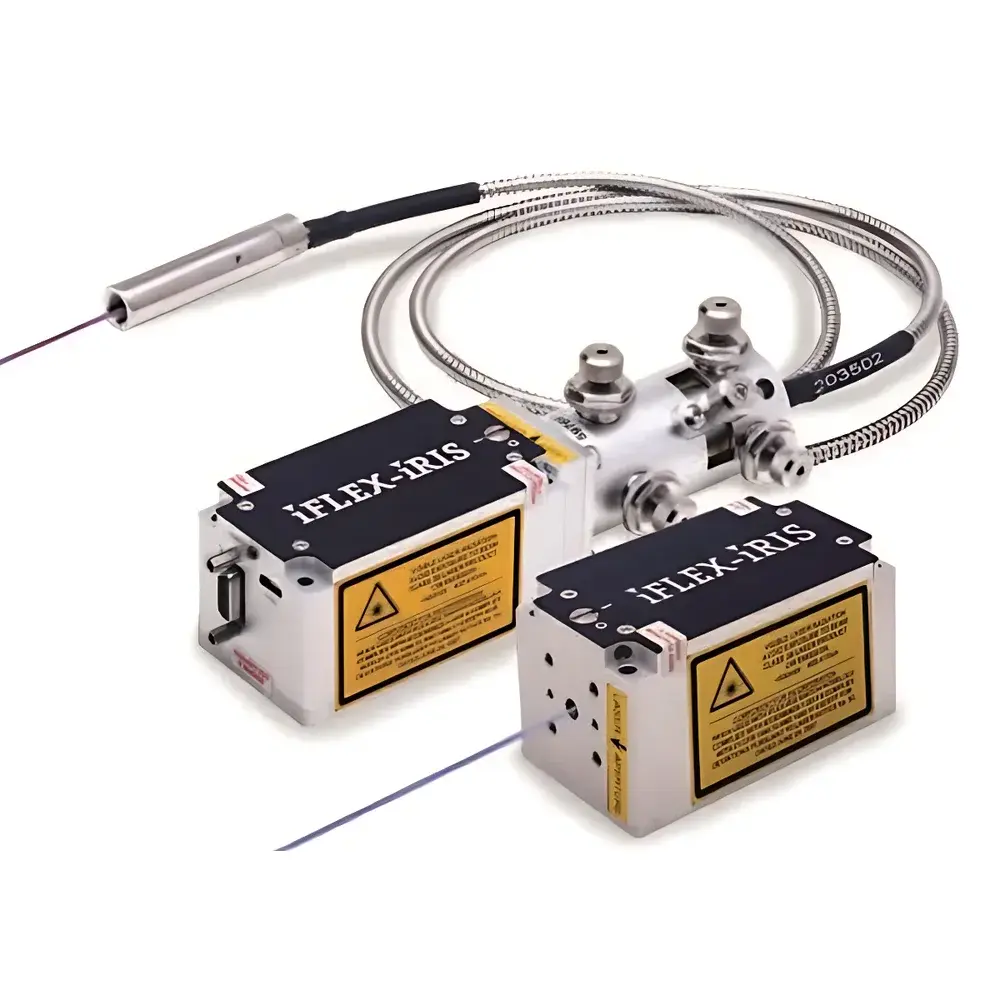
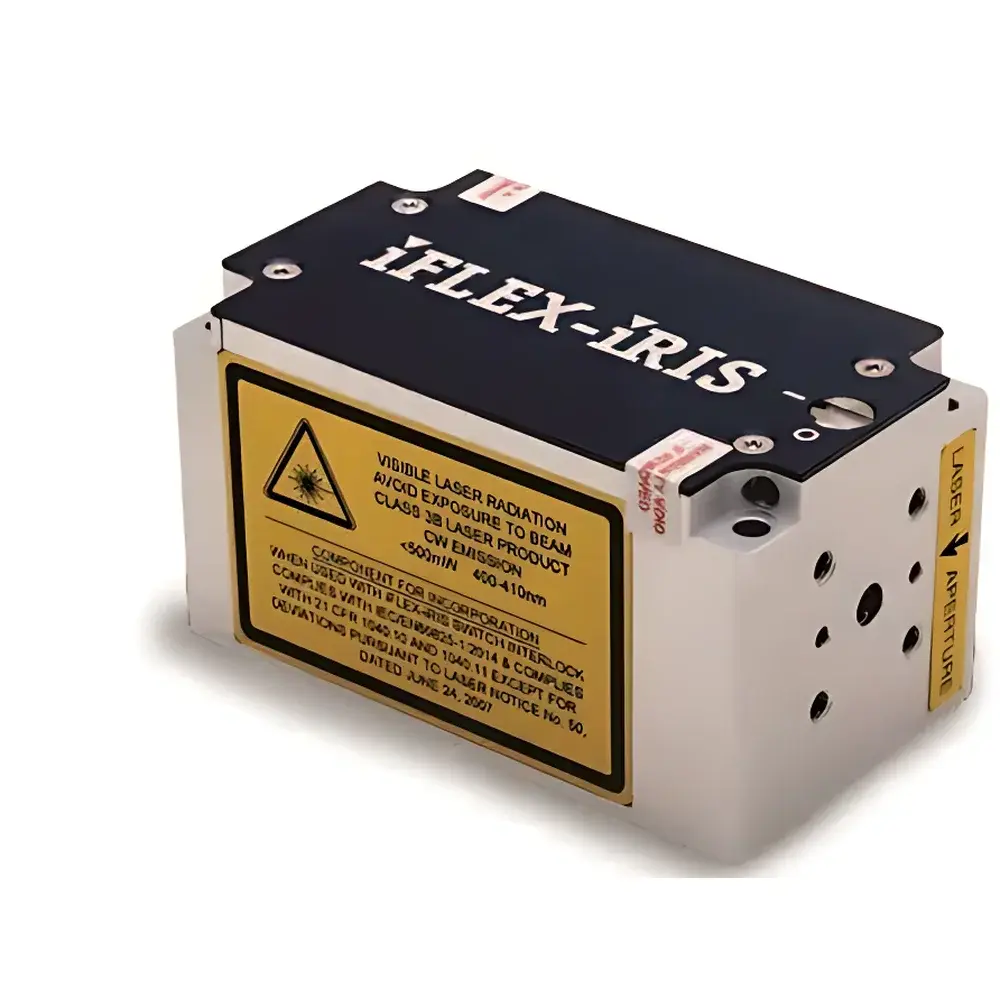
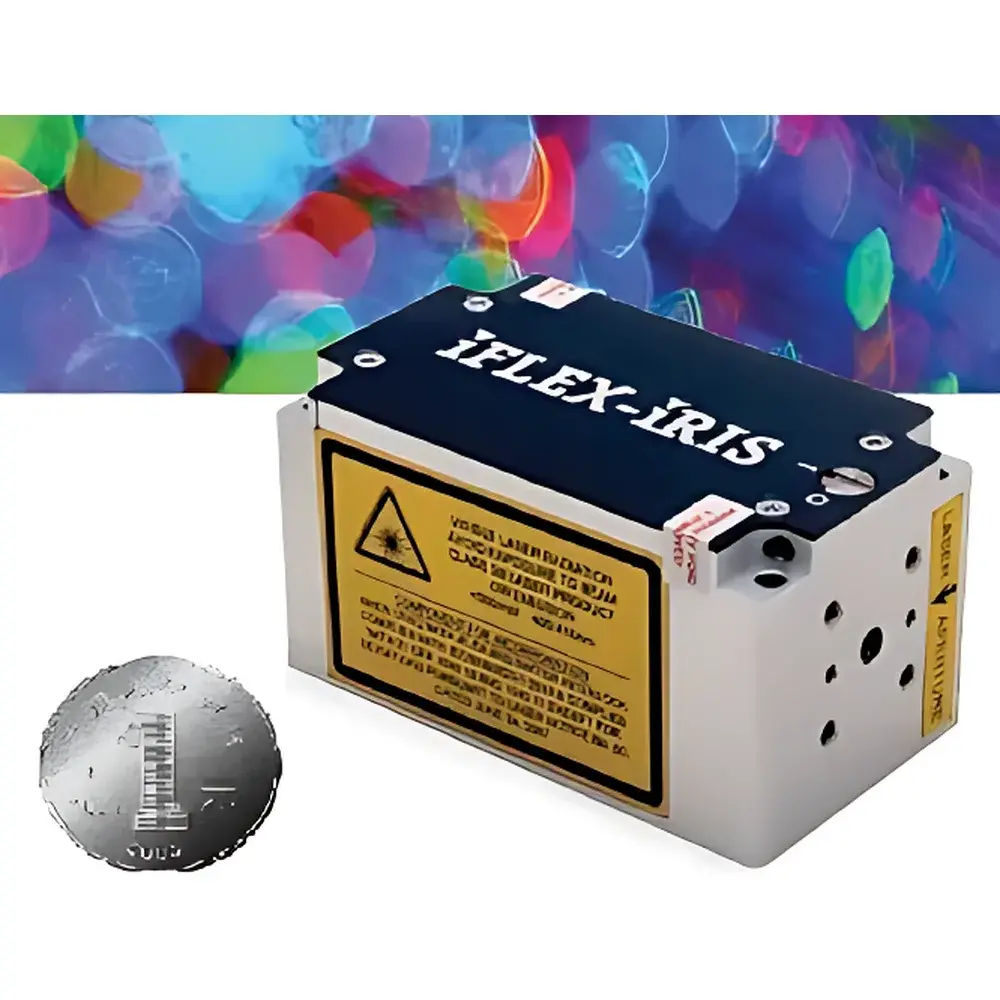
Qioptiq iFLEX-iRIS-640 Compact Diode Laser Module
| Brand | Qioptiq |
|---|---|
| Origin | UK |
| Model | iFLEX-iRIS-640 |
| Wavelength | 640 nm |
| Output Mode | CW / Analog & Digital Modulation |
| Beam Quality | TEM₀₀, M² < 1.2 (typ.) |
| Beam Diameter (1/e²) | 0.7 ± 0.2 mm |
| Pointing Stability | < 5 µrad/°C |
| Polarization Ratio | ≥ 200:1 (Vertical ± 2°) |
| Power Stability (8 h) | < 0.5 % RMS |
| Intensity Noise (20 Hz – 20 MHz) | < 0.05 % RMS |
| Peak-to-Peak Noise (20 Hz – 1 MHz) | < 0.5 % |
| Modulation Bandwidth | DC – 5 MHz |
| Extinction Ratio | 1,000,000:1 |
| Rise/Fall Time | < 100 ns |
| Operating Temperature | ≤ 40 °C |
| Max Power Dissipation | 12 W |
| Dimensions (L×W×H) | 70 × 40 × 38 mm |
| Interface | micro-USB, RS232 |
| Compliance | CE, RoHS, FDA 21 CFR Part 1040.10 (Laser Safety Class 3B) |
Overview
The Qioptiq iFLEX-iRIS-640 is a compact, OEM-optimized diode laser module engineered for high-stability continuous-wave (CW) emission at 640 nm—a critical wavelength in fluorescence excitation, particularly for dyes such as Alexa Fluor 647, Cy5, and AF647. Based on advanced semiconductor laser technology, the iFLEX-iRIS platform integrates proprietary thermal management, active power stabilization, and low-noise current control to deliver exceptional beam pointing stability (< 5 µrad/°C), near-diffraction-limited beam quality (TEM₀₀, M² < 1.2), and polarization purity (≥ 200:1, vertical). Unlike standard commercial diode lasers, the iFLEX-iRIS architecture eliminates mechanical drift and mode hopping through monolithic optical design and hermetically sealed packaging—ensuring reproducible performance across laboratory, clinical, and industrial environments. Its fixed-wavelength operation at 640 nm is optimized for integration into space-constrained systems where long-term reliability and minimal maintenance are non-negotiable.
Key Features
- Ultra-low intensity noise: < 0.05 % RMS (20 Hz – 20 MHz), enabling high signal-to-noise ratio measurements in sensitive optical detection schemes.
- Sub-100 ns digital and analog modulation capability with >1,000,000:1 extinction ratio—ideal for time-resolved fluorescence, gated imaging, and pulsed excitation protocols.
- Dual-input modulation interface supporting simultaneous analog (0–5 V) and TTL-compatible digital control, allowing flexible synchronization with external triggers or software-defined timing sequences.
- Integrated thermal regulation maintains junction temperature within tight limits; maximum baseplate temperature capped at 40 °C with typical power dissipation < 5 W—reducing cooling system complexity in multi-laser platforms.
- Compact form factor (70 × 40 × 38 mm) and standardized electrical interfaces (12 V DC, micro-USB, RS232) simplify drop-in replacement and system-level integration without custom mechanical redesign.
- Compliant with IEC 60825-1:2014 and FDA 21 CFR Part 1040.10 for Class 3B laser safety—certified documentation provided for regulatory submissions and GLP/GMP-aligned instrumentation validation.
Sample Compatibility & Compliance
The iFLEX-iRIS-640 is routinely deployed in applications requiring precise photonic excitation of biological fluorophores and nanomaterials. It is compatible with standard microscope filter sets (e.g., Semrock FF01-640/14), fiber-coupled delivery systems (including single-mode PM fibers), and free-space optical benches. Its polarization orientation (vertical ±2°) ensures optimal coupling efficiency into polarizing optics and acousto-optic modulators. The module meets CE marking requirements for electromagnetic compatibility (EN 61326-1) and environmental robustness (EN 60068-2 series). For regulated life science instrumentation—including flow cytometers and clinical DNA sequencers—the laser supports audit-trail-capable firmware logging via RS232 and adheres to ISO 13485-aligned manufacturing traceability protocols.
Software & Data Management
Qioptiq provides the iFLEX Control Suite—a cross-platform application (Windows/macOS/Linux) supporting real-time power monitoring, modulation parameter configuration, and firmware updates via micro-USB. All operational states—including output power setpoint, modulation mode, temperature feedback, and error flags—are accessible via ASCII-based RS232 command protocol for seamless integration into LabVIEW, Python (PySerial), or MATLAB automation frameworks. Event logs record timestamped thermal events, power deviations exceeding ±0.2%, and modulation fault conditions—enabling root-cause analysis during IQ/OQ/PQ validation. The embedded controller complies with FDA 21 CFR Part 11 requirements when deployed with validated host software, including electronic signature support and immutable audit trails.
Applications
- Confocal and super-resolution microscopy: Stable 640 nm excitation enables consistent STED depletion or single-molecule localization microscopy (SMLM) with minimal photobleaching-induced artifacts.
- Flow cytometry: High extinction ratio and fast switching support multi-parameter spectral unmixing and rare-cell detection protocols compliant with ISO 13251 and CLSI H42-A3 standards.
- DNA sequencing platforms: Integrated into Illumina-style bridge amplification and fluorescent termination detection systems where pulse-to-pulse power consistency directly impacts base-calling accuracy.
- Dynamic light scattering (DLS): Low-frequency intensity noise (< 0.5 % peak-to-peak, 20 Hz – 1 MHz) minimizes spurious correlation decay artifacts in sub-10 nm particle sizing.
- Holographic data storage and optical trapping: Diffraction-limited beam profile and pointing stability ensure repeatable interference fringe contrast and trap stiffness calibration.
FAQ
Is the iFLEX-iRIS-640 suitable for FDA-regulated diagnostic instrument development?
Yes. The module carries Class 3B laser safety certification per FDA 21 CFR Part 1040.10 and supports full traceability documentation required for 510(k) or De Novo submissions.
Can this laser be fiber-coupled without additional optics?
It is designed for free-space use but may be coupled into single-mode fiber using optional collimation and focusing adapters—Qioptiq offers OEM-customized fiber-pigtailed variants upon request.
What is the recommended warm-up time to achieve specified power stability?
Full thermal equilibrium is reached within 15 minutes; however, < 0.5 % power drift is guaranteed after 5 minutes under nominal ambient conditions (23 ± 2 °C).
Does the unit include internal temperature sensing and closed-loop feedback?
Yes. An integrated thermistor monitors baseplate temperature and feeds back to the driver’s thermal compensation algorithm, maintaining wavelength and power stability across operating range.
Are firmware updates backward-compatible with legacy control software?
All firmware revisions maintain ASCII command syntax and register mapping; binary updates preserve historical log structure and do not invalidate existing validation protocols.






