
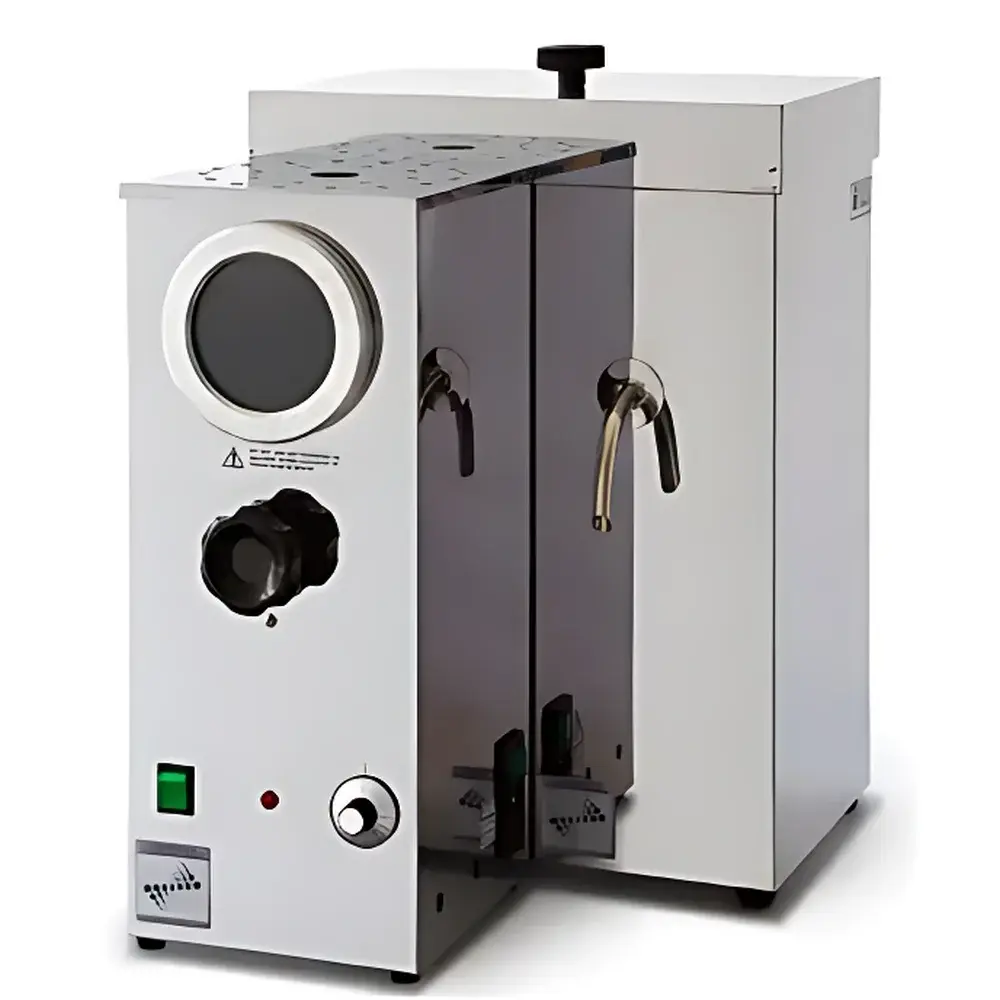
English Product Name
| Origin | Switzerland |
|---|---|
| Type | ASTM D86 Compliant Manual Atmospheric Distillation System |
| Model | 1000 Series |
| Configuration | Modular (Heating Unit 990/A + Condensation Unit 990/B) |
| Compliance | ASTM D86, IP 62–88, ISO 3405 |
| Heating Control | Electronically Adjustable Stainless Steel Heating Plate |
| Condenser | Chrome-Plated Copper Tubing with Water-Circulated Jacket |
| Visibility | Front-Mounted Tempered Glass View Window |
| Bottle Capacity Options | 100 mL (Type A), 125 mL (Type B), 200 mL (Type C), 250 mL (Type D) |
| Receiver Volumes | 25 mL (Type A), 100 mL (Type B), 200 mL (Type C) |
| Temperature Measurement | ASTM/IP Calibrated Thermometers (ASTM 2C to 107C / IP 62C to 88C) |
Overview
The Swiss-made 1000 Series D86 Manual Atmospheric Distillation Apparatus is a precision-engineered laboratory instrument designed to perform standardized atmospheric distillation tests in strict accordance with ASTM D86 and ISO 3405. It implements the classical batch distillation principle under ambient pressure, enabling quantitative determination of initial boiling point (IBP), final boiling point (FBP), and intermediate recovery temperatures (e.g., 10%, 50%, 90% vol.) for petroleum fractions. Unlike automated or vacuum-based systems, this apparatus maintains full manual control over heating rate, condensate collection timing, and visual observation—critical for method validation, reference lab verification, and regulatory audit traceability. Its robust mechanical architecture ensures long-term stability and repeatability across high-frequency testing environments typical of refinery QC labs, independent testing laboratories, and fuel certification facilities.
Key Features
- Modular stainless steel construction: Both the 990/A heating unit and 990/B condensation unit are fabricated entirely from corrosion-resistant stainless steel, ensuring compliance with stringent hygiene and durability requirements in petrochemical analysis.
- Electronically regulated heating plate: Provides precise, stepless adjustment of thermal input to maintain ASTM D86-specified heating rates (e.g., 4–5 °C/min for light distillates; 2–3 °C/min for heavier fractions), minimizing superheating and thermal lag.
- Height-adjustable support base: Integrated external handwheel enables fine vertical positioning of the distillation flask relative to the heating surface—essential for consistent heat transfer and reproducible vapor path geometry.
- Dual-hand orientation option: The 990/B condenser is available in left- or right-handed configurations to accommodate ergonomic workflow layouts and bench space constraints.
- Front-mounted tempered glass viewport: Offers unobstructed real-time observation of boiling behavior, foam formation, and condensate flow without compromising operator safety or system integrity.
- Water-jacketed chrome-plated copper condenser: Ensures efficient and uniform cooling across the entire condensation length, preventing vapor bypass and maintaining ASTM-defined condensate temperature limits (≤ 30 °C at receiver outlet).
Sample Compatibility & Compliance
This apparatus is validated for use with a defined range of volatile and semi-volatile petroleum products, including but not limited to: natural gasoline, motor gasoline (spark-ignition), aviation gasoline (AVGAS), jet turbine fuels (Jet A, Jet A-1), naphthas, kerosene, lamp oils (Grade 1 & 2), low-sulfur diesel fuels (1-D and 2-D), and refined white spirits. Per ASTM D86 Section 1.3, it is explicitly unsuitable for samples containing significant non-volatile residues, suspended solids, or thermally unstable components (e.g., heavy crudes, polymer-modified fuels, or bio-blendstocks with high FAME content). All operational procedures adhere to GLP-compliant documentation practices, and the system supports full traceability when used with certified ASTM/IP thermometers (e.g., T-AS2C through T-AS107C) and calibrated volumetric receivers.
Software & Data Management
As a fully manual analytical platform, the 1000 Series D86 apparatus does not incorporate embedded firmware or digital data acquisition. Instead, it is engineered to integrate seamlessly into regulated laboratory information management systems (LIMS) via standardized manual entry protocols. Test records—including observed temperatures, recovered volumes, barometric pressure, and ambient humidity—are documented in accordance with 21 CFR Part 11-compliant electronic notebooks or paper-based logbooks featuring dual-signature verification. Optional accessories such as calibrated mercury-in-glass thermometers (ASTM 2C–107C series) and volumetric receivers (certified to ISO/IEC 17025-accredited standards) ensure metrological traceability to NIST or PTB reference standards. Audit trails remain fully reconstructible for FDA, EPA, or EN 14214 certification submissions.
Applications
- Quality control of finished gasoline and diesel fuels prior to dispatch from refineries.
- Verification of blending stock volatility profiles during formulation development.
- Regulatory compliance testing for ASTM D86 specifications in third-party certification laboratories.
- Educational demonstration of fundamental distillation thermodynamics in university petroleum engineering curricula.
- Reference method validation against automated simdist (ASTM D2887) or gas chromatographic (ASTM D7169) results.
- Investigation of thermal stability and fractionation behavior in reformulated oxygenated fuels.
FAQ
Is this apparatus compatible with ASTM D86 Revision 2023?
Yes—the mechanical design, dimensional tolerances, and thermal response characteristics fully satisfy all mandatory requirements in ASTM D86–23, including flask geometry, condenser immersion depth, and thermometer placement specifications.
Can it be used for biodiesel blends (e.g., B5 or B20)?
Only if the blend exhibits no phase separation, minimal residue formation, and boiling behavior within the validated volatility range; ASTM D86 explicitly excludes high-FAME content fuels due to decomposition risk during distillation.
What calibration documentation is provided with the system?
Each unit ships with a factory test report confirming mechanical conformity to ASTM D86 Annex A1; thermometer and receiver calibrations must be performed separately by an ISO/IEC 17025-accredited provider.
Is the heating plate explosion-proof?
No—it is rated for general laboratory use in non-hazardous atmospheres; operation in classified zones requires external explosion-proof enclosures per NEC Class I, Division 2 guidelines.
Are spare parts available for long-term maintenance?
Yes—Swiss OEM-sourced components including heating elements, glass viewports, condenser tubing, and flask retention fixtures are stocked globally with lead times under 4 weeks.





