
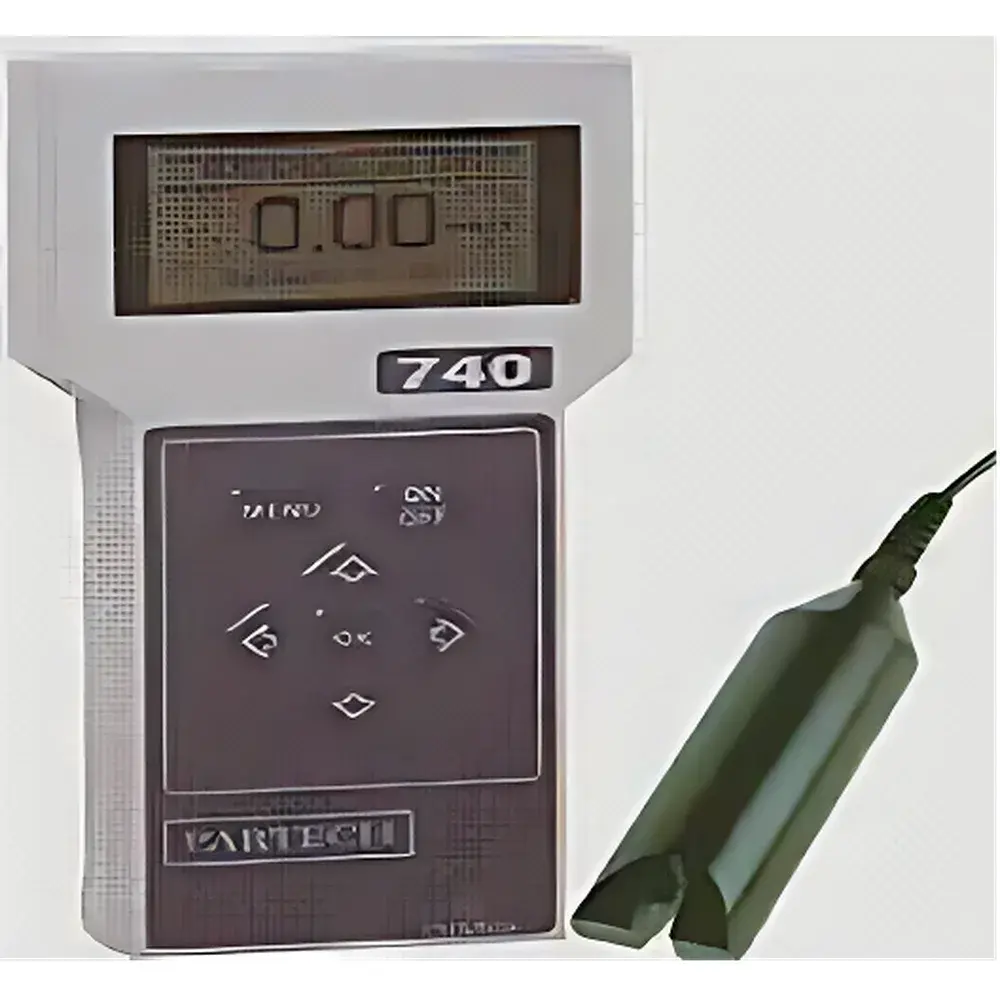
English Product Name
| Origin | UK |
|---|---|
| Manufacturer Type | Authorized Distributor |
| Origin Category | Imported |
| Model | 740 |
| Pricing | Available Upon Request |
Overview
The Soli-Tech 740 Portable Suspended Solids Analyzer is an engineered field instrument designed for rapid, in-situ quantification of suspended solids (SS), mixed liquor suspended solids (MLSS), sludge blanket depth, and turbidity in wastewater and natural water systems. It operates on the principle of infrared light scattering at 880 nm—optimized to minimize interference from color, dissolved organics, and air bubbles—delivering robust optical measurement performance across variable matrix conditions. Unlike gravimetric lab methods requiring filtration, drying, and weighing, the 740 provides real-time digital output calibrated against weight-based reference standards, enabling immediate operational decisions at treatment basins, clarifiers, and effluent discharge points. Its compact handheld architecture (224 × 106 × 39 mm, 0.5 kg), IP65-rated ABS enclosure, and integrated safety strap ensure reliable deployment in harsh industrial environments—from open-air lagoons to confined-space pump stations—without compromise to measurement integrity or operator safety.
Key Features
- Optical sensing based on 880 nm infrared light scattering, with 0.5-second response time and immunity to flow velocity fluctuations
- Wide dynamic range: 0–50 mg/L (low-range) and 0–20,000 mg/L (high-range), selectable via probe configuration and software menu
- High-contrast 5-digit graphical LCD with auto-adjusting backlight and contrast—fully legible from –20 °C to +60 °C operating temperature
- Six tactile membrane keys supporting gloved operation; intuitive hierarchical menu navigation with status line showing real-time values, battery level, and error codes
- Configurable display units: mg/L, g/L, ppm, FTU, NTU, %SS, or user-defined scaling
- On-device password protection (4-digit numeric code; default: 1000) restricting access to calibration and system setup menus
- PWM digital signal interface between probe and host ensures noise-immune transmission over standard 3-core polyurethane-jacketed cable (5 m standard, up to 100 m optional)
Sample Compatibility & Compliance
The 740 analyzer is validated for use with Soli-Tech series optical probes rated for submersion up to 10 mWC (water column) pressure. It maintains measurement stability in high-solids slurries (e.g., activated sludge, primary clarifier underflow, pulp mill effluents) and low-turbidity surface waters (e.g., lake outflows, drinking water pre-filtration). Calibration employs a 10-point lookup table derived from laboratory gravimetric SS analysis, allowing site-specific compensation for particle size distribution, refractive index variation, and fouling tendencies. The instrument complies with EN 50082-1:1994 for electromagnetic compatibility (EMC), and its design supports adherence to ISO 7027 (turbidity) and ISO 11923 (suspended solids in water) measurement principles. While not certified for regulatory reporting per se, its ±5% FSD accuracy and ±1% FSD repeatability meet typical process control requirements under EPA Method 160.2 and ASTM D3977-98 (Standard Practice for Suspended Solids Determination).
Software & Data Management
All calibration, unit selection, and probe configuration are managed locally through the device’s embedded firmware—no external PC required. Each of the 10+ factory-configurable modules corresponds to a predefined application profile (e.g., “MLSS in Aeration Basin”, “Effluent SS in Food Processing”, “Sludge Blanket in Lamella Clarifier”), preloaded with optimized gain settings, zero-offset compensation, and multi-point calibration coefficients. Field recalibration is performed via the dedicated “Liquid Sample Save” function: users introduce a representative sample, adjust the displayed value to match a reference lab result, and store the correction point directly into the active module’s lookup table. All calibration history—including date/time stamps, operator ID (if enabled), and deviation logs—is retained onboard for auditability. While the 740 does not feature built-in data logging or wireless export, its analog/digital output architecture permits integration into SCADA or PLC systems via optional I/O modules compliant with Modbus RTU or 4–20 mA protocols.
Applications
- Real-time MLSS monitoring in activated sludge and MBR bioreactors for DO and nutrient dosing optimization
- Sludge blanket profiling in secondary clarifiers and lamella settlers to prevent washout events
- Coagulant/flocculant dosing control based on influent turbidity and suspended solids load
- Effluent compliance verification at municipal and industrial wastewater discharge points
- Process troubleshooting in pulp & paper mills, breweries, dairy plants, and quarry runoff management
- Lake and reservoir sediment transport studies where portability and rapid deployment are critical
FAQ
What is the maximum submersion depth for the Soli-Tech probe connected to the 740 analyzer?
The probe is rated for continuous operation at depths up to 10 meters water column (10 mWC), provided the cable gland and connector are properly sealed.
Can the 740 be used for drinking water turbidity measurements?
Yes—when fitted with the low-range turbidity probe option, it meets ISO 7027 optical requirements for raw and treated water applications, though it is not certified as a Class 1 or Class 2 turbidimeter per US EPA guidelines.
Is the 740 compatible with GLP/GMP data integrity requirements?
While the unit itself lacks electronic audit trail or 21 CFR Part 11-compliant user authentication, its password-protected calibration menus and timestamped calibration storage support basic traceability in non-regulated process environments.
How often does the probe require cleaning or maintenance?
No routine maintenance is required; periodic wiping of the optical window with a lint-free, damp cloth is sufficient under normal service conditions. Cleaning frequency increases in high-fouling applications such as grease-laden food processing effluents.
What power source options are available for extended field use?
The analyzer operates on rechargeable internal batteries charged via a universal 90–264 VAC adapter. Battery life exceeds 12 hours under typical intermittent-use conditions.







