
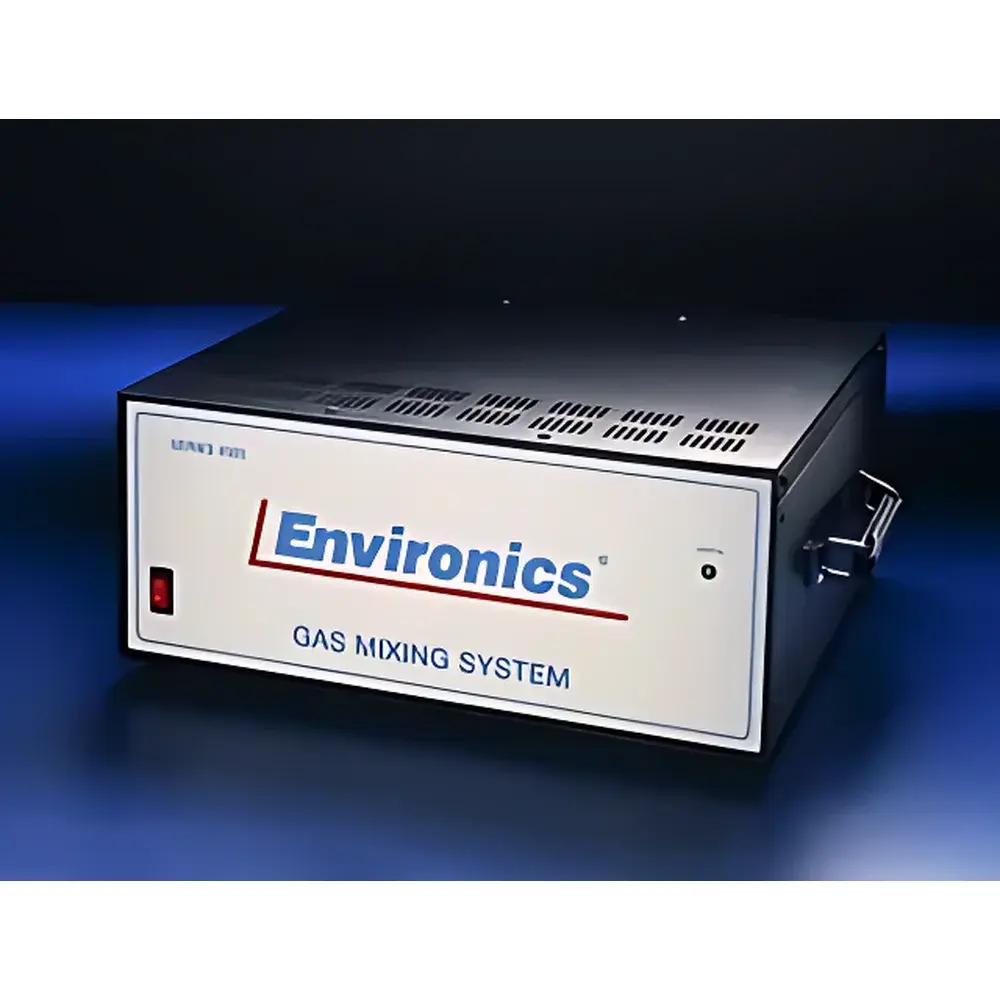
Environics 4040 Intelligent Gas Dilution System
| Brand | Environics |
|---|---|
| Origin | USA |
| Model | 4040 |
| Dilution Ratio | Up to 10,000:1 |
| Flow Accuracy | ±1.0% of setpoint |
| Concentration Accuracy | ±1.0% of setpoint |
| Flow Repeatability | ±0.05% |
| Dimensions (Portable) | 43.18 cm × 17.78 cm × 38.1 cm |
| Weight | 8.2 kg (2-MFC), 10.4 kg (4-MFC), 15.9 kg (8-MFC) |
Overview
The Environics 4040 Intelligent Gas Dilution System is a precision-engineered, NIST-traceable gas standard generator designed for high-accuracy dynamic dilution of calibration gases in environmental monitoring, emissions testing, and analytical laboratory applications. Based on the principle of mass flow-controlled gas blending, the system dynamically mixes primary standard gases with zero air or nitrogen to produce trace-level reference standards across a wide concentration range—from parts-per-million (ppm) down to sub-parts-per-trillion (ppt)—with full traceability to NIST-certified flow standards. Its architecture supports both portable and rack-mount configurations, enabling seamless integration into mobile emissions labs, fixed-site ambient air monitoring stations, and regulated QA/QC laboratories operating under EPA Method 205, ISO 16140, ASTM D6348, and EU Reference Method EN 15267-3. The 4040 is not a static gas blender but a real-time dilution platform—capable of generating stable, repeatable gas standards on demand without reliance on pre-filled permeation tubes or cylinder-based multi-point calibrants.
Key Features
- Dynamic dilution capability with programmable ratios up to 10,000:1—enabling generation of ultra-low-concentration standards from high-purity stock gases while minimizing cylinder inventory and logistical overhead.
- Configurable chassis supporting up to eight individually calibrated, NIST-traceable thermal mass flow controllers (MFCs), each independently validated per ISO 17025-accredited procedures.
- Windows-based control software with intuitive graphical interface for defining multi-step calibration sequences, automated k-factor calculation, and real-time flow verification.
- Modular gas path architecture—allowing field-upgradable expansion of gas channels, integration of optional pressure regulators, and compatibility with reactive or corrosive gas species via chemically inert wetted materials (e.g., electropolished 316L SS, VCR fittings, PFA tubing).
- On-board metrological validation: integrated flow verification routines confirm MFC performance against factory calibration curves prior to each dilution sequence, ensuring compliance with GLP and ISO/IEC 17025 data integrity requirements.
- Automated gas library management: users define custom cylinder profiles—including composition, purity, expiration date, and certified uncertainty—enabling automatic stoichiometric compensation and uncertainty propagation during dilution calculations.
Sample Compatibility & Compliance
The Environics 4040 accommodates a broad spectrum of calibration gases—including CO, NO, NO₂, SO₂, O₃, NH₃, VOCs (e.g., benzene, formaldehyde), greenhouse gases (CO₂, CH₄, N₂O), and halogenated compounds—provided compatible with stainless steel and fluoropolymer wetted components. All MFCs are calibrated using primary-standard flow benches traceable to NIST SRM 2710a (gas flow calibration standard), satisfying metrological requirements of ISO/IEC 17025, EPA Traceability Protocol for Gaseous Calibration Standards (TP-100), and USP . The system meets electromagnetic compatibility (EMC) per IEC 61326-1 and safety requirements per UL 61010-1. It supports audit-ready operation under FDA 21 CFR Part 11 when deployed with validated software configuration and electronic signature controls.
Software & Data Management
The Environics Control Software (v5.x) provides full local and remote operation via Ethernet or USB. It enables creation of reusable dilution protocols—including multi-point linear/nonlinear calibration ramps, bracketed zero/span checks, and response-time characterization sequences. All operational parameters—including actual vs. setpoint flows, calculated concentrations, timestamped event logs, and MFC diagnostic flags—are recorded in encrypted SQLite databases compliant with ALCOA+ principles (Attributable, Legible, Contemporaneous, Original, Accurate, Complete, Consistent, Enduring, Available). Raw data exports support CSV, XML, and PDF report formats; optional API integration allows bidirectional communication with LIMS or SCADA systems.
Applications
- Multi-point calibration of CEMS (Continuous Emission Monitoring Systems) and ambient air analyzers per EPA Performance Specification 2 (PS-2) and EN 15267-3.
- Generation of challenge gases for sensor response testing, including low-concentration ozone stability studies and NOₓ converter efficiency validation.
- Dynamic dilution for method validation per ISO 11843-7 (detection limit determination) and ASTM D5466 (VOC analyzer calibration).
- Support of regulatory stack testing campaigns requiring traceable, on-site gas standard generation without cylinder transport constraints.
- Research-grade gas standard production for atmospheric chemistry simulation chambers and catalytic converter durability testing.
FAQ
Is the Environics 4040 compliant with EPA Method 205 for calibration gas preparation?
Yes—the system satisfies all dynamic dilution requirements specified in EPA Method 205, including NIST-traceable flow measurement, documented uncertainty budgets, and procedural validation of dilution linearity and stability.
Can the 4040 generate humidified calibration gases?
Humidification is supported via optional integrated Nafion™ or permeation-based humidity modules, with RH control accuracy ±2% and independent traceability to NIST SRM 2711.
What level of software validation support is provided?
Environics supplies IQ/OQ documentation templates, risk assessments per ICH Q9, and installation qualification checklists aligned with GAMP 5 guidelines—facilitating user-led validation in regulated environments.
Does the system require annual recalibration?
While MFCs retain calibration stability for ≥12 months under normal use, Environics recommends biannual verification using NIST-traceable secondary standards—and full recalibration every 24 months per ISO/IEC 17025 accreditation requirements.
How is cybersecurity addressed in the control software?
The software operates in isolated network mode by default; when connected to corporate networks, it supports TLS 1.2 encryption, role-based access control (RBAC), and Windows-native Active Directory integration—all configurable per NIST SP 800-53 Rev. 5 controls.







