
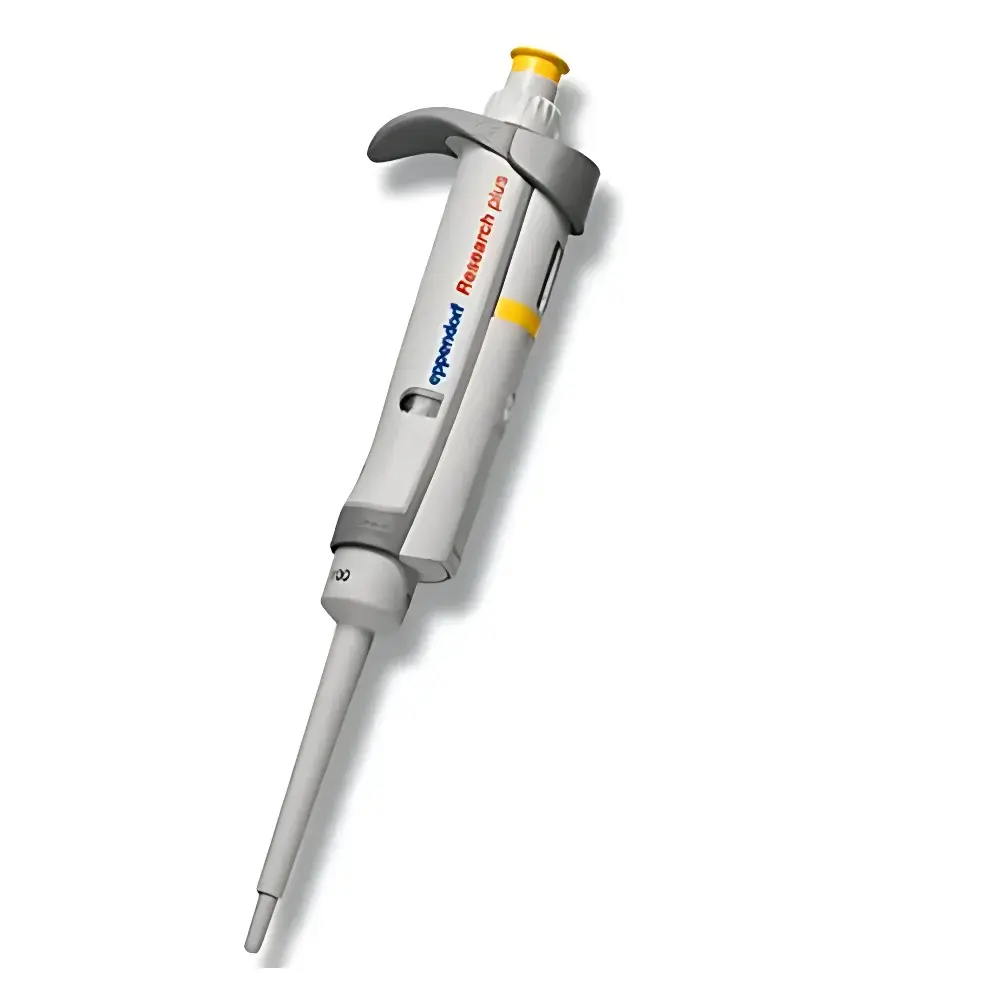
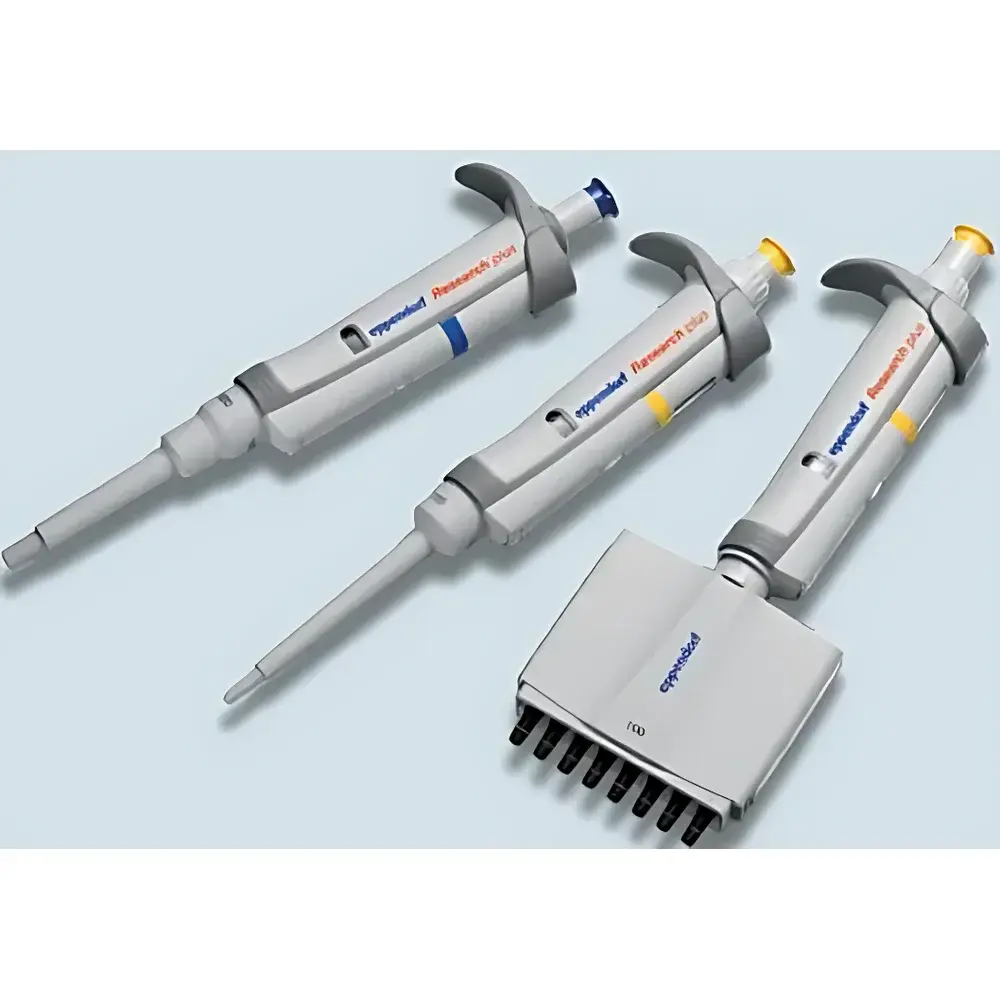
Eppendorf Research Plus Single-Channel Manual Pipette, 10–100 µL
| Brand | Eppendorf |
|---|---|
| Origin | Germany |
| Type | Single-channel manual pipette |
| Volume range | 10–100 µL |
| Maximum capacity | 100 µL |
| Accuracy | ±0.3 µL |
| Compliance | ISO 8655-compliant |
| Calibration interval | Factory-calibrated per ISO 8655-6 |
Overview
The Eppendorf Research Plus Single-Channel Manual Pipette (10–100 µL) is a precision-engineered liquid handling instrument designed for reproducible, ergonomic, and traceable volumetric transfer in life science, clinical diagnostics, pharmaceutical QA/QC, and academic research laboratories. Built upon Eppendorf’s decades-long heritage in pipette development, this model employs an advanced air-cushion (positive displacement–compatible) piston system with low-friction seals and temperature-stable materials to minimize thermal drift and mechanical hysteresis. Its patented spring-loaded tip cone ensures consistent tip attachment force across repeated cycles—critical for maintaining accuracy when using certified low-retention or filtered tips. The pipette operates on the principle of positive air displacement: depression of the plunger creates a vacuum within the air column above the piston; aspiration draws liquid into the tip via atmospheric pressure differential; controlled plunger release expels the volume with minimal residual carryover. This mechanism enables high repeatability (CV ≤ 0.5%) and linearity across its full 10–100 µL range under standard ISO 8655 test conditions (20 °C, distilled water, Class A glassware).
Key Features
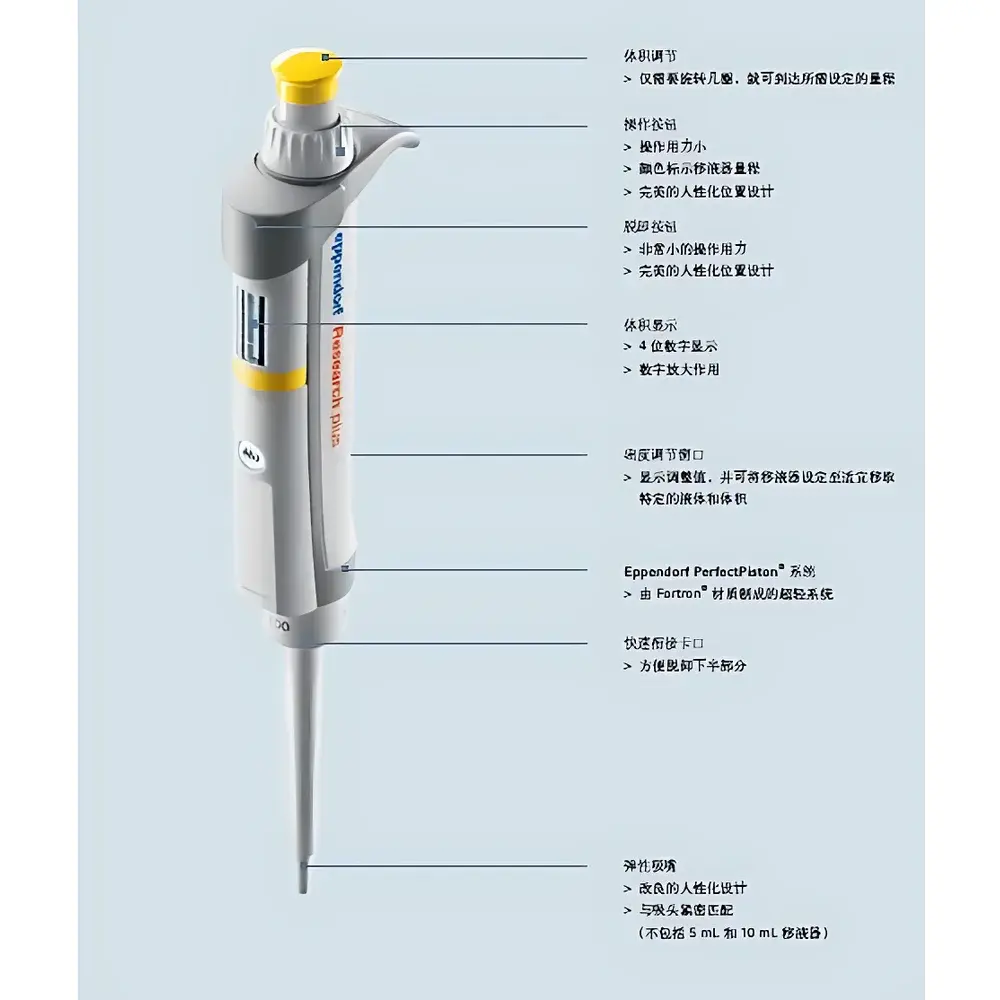
- Ergonomic design with lightweight polymer housing (110 g), adjustable thumb rest, and 360° rotating tip cone for left- and right-handed users—reducing repetitive strain injury (RSI) risk during extended use.
- Two-stage plunger action: first stop for aspiration, second stop for blow-out—enabling precise control over partial dispensing and complete emptying.
- Integrated calibration tool allows on-site adjustment without disassembly; requires only a certified reference weight and balance (e.g., ASTM E2497 Class 1).
- Chemical-resistant piston and O-rings compatible with common solvents including ethanol, isopropanol, and diluted acids/bases (per Eppendorf Chemical Resistance Guide v.4.2).
- Autoclavable at 121 °C, 1 bar for 20 minutes (without tip cone); all components are individually replaceable per ISO 8655-7 maintenance guidelines.
- Volume display window with dual-scale graduation (µL and % setting) and anti-parallax lens for unambiguous reading under laboratory lighting.
Sample Compatibility & Compliance
The Research Plus 10–100 µL pipette is validated for use with aqueous solutions, buffers, cell suspensions, serum, and viscous media up to 50 mPa·s (e.g., glycerol–water mixtures ≤ 20% v/v). For non-aqueous or high-density liquids, users must apply correction factors derived from density and surface tension measurements per ISO 8655-5 Annex B. The device complies fully with ISO 8655-1 (general requirements), ISO 8655-2 (volumetric performance), ISO 8655-3 (test methods), and ISO 8655-6 (calibration procedures). It supports GLP/GMP workflows through documented calibration history, traceable to national metrology institutes (e.g., PTB Germany, NIST USA) via Eppendorf’s Certificate of Conformance (CoC) and optional UKAS-accredited calibration reports. All units ship with a factory calibration certificate referencing ISO/IEC 17025-accredited testing.
Software & Data Management
While the manual Research Plus model does not incorporate onboard electronics or Bluetooth connectivity, it integrates seamlessly into digital lab ecosystems via Eppendorf’s free Pipette+ Manager desktop software (Windows/macOS). This application enables centralized tracking of calibration due dates, service logs, operator assignments, and audit trails compliant with FDA 21 CFR Part 11 (electronic signatures, audit trail activation, role-based access control). When paired with Eppendorf’s Calibration Station CS-2, users can generate PDF reports containing raw gravimetric data, uncertainty calculations (k = 2), and pass/fail status against ISO 8655 acceptance criteria. All calibration records are exportable in CSV or XML format for LIMS integration (e.g., LabWare, Thermo Fisher SampleManager).
Applications
- Preparation of serial dilutions for ELISA, qPCR master mixes, and cell culture media supplementation.
- Accurate dispensing of reagents into 96-well and 384-well microplates for HTS assay development.
- Standard curve generation in analytical chemistry (HPLC sample prep, ICP-MS calibration standards).
- Quality control testing of raw materials and intermediates per USP and EP 2.6.27 guidelines.
- Teaching laboratories requiring robust, student-proof instruments with intuitive operation and clear volume feedback.
FAQ
Is this pipette suitable for handling volatile organic solvents?
Yes—when used with Eppendorf PhysioTip or LoRetention tips and operated at ambient temperature (15–25 °C), it maintains accuracy for acetone, chloroform, and DMSO within ±0.6 µL (per internal validation SOP-LH-042).
Can I calibrate it in-house without external certification?
Yes—the built-in calibration tool permits user adjustment; however, formal compliance with ISO/IEC 17025 or GxP requires verification by an accredited lab every 6–12 months depending on usage frequency.
What tip types are recommended for maximum accuracy at 10 µL?
Eppendorf Research Plus Tips (0.1–10 µL yellow-coded) or low-volume filtered tips (Cat. No. 0030089107) provide optimal seal integrity and reduced evaporation error at the lower end of the range.
Does the pipette include a certificate of calibration?
Yes—each unit ships with a factory-issued ISO 8655-compliant calibration certificate listing measured values at 10 µL, 50 µL, and 100 µL, along with expanded uncertainty (k = 2).
How often should the O-rings be replaced under daily use?
Eppendorf recommends replacement every 12 months or after 10,000 operating cycles—whichever occurs first—as outlined in Maintenance Manual RM-2023-EN Section 4.3.
Related Products



