
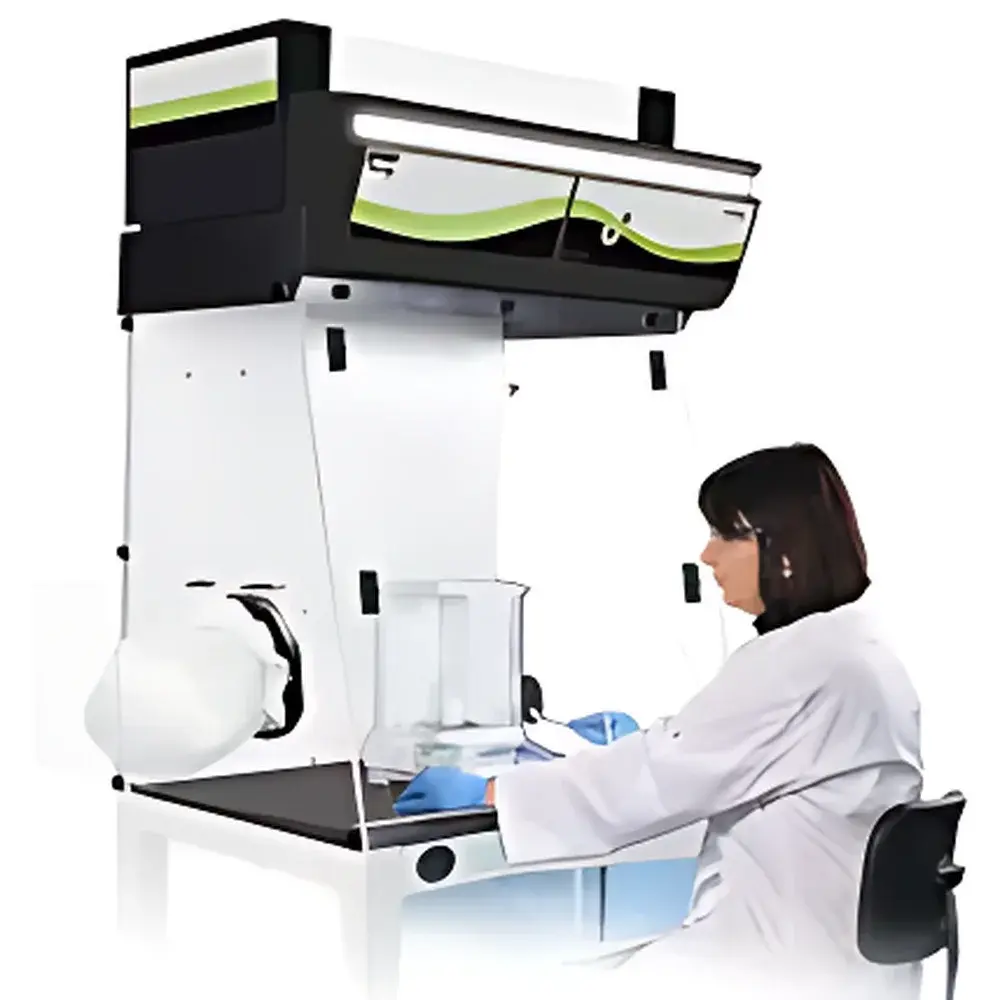
Erlab Captair Smart Precision Balance Enclosure
| Brand | Erlab |
|---|---|
| Origin | France |
| Model | Captair Smart Precision Balance Enclosure |
| Airflow Capacity | 220–660 m³/h |
| Filtration | Dual-module (activated carbon + HEPA/ULPA particle filter) |
| Operating Mode | Recirculating (non-ducted) |
| Compliance | JG/T 385–2012 Class A & B |
| Weighing Stability | Optimized for ≤1 µg (10⁻⁶ g) resolution balances |
| Power Supply | 100–240 V AC, 50–60 Hz |
| Noise Level | 52–58 dB(A) |
| Construction | Stainless steel base, tempered glass front sash, ergonomic inclined access panel |
Overview
The Erlab Captair Smart Precision Balance Enclosure is an engineered containment solution specifically designed for high-sensitivity gravimetric operations in analytical laboratories. Unlike conventional fume hoods or generic enclosures, this system operates on a negative-pressure recirculating airflow principle—drawing ambient air through the working chamber, passing it sequentially through a dual-stage filtration module (gas-phase activated carbon and particulate-grade HEPA or ULPA), and returning purified air back into the laboratory. This closed-loop architecture eliminates ducting requirements, preserves HVAC integrity, and maintains thermal and pressure stability critical for microgram-level weighing accuracy. Its structural design integrates vibration-dampening features—including reinforced stainless-steel chassis, isolated mounting interface, and aerodynamically balanced internal flow paths—to mitigate mechanical and acoustic disturbances that compromise balance repeatability. The enclosure meets JG/T 385–2012 Class A and B performance criteria for balance protection enclosures, ensuring alignment with China’s national technical specification for precision weighing environments.
Key Features
- Vibration-isolated platform interface compatible with standard analytical balance mounts and anti-vibration tables
- Ergonomically inclined front sash (elliptical or full-open variants) optimized for line-of-sight readability and operator posture during extended weighing sessions
- Modular filtration system: interchangeable cartridges supporting simultaneous adsorption of volatile organic compounds (VOCs), acidic/basic vapors, and sub-micron particulates (down to 0.3 µm @ ≥99.995% efficiency)
- Intelligent airflow management: laminar, low-turbulence inflow profile maintained across all operating widths (800–1298 mm), minimizing convective interference at the balance pan
- Integrated hazardous waste containment tray with chemical-resistant lining, preventing secondary exposure from contaminated packaging or spill residues
- Energy-efficient DC-powered centrifugal blower(s) with variable-speed control—power consumption ranges from 65 W to 160 W depending on model and airflow demand
Sample Compatibility & Compliance
The Captair Smart accommodates a broad range of sample types requiring containment during mass determination: hygroscopic powders, cytotoxic APIs, nanomaterials, radioactive tracers, and volatile solvents. Its non-ducted operation complies with ISO 14644-1 Class 5 cleanroom-compatible air handling standards when used with ULPA filtration. While not certified to ISO 15195 (reference measurement laboratories), its mechanical stability and environmental isolation support GLP-aligned weighing procedures where traceability, audit readiness, and documented environmental controls are required. The unit is constructed per IEC 61010-1 for electrical safety in laboratory equipment and incorporates fail-safe airflow monitoring (optional sensor integration available) to trigger visual/audible alerts if face velocity drops below 0.4 m/s—ensuring continuous operator protection and data integrity.
Software & Data Management
The Captair Smart operates as a standalone hardware platform without embedded firmware or cloud connectivity. However, it supports third-party integration via analog voltage output (0–10 V) or digital relay signals for airflow status, filter saturation, and power-on state—enabling linkage with laboratory building management systems (BMS) or electronic lab notebooks (ELN). Filter service intervals are tracked manually using maintenance logs aligned with ISO/IEC 17025 clause 6.4.6 (equipment maintenance records). For regulated environments, optional audit-trail-capable digital controllers (sold separately) provide timestamped event logging compliant with FDA 21 CFR Part 11 requirements when paired with validated ELN platforms.
Applications
- Weighing of potent pharmaceutical compounds under GMP Annex 1-compliant conditions
- Preparation of certified reference materials (CRMs) requiring microgram-level reproducibility
- Handling of nanoscale catalysts and metal-organic frameworks (MOFs) prone to airborne dispersion
- Standardization of volumetric glassware using gravimetric water delivery methods (ASTM E542, USP <41>)
- Environmental analysis workflows involving PCBs, dioxins, or pesticide standards sensitive to ambient contamination
- Academic research in metrology, materials science, and radiochemistry where balance drift must be minimized over multi-hour measurements
FAQ
Does the Captair Smart require external ductwork or make-up air systems?
No. It is a self-contained recirculating enclosure; no external exhaust or dedicated HVAC modifications are needed.
Can it be used with ultra-microbalances (e.g., 0.1 µg resolution)?
Yes—its vibration-damped structure and laminar airflow design are validated for use with balances meeting ISO 11352:2012 sensitivity classes U1 and U2.
How often must the filters be replaced?
Activated carbon filters should be replaced every 6–12 months depending on VOC load; particulate filters every 12–24 months—monitoring via differential pressure gauges is recommended.
Is the unit compatible with ISO/IEC 17025 accredited laboratories?
Yes—when operated within specified environmental parameters (temperature ±2°C, humidity 30–60% RH) and maintained per manufacturer-recommended schedules, it satisfies clause 6.4.1 (equipment suitability) and 6.4.8 (verification of fitness for purpose).
What safety certifications does it hold beyond JG/T 385–2012?
It carries CE marking per Machinery Directive 2006/42/EC and EMC Directive 2014/30/EU; electrical safety certification to IEC 61010-1:2010 is included in the EU Declaration of Conformity.



