
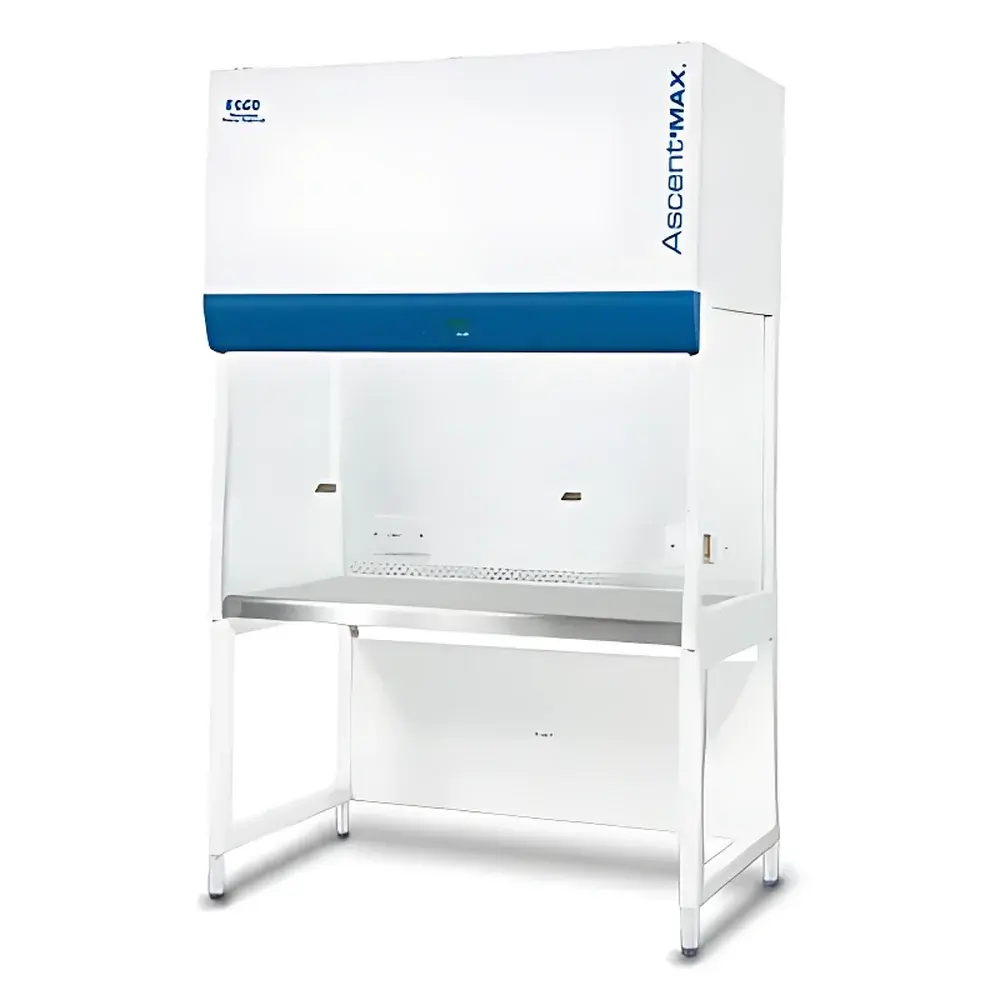
Esco Ascent Max ACD-B Ductless Fume Hood
| Brand | Esco |
|---|---|
| Origin | Singapore |
| Manufacturer Type | Original Equipment Manufacturer (OEM) |
| Product Category | Imported Laboratory Equipment |
| Model | ACD-B |
| Construction | Fully Steel Enclosure |
| Configuration | Single-Face Workstation |
| Certification | AFNOR NF X 15-203, BS 7258, BS 7989, ASHRAE 110, EN 14175-3 |
| Airflow Inflow Velocity | 0.40 m/s (80 fpm) |
| Power Supply | 220–240 V AC, 50 Hz, 1 Phase |
| Filter System | Nanocarb™ Activated Carbon Filters (7+ chemically selective variants) |
| Surface Finish | ISO-CIDE® Antimicrobial Coating |
| Control System | Esco Sentinel™ Microprocessor-Based Airflow Monitoring & Alarm Interface |
| Lighting | 5000 K Warm White Fluorescent Lamp |
| Work Surface | #304 Stainless Steel |
| Spill Containment | Front Raised Lip Design |
| Service Access | Front-Panel Maintenance Architecture |
| Optional Sensors | Integrated VOC Sensor (factory-installed) |
| Retrofit Compatibility | Air/Water/Vacuum/Gas Service Kits (DIN/BS-compliant) |
Overview
The Esco Ascent Max ACD-B is a high-performance ductless fume hood engineered for laboratories requiring containment of low-to-moderate volatility chemical vapors without external ducting infrastructure. Unlike conventional ducted hoods that exhaust conditioned air to the exterior, the ACD-B employs a closed-loop recirculation system with dual-stage filtration—pre-filter and chemically selective Nanocarb™ activated carbon filters—to capture and neutralize airborne contaminants before returning purified air into the laboratory environment. Its design adheres strictly to internationally recognized performance standards including EN 14175-3 (Europe), ASHRAE 110 (USA), BS 7258 and BS 7989 (UK), and AFNOR NF X 15-203 (France), ensuring validated containment efficiency, operator protection, and reproducible airflow dynamics. The unit is manufactured in Singapore by Esco, a Tier-1 OEM with ISO 13485 and ISO 9001 certification, and features a fully welded 304 stainless steel chassis with ISO-CIDE® antimicrobial coating—a silver-ion-based surface treatment proven to eliminate ≥99.9% of common bacterial strains (e.g., Staphylococcus aureus, Escherichia coli) within 24 hours.
Key Features
- Fully welded #304 stainless steel work surface and enclosure—resistant to corrosion, chipping, and particulate shedding under routine laboratory use.
- Front raised lip design (≥10 mm height) to contain incidental liquid spills within the work area, preventing migration toward the operator or control panel.
- Sentinel™ microprocessor-based airflow monitoring system with large-format LED display—provides real-time visualization of inflow velocity, filter saturation status, and operational alarms.
- Integrated audible and visual alarm system triggered by airflow deviation (>±10% from setpoint), filter end-of-life, or VOC concentration exceeding user-defined thresholds.
- 5000 K warm-white fluorescent lighting optimized for color fidelity and visual fatigue reduction during extended procedures.
- Front-accessible service architecture—enables full filter replacement, sensor calibration, and internal component maintenance without relocating the unit or removing rear panels.
- Hinged front panel with integrated electronics bay—simplifies diagnostic access and facilitates third-party certification audits per ISO/IEC 17025 requirements.
- Modular retrofit capability via DIN- and BS-compliant service kits (air/water/vacuum/gas) for seamless integration into existing lab utility grids.
- Optional factory-installed VOC sensor with analog output (4–20 mA) and digital interface—supports data logging and integration with centralized building management systems (BMS).
Sample Compatibility & Compliance
The ACD-B is designed for safe handling of non-radioactive, non-explosive, and low-hazard volatile organic compounds (VOCs), acids, aldehydes, amines, halogenated solvents, mercury vapors, and sulfur-containing reagents. Its Nanocarb™ filter portfolio includes seven chemically tailored variants—each validated for specific contaminant classes per ASTM D5212 and ISO 10121-2 protocols. The hood is not intended for use with perchloric acid, hydrogen sulfide, or highly reactive pyrophoric substances. All models comply with GLP-aligned documentation practices; electronic audit trails generated by the Sentinel™ controller meet FDA 21 CFR Part 11 requirements when deployed with validated software configuration. CE marking, UKCA, and RoHS compliance are standard across all configurations.
Software & Data Management
The Sentinel™ controller operates on embedded firmware with non-volatile memory for storing up to 30 days of continuous airflow and alarm event logs. Data export is supported via USB 2.0 port (CSV format) or optional RS-485 Modbus RTU interface for integration into LIMS or enterprise SCADA platforms. User access levels include Operator (basic parameter viewing), Technician (filter reset, calibration), and Administrator (alarm threshold adjustment, firmware update). All configuration changes are timestamped and attributed to logged-in users—supporting traceability in regulated environments governed by ISO/IEC 17025, CLIA, or GMP Annex 11.
Applications
- Chemistry teaching labs requiring flexible, space-efficient containment for solvent dispensing, titration, and small-scale synthesis.
- Pharmaceutical QC laboratories performing HPLC sample preparation, dissolution testing, and reference standard handling.
- Environmental testing facilities conducting VOC analysis, pesticide residue extraction, and soil leachate processing.
- Biotechnology labs using low-volatility reagents in cell culture support workflows (e.g., ethanol sterilization, pH adjustment with weak acids/bases).
- Industrial R&D centers evaluating formulation stability, catalyst screening, and polymerization kinetics under controlled vapor conditions.
FAQ
What types of chemicals can be safely handled in the Ascent Max ACD-B?
The ACD-B is validated for low-to-moderate volatility organic solvents (e.g., acetone, methanol, hexane), weak acids (e.g., acetic, citric), ammonia, formaldehyde, and halogenated compounds. It is not approved for perchloric acid, hydrofluoric acid, hydrogen cyanide, or explosive peroxides.
How often must the Nanocarb™ filters be replaced?
Filter service life depends on chemical type, concentration, and usage frequency. Sentinel™ provides real-time saturation indicators; typical replacement intervals range from 6 to 18 months under standard academic lab usage (≤4 hrs/day, ≤5 days/week).
Can the ACD-B be installed against a wall?
Yes—the front-service design allows full maintenance access without rear clearance, enabling wall-mounted installation to maximize floor space utilization.
Is the VOC sensor calibrated at the factory?
Yes—each VOC sensor undergoes NIST-traceable calibration prior to shipment and includes a certificate of conformance. Field recalibration is supported using certified gas standards.
Does Esco provide validation documentation for regulatory submissions?
Upon request, Esco supplies IQ/OQ documentation packages—including test protocols, raw data records, and summary reports—aligned with ISO/IEC 17025 and FDA guidance for equipment qualification in GxP environments.



