
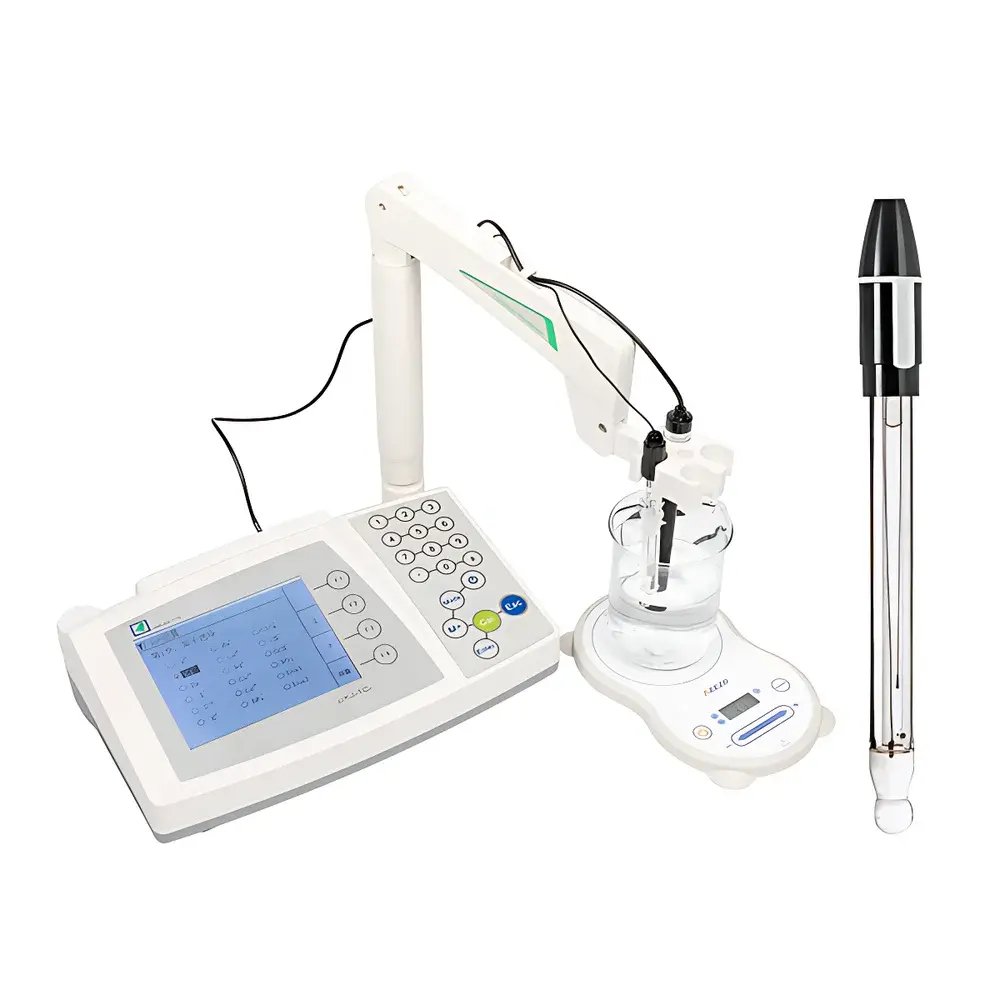
FangZhou PXJ-1C+ Sodium Ion Analyzer
| Brand | FangZhou |
|---|---|
| Origin | Sichuan, China |
| Manufacturer Type | Authorized Distributor |
| Product Category | Domestic |
| Model | PXJ-1C+ |
| Instrument Type | Benchtop |
| Ion Measurement Range | (0–99999) ppm |
| Detection Limit | 9999 ppm |
| Response Time | 3 s |
| Measurement Accuracy | ±0.5% FS ±1 digit |
| Temperature Range | (−20.0–135.0) °C |
| pH Resolution | 0.001 pH |
| mV Resolution | 0.01 mV |
| Input Impedance | ≥3×10¹² Ω |
| Data Storage Capacity | 4096 sets |
| GLP Compliance | Yes |
| Calibration Points | 2–9 points (ion), up to 5 points (pH) |
| Temperature Compensation | Automatic (ATC) or Manual |
| Communication Interfaces | USB, RS-232, 0–20 mV analog output |
Overview
The FangZhou PXJ-1C+ Sodium Ion Analyzer is a high-precision benchtop ion concentration meter engineered for reliable quantitative analysis of sodium (Na⁺) and 16 pre-programmed ions—including fluoride, chloride, bromide, ammonia, nitrate, and others—in aqueous environmental, industrial, and laboratory samples. Based on potentiometric measurement using ion-selective electrodes (ISEs), the instrument determines ion activity via Nernstian response, delivering direct concentration readouts in multiple units without manual calculation. Its architecture integrates dual-mode temperature compensation (ATC/manual), wide-range thermal operation (−20.0 to 135.0 °C), and robust input impedance (>3×10¹² Ω) to ensure signal stability with high-resistance ISEs. Designed for regulatory-aligned workflows, the PXJ-1C+ conforms to Good Laboratory Practice (GLP) requirements through timestamped data logging, audit-ready calibration records, and traceable measurement history—making it suitable for water quality monitoring labs operating under ISO/IEC 17025, EPA Method 300.0, or local environmental compliance frameworks.
Key Features
- Benchtop platform with backlit LCD display and intuitive menu-driven navigation for rapid method selection and parameter adjustment
- Multi-parameter capability: simultaneous measurement of Na⁺ concentration, pH (−10.000 to 20.000), mV/RelmV/ORP (−2000.00 to 2000.00 mV), and temperature (−20.0 to 135.0 °C)
- High-resolution detection: 0.001 pH, 0.01 mV, and configurable ion resolution (1–3 significant digits) across 13 concentration units (ppm, ppb, mol/L, mmol/L, µmol/L, ng/L, mg/L, g/L, %, µg/L, ppt, pX, and nmol/L)
- Advanced calibration architecture: 2–9-point ion calibration with automatic standard curve generation; 5-point pH calibration with auto-recognition of 4 predefined buffer sets (including NIST and DIN standards)
- Comprehensive data management: 4096 internal storage slots with time/date stamping, GLP-compliant record structure, and export-ready formatting
- Dual temperature compensation: ATC via integrated Pt1000 sensor or manual entry; full-range compensation (−20.0 to 135.0 °C) applied to both pH and ion measurements
- Expandable connectivity: USB and RS-232 interfaces plus 0–20 mV analog output for integration into SCADA or LIMS environments
Sample Compatibility & Compliance
The PXJ-1C+ supports aqueous samples across municipal drinking water, wastewater effluent, boiler feedwater, seawater dilutions, and industrial process streams. It accommodates standard sodium-selective electrodes (e.g., glass-membrane or solid-state ISEs) via a universal electrode converter interface, enabling compatibility with major third-party sensor brands. All measurements adhere to internationally recognized electrochemical principles defined in ASTM D1293 (pH of water), ISO 10523 (water quality — pH determination), and ISO 14911 (determination of anions and cations by ion chromatography — supporting validation context). The instrument’s GLP functionality includes mandatory field capture of operator ID, calibration date/time, electrode serial number, and environmental conditions—fulfilling documentation prerequisites for ISO 17025-accredited laboratories and routine EPA or provincial environmental agency reporting.
Software & Data Management
Equipped with “FangZhou pH-Link” PC software, the PXJ-1C+ enables bidirectional data exchange over USB or RS-232. Raw measurement logs—including ion concentration, pH, mV, temperature, calibration coefficients, and metadata—are exported in CSV and XLSX formats for statistical analysis, trend visualization, and regulatory submission. The software enforces secure user access levels, supports electronic signature workflows, and maintains immutable audit trails for all configuration changes and data exports—aligning with FDA 21 CFR Part 11 expectations for electronic records and signatures where applicable. Internal memory retains full GLP records even during power interruption, ensuring continuity of compliance-critical data integrity.
Applications
- Environmental monitoring: Sodium quantification in surface water, groundwater, and desalination plant influent/effluent per Chinese HJ 506-2009 and US EPA Method 300.0
- Power generation: Boiler water and steam condensate purity control to prevent corrosion and scaling
- Food & beverage QA/QC: Salt content verification in brines, dairy products, and processed foods
- Pharmaceutical water systems: Monitoring of purified water (PW) and water for injection (WFI) conductivity-correlated sodium residuals
- Academic research: Multi-ion speciation studies in hydrogeochemical modeling and soil leachate analysis
FAQ
What ion-selective electrodes are compatible with the PXJ-1C+?
The analyzer supports industry-standard BNC and DIN-style sodium ISEs via its included electrode converter; compatibility extends to any ISE meeting ≥10¹² Ω input impedance specifications.
Does the instrument support automatic calibration verification?
Yes—built-in self-diagnostic routines verify electrode slope, asymmetry potential, and reference junction integrity prior to each measurement cycle.
Can calibration data be exported for external audit review?
All calibration events—including standard concentrations, measured potentials, R² values, and operator timestamps—are stored internally and exportable via pH-Link software in uneditable PDF or CSV format.
Is temperature compensation applied independently to pH and ion measurements?
Yes—both parameters use identical temperature inputs but apply distinct Nernstian correction algorithms optimized for their respective electrode response characteristics.
What is the warranty coverage for the PXJ-1C+ host unit?
The main unit carries a three-year limited warranty; defective units are replaced within six months of purchase under standard terms.







