

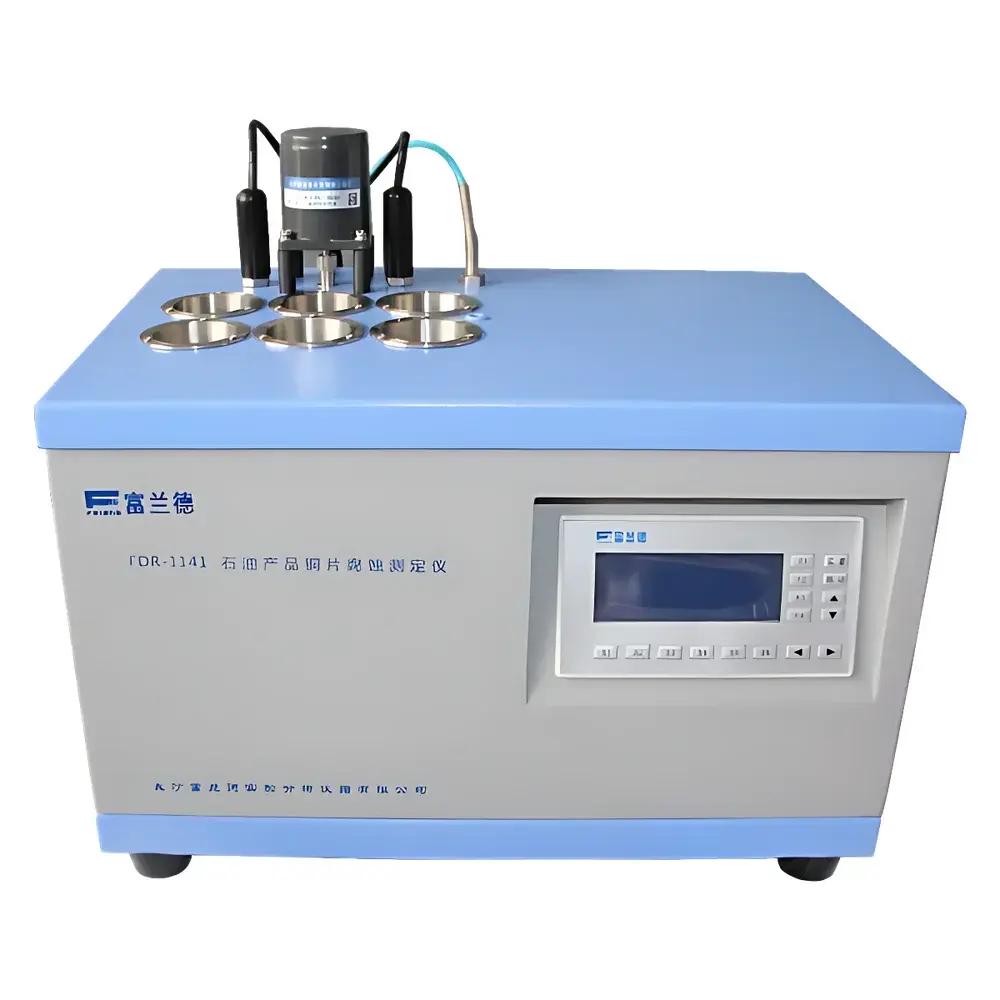
FDR-1141 Copper Strip Corrosion Tester for Petroleum Products
| Brand | FuLand / csfriend |
|---|---|
| Origin | Hunan, China |
| Model | Compliant with GB/T 5096 |
| Temperature Range | Ambient to 150 °C |
| Temperature Control Accuracy | ±0.1 °C |
| Heating Power | 1200 W |
| Display | LCD (English/Chinese) |
| Test Stations | 6 |
| Diagnostic Function | Built-in Self-Diagnosis & Auto-Tuning Capability |
| Oxygen Bomb Storage Compartment | Integrated |
Overview
The FDR-1141 Copper Strip Corrosion Tester is a dedicated benchtop instrument engineered for precise evaluation of copper strip corrosion in petroleum products—primarily gasoline, diesel, jet fuel, lubricating oils, and distillates—according to the internationally harmonized methodology specified in GB/T 5096 (equivalent to ASTM D130 and ISO 2160). It operates on the principle of controlled immersion: a standardized polished copper strip is immersed in a sealed sample under defined temperature and time conditions, after which the resulting surface discoloration is visually or spectrophotometrically assessed against the ASTM Copper Corrosion Standard Color Chart. This test serves as a critical indicator of active sulfur compounds (e.g., mercaptans, elemental sulfur, hydrogen sulfide) and other corrosive species that may degrade fuel system components, accelerate oxidation, or compromise storage integrity. The FDR-1141 delivers reproducible thermal environments essential for compliance-driven quality control in refineries, third-party testing laboratories, and OEM fuel certification programs.
Key Features
- Multi-station parallel testing: Six independent reaction chambers enable simultaneous processing of up to six copper strips, improving throughput without compromising thermal uniformity across positions.
- Precision temperature regulation: A PID-controlled heating system maintains setpoint stability within ±0.1 °C over the full operational range (ambient to 150 °C), validated per IEC 61000-4-30 traceable protocols.
- Intelligent thermal management: Integrated self-diagnostic firmware continuously monitors sensor drift, heater response, and ambient thermal load; automatic tuning adjusts control parameters to sustain accuracy during extended runs or ambient fluctuations.
- Dual-language human interface: High-contrast LCD display supports both English and Chinese menus, parameter entry, real-time temperature logging, and elapsed time tracking—optimized for multilingual lab personnel and audit-ready documentation.
- Dedicated oxygen bomb storage module: An insulated, ventilated compartment integrated into the instrument chassis facilitates safe post-test handling, cooling, and organized storage of pressurized oxygen bombs used in related oxidation stability tests (e.g., GB/T 268, ASTM D2274).
Sample Compatibility & Compliance
The FDR-1141 accommodates standard 12.7 mm × 76.2 mm × 1.5 mm copper strips (ASTM B152 Grade C10200, minimum 99.9% Cu purity) and accepts sample volumes from 30 mL to 50 mL in glass test tubes conforming to GB/T 5096 Annex A. It meets mechanical and thermal requirements of GB/T 5096–2023, and its operational protocol aligns with the technical scope of ASTM D130–22, ISO 2160:2015, and IP 154. While not certified to UL/CE for standalone safety listing, the unit incorporates overtemperature cut-off, grounded chassis design, and thermal insulation compliant with IEC 61010-1:2010 for laboratory electrical equipment. Data outputs support GLP/GMP-aligned recordkeeping when paired with external timestamped loggers.
Software & Data Management
The FDR-1141 operates via embedded firmware with no external PC dependency. All test parameters—including target temperature, soak duration (up to 24 h), start time, and chamber ID—are programmable directly via keypad navigation. Real-time temperature curves and status flags (e.g., “Heating”, “Soaking”, “Cooling”, “Fault”) are retained in non-volatile memory for up to 100 test cycles. Export is supported via RS-232 serial interface (optional USB-to-serial adapter) for integration into LIMS or QA databases. Audit trail functionality includes operator ID input (alphanumeric), date/time stamps, and error code logging—facilitating alignment with FDA 21 CFR Part 11 requirements when deployed in regulated environments using validated data capture workflows.
Applications
- Refinery QC labs performing routine copper strip corrosion screening on finished gasoline blends prior to pipeline shipment.
- Fuel additive compatibility assessment: evaluating interaction between novel detergent packages and base stocks under accelerated aging conditions.
- Aviation turbine fuel certification per DEF STAN 91-91 and ASTM D130 Class 1a requirements.
- Monitoring sulfur scavenger efficacy in hydrotreated diesel streams during catalyst life-cycle studies.
- Supporting root-cause analysis in field complaints involving fuel filter plugging or injector coking linked to latent corrosion activity.
FAQ
What standards does the FDR-1141 comply with?
It is designed and verified for full conformance with GB/T 5096–2023, and functionally equivalent to ASTM D130–22 and ISO 2160:2015 in thermal control, timing accuracy, and sample containment geometry.
Can the instrument be used for non-petroleum samples such as biodiesel or synthetic esters?
Yes—provided the sample does not exceed 150 °C thermal stability and does not chemically attack copper or borosilicate glass; method validation per ASTM D6751 or EN 14214 is recommended prior to routine use.
Is calibration certificate included with shipment?
A factory-issued calibration report (traceable to NIM, China) covering temperature sensor linearity and timer accuracy is provided; user-performed verification using NIST-traceable RTD and stopwatch is advised before first use and at quarterly intervals.
Does the unit support automated pass/fail judgment based on color rating?
No—the final corrosion rating remains a visual assessment per ASTM D130 Section 7.3; however, optional digital colorimetry modules (e.g., X-Rite Ci7800) can be integrated externally for objective quantification.
What maintenance is required for long-term reliability?
Monthly cleaning of chamber seals and oxygen bomb ports with anhydrous ethanol; annual verification of thermocouple offset and heater resistance; replacement of silicone O-rings every 18 months under continuous operation.




