
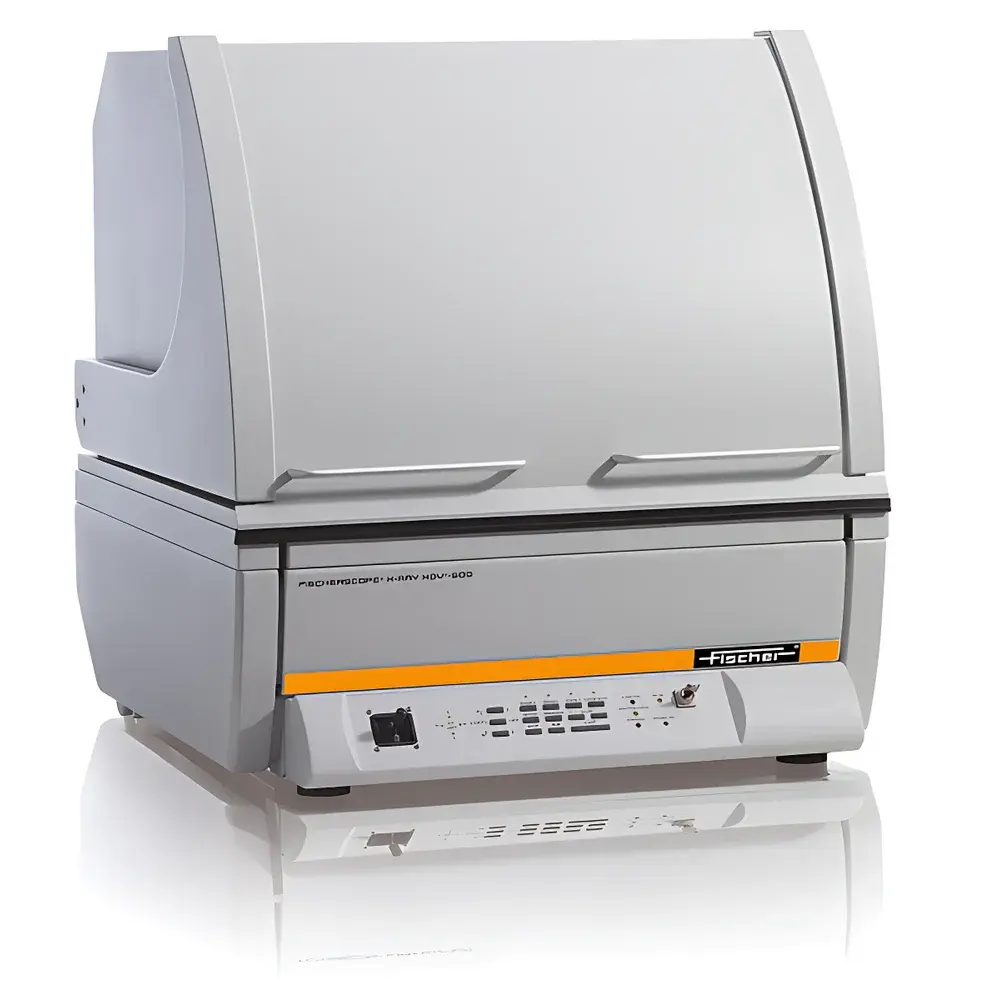
FISCHERSCOPE® X-RAY XDV-SDD® Energy Dispersive X-Ray Fluorescence Spectrometer
| Brand | Fischer |
|---|---|
| Origin | Germany |
| Model | XDV-SDD |
| Form Factor | Benchtop |
| Elemental Range | Al (Z=13) to U (Z=92) |
| Detection Limit | 1 ppm |
| Quantification Range | 1 ppm – 100 wt% |
| Energy Resolution | ≤140 eV (Mn Kα) |
| Repeatability | ≤5% RSD |
| Sample Stage | Motorized XYZ with Programmable XY Translation and Z-Axis Lift |
| X-ray Source | Microfocus Tungsten Anode Tube with Beryllium Window |
| High Voltage | 3-step Adjustable (up to 50 kV) |
| Filter Options | 6 Interchangeable Primary Filters |
| Collimators | Motorized, Switchable Apertures |
| Optical Alignment | Integrated HD Video System with 20× Digital Zoom, Crosshair Overlay, and Laser Spot Locator |
| Software Platform | WinFTM® v8.x (FDA 21 CFR Part 11 Compliant, Audit Trail Enabled, GLP/GMP-Ready) |
Overview
The FISCHERSCOPE® X-RAY XDV-SDD® is a benchtop energy dispersive X-ray fluorescence (EDXRF) spectrometer engineered for non-destructive, high-precision thickness measurement of ultra-thin metallic and alloy coatings — down to sub-nanometer levels — and quantitative elemental analysis of solid materials. Based on the fundamental principle of EDXRF, the instrument irradiates a sample with primary X-rays from a microfocus tungsten anode tube; characteristic secondary (fluorescent) X-rays emitted by constituent elements are detected by a silicon drift detector (SDD), enabling simultaneous multi-element identification and quantification without chemical dissolution or vacuum requirements. Its compact yet robust architecture integrates motorized XYZ positioning, real-time optical guidance, and regulatory-compliant software — making it suitable for routine QC in electronics manufacturing, plating line monitoring, RoHS/ELV compliance screening, and R&D material characterization under ISO 14713, ASTM B568, and DIN EN ISO 3497 standards.
Key Features
- Motorized XYZ sample stage with programmable XY translation (±50 mm range, 0.1 µm resolution) and motor-driven Z-axis lift (15 mm travel) for precise focal distance control and automated multi-point mapping.
- Integrated high-definition video system with 20× digital zoom, crosshair overlay, and coaxial laser spot locator for rapid, repeatable positioning — eliminating manual alignment errors.
- Microfocus tungsten X-ray tube (Be window, 50 kV max) with three-step adjustable high voltage and six interchangeable primary filters to optimize excitation conditions across light-to-heavy element ranges.
- Silicon drift detector (SDD) delivering ≤140 eV energy resolution at Mn Kα (5.9 keV), ensuring clear peak separation for overlapping transitions (e.g., S Kα/Pb Mα, Cr Kβ/Fe Kα).
- WinFTM® v8.x software platform supporting method development, calibration curve generation (fundamental parameters + empirical), statistical process control (SPC), and automated report generation with embedded metadata (operator, timestamp, instrument ID, measurement position).
- FDA 21 CFR Part 11–compliant architecture featuring electronic signatures, full audit trail, user role-based access control, and data integrity safeguards aligned with GLP and GMP laboratory practices.
Sample Compatibility & Compliance
The XDV-SDD accommodates flat, curved, or irregularly shaped samples up to Ø150 mm × 40 mm height, including printed circuit boards (PCBs), connector pins, semiconductor lead frames, electroplated fasteners, and thin-film solar substrates. It complies with IEC 61000-4-3 (EMC), CE marking directives, and radiation safety standards (IEC 61010-1). Measurement protocols adhere to internationally recognized methods: ASTM B568 (coating thickness), ISO 3497 (metallic coatings), ISO 22037 (electronic components), and RoHS Directive 2011/65/EU Annex II for restricted substance screening (Pb, Cd, Hg, Cr⁶⁺, Br). All calibrations are traceable to NIST SRM reference materials, and uncertainty budgets conform to ISO/IEC 17025 requirements.
Software & Data Management
WinFTM® serves as the central analytical engine — not merely a GUI but a validated, scalable data management environment. It supports batch measurement scripting, automatic ROI (region-of-interest) definition via image recognition, and dynamic background subtraction algorithms. Raw spectra are stored in standardized .spc format with embedded acquisition parameters; processed results export to CSV, PDF, or XML for LIMS integration. The software includes built-in statistical tools (Cp/Cpk, X-bar R charts), trend analysis over time, and customizable certificate templates compliant with ASME BPE and IPC-4552A. All user actions, parameter changes, and result modifications are logged with immutable timestamps and operator IDs — satisfying FDA audit readiness and internal QA documentation requirements.
Applications
- Thickness metrology of Au/Ni/Cu multilayer stacks on PCB pads and wire bond pads (0.5 nm – 50 µm).
- Quantitative analysis of solder paste composition (Sn, Pb, Ag, Cu, Bi) and contamination detection (Cl, S, Br).
- Verification of functional coatings on medical device components (e.g., TiN on stainless steel implants).
- Screening for restricted substances in consumer electronics per EU RoHS, China RoHS, and JEITA guidelines.
- Alloy verification of precision-machined parts (e.g., brass, phosphor bronze, Inconel) using FP-based quantification.
- Research-grade thin-film characterization in photovoltaics (CdTe, CIGS) and display technologies (ITO, AZO).
FAQ
What is the minimum detectable thickness for gold on nickel substrates?
Typical detection limit is ~0.3 nm (3 Å) for Au/Ni under optimized conditions (50 kV, Pd filter, 100 s live time), depending on substrate homogeneity and surface roughness.
Can the instrument analyze liquids or powders?
Yes — with optional sample cups and support plates; however, certified thickness measurements require flat, homogeneous solids per ASTM B568. Liquid/powder analysis follows ISO 22037 Annex A for semi-quantitative screening.
Is vacuum or helium purge required for light element analysis?
No — the Be-window tube and SDD enable reliable detection of Al (Z=13) through Si (Z=14) in air; Na (Z=11) and Mg (Z=12) are accessible with helium flush option (optional accessory).
How is calibration maintained across shifts and operators?
WinFTM® supports multi-level calibration hierarchies: daily verification with check standards, quarterly recalibration using CRM sets, and full validation per ISO/IEC 17025 every 12 months — all tracked via integrated calibration management module.
Does the system support remote diagnostics and firmware updates?
Yes — via secure TLS-encrypted connection; remote support sessions include screen sharing, log file retrieval, and over-the-air firmware upgrades compliant with IEC 62443-3-3 cybersecurity standards.






