
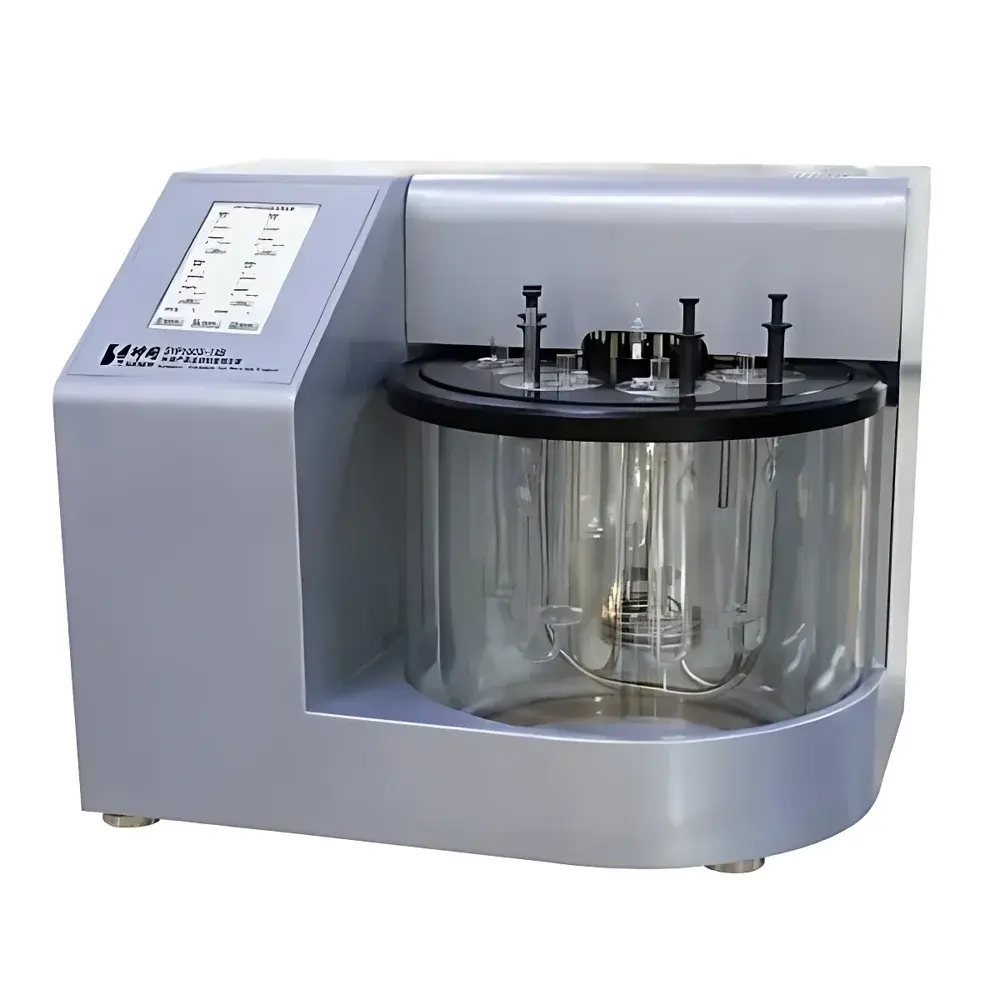
Shenkai SYP1003-IXB Kinematic Viscosity Tester for Petroleum Products
| Brand | Shenkai |
|---|---|
| Origin | Shanghai, China |
| Model | SYP1003-IXB |
| Temperature Control Range | 20–100 °C (20 °C requires optional immersion chiller) |
| Temperature Stability | ±0.01 °C |
| Bath Capacity | ~18 L |
| Bath Dimensions | Ø300 × 300 mm (hardened borosilicate glass, double-wall construction) |
| Test Stations | 4 independent capillary viscometer ports |
| Timing Resolution | 0.1 s per channel, auto-calculation of kinematic viscosity (ν, mm²/s) |
| Heating Power | 1600 W |
| Stirring Motor | 40 W, 1250 rpm, impeller Ø50 mm |
| Power Supply | 220 V ±10%, 50 Hz ±1 Hz |
| Dimensions (W×D×H) | 580 × 400 × 482 mm |
| Weight | 15 kg |
| Compliance | GB/T 265, ISO 3104, ASTM D445, SH/T 0173 |
Overview
The Shenkai SYP1003-IXB Kinematic Viscosity Tester is a precision-engineered instrument designed specifically for the determination of kinematic viscosity (ν) of Newtonian liquid petroleum products—such as base oils, lubricants, diesel fuels, and jet fuels—according to internationally harmonized standard test methods. It operates on the fundamental principle of gravity-driven capillary flow: a fixed volume of sample is drawn into a calibrated glass capillary viscometer (e.g., Ubbelohde, Cannon-Fenske, or BS/ISO types), then allowed to flow under gravity between two etched marks. Kinematic viscosity is calculated as the product of the capillary constant (C, mm²/s²) and the measured efflux time (t, s), i.e., ν = C × t. The instrument integrates a high-stability thermostatic bath, four independent timing channels, and intelligent firmware that automates data acquisition, temperature compensation, and unit conversion—eliminating manual stopwatch use and transcription errors. Its dual-wall hard-glass bath ensures rapid thermal equilibration and minimal radial temperature gradients (<0.01 °C deviation across bath volume), critical for achieving repeatability ≤0.35% RSD per ASTM D445 Annex A1.
Key Features
- Four independent test stations with synchronized high-resolution timing (0.1 s resolution), enabling concurrent analysis of up to four samples or replicate runs without cross-interference
- Ultra-stable temperature control system with ±0.01 °C accuracy over 20–100 °C range; optional immersion chiller extends low-end capability to 20 °C
- Double-wall borosilicate glass bath (Ø300 × 300 mm, ~18 L capacity) with optimized fluid dynamics—achieves thermal equilibrium in <15 minutes after setpoint change
- Integrated digital touch interface with real-time display of bath temperature, elapsed time per channel, calculated ν values (mm²/s), and pass/fail status against method-defined repeatability limits
- Dedicated vertical alignment fixture (optional accessory) enables precise 360° angular adjustment of capillary viscometers to ensure strict vertical orientation—critical for minimizing hydrostatic pressure error
- Comprehensive safety architecture: over-temperature cut-off, insulated outer jacket, automatic power shutdown upon lid removal, and thermally shielded access zones
- Modular mechanical design permits field replacement of heating elements, stirrers, sensors, and timing modules without recalibration
Sample Compatibility & Compliance
The SYP1003-IXB accommodates all standard glass capillary viscometers conforming to SH/T 0173, including BMN-1, BMN-2, BMN-3, Ubbelohde, and suspended-level types. It supports kinematic viscosity measurement across the full practical range of petroleum liquids (approximately 1–100,000 mm²/s), provided appropriate capillary constants and bath temperatures are selected per ASTM D445 Table 1. The system is fully compliant with mandatory regulatory and quality framework requirements: GB/T 265 (China National Standard), ISO 3104:2023 (Petroleum products — Determination of kinematic viscosity and calculation of dynamic viscosity), and ASTM D445 – 23a (Standard Test Method for Kinematic Viscosity of Transparent and Opaque Liquids). All temperature and timing data are traceable to NIST-traceable references, and the firmware supports audit-ready logging for GLP and GMP environments—including user authentication, electronic signatures, and 21 CFR Part 11–compatible data integrity controls when paired with validated LIMS integration.
Software & Data Management
The embedded control software provides complete assay lifecycle management: method setup (including capillary ID, calibration constant, test temperature, and acceptance criteria), real-time monitoring, automated ν calculation using standardized equations, and result validation against intra-run and inter-run reproducibility thresholds. Each test station stores metadata (operator ID, date/time stamp, ambient conditions, viscometer ID, raw efflux time) and final results locally in non-volatile memory. Data export is supported via USB 2.0 to CSV or PDF formats—with optional Ethernet connectivity for centralized data archiving. The system maintains full audit trails: every parameter modification, result deletion, or calibration event is timestamped and attributed to a logged-in user. For regulated laboratories, optional software validation packages (IQ/OQ/PQ documentation, risk assessments, and change control logs) are available to support FDA, CNAS, or ISO/IEC 17025 accreditation.
Applications
This instrument serves as the primary viscosity verification platform in refinery QC labs, lubricant formulation centers, third-party testing facilities, and petrochemical R&D departments. Typical use cases include: routine batch release testing of engine oils and hydraulic fluids per OEM specifications (e.g., SAE J300, ISO VG classification); stability assessment of fuel blends during oxidation aging studies; viscosity index (VI) determination per ASTM D2270; evaluation of shear-thinning behavior in multigrade oils using multi-temperature protocols; and reference material certification where certified kinematic viscosity values must be reproduced within ±0.1% of assigned values. Its robustness and compliance readiness also make it suitable for contract testing laboratories operating under CNAS (China), UKAS (UK), or A2LA (US) accreditation scopes.
FAQ
What capillary viscometers are compatible with the SYP1003-IXB?
BMN-1, BMN-2, BMN-3, Ubbelohde, Cannon-Fenske, and all viscometers meeting SH/T 0173 dimensional and calibration requirements.
Is external refrigeration required for tests below 40 °C?
Yes—operation at 20 °C requires the optional immersion chiller; the standard heater-only configuration supports 40–100 °C without auxiliary cooling.
Can test data be exported to LIMS or ERP systems?
Yes—via USB mass storage mode (CSV) or optional TCP/IP interface with configurable SCPI-like command protocol for automated ingestion.
Does the system support multi-point temperature calibration verification?
Yes—the firmware includes a built-in calibration mode allowing verification at three user-defined temperatures using certified RTD probes.
What maintenance intervals are recommended for long-term accuracy?
Stirrer motor and heater element inspection every 12 months; annual verification of bath temperature uniformity and timing accuracy using NIST-traceable standards.



