
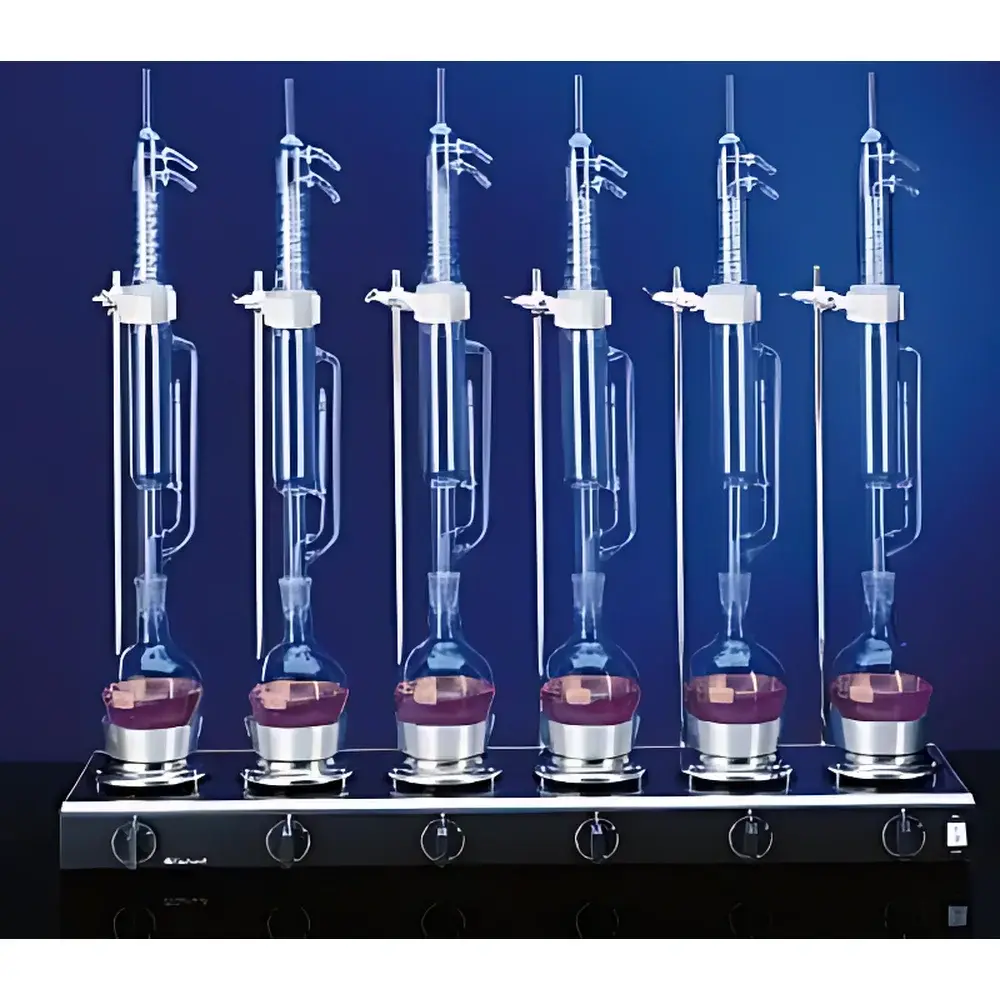
Gerhardt EV6 AII14 / EV6 AII16 Traditional Solvent Extraction Apparatus
| Brand | Gerhardt |
|---|---|
| Origin | Germany |
| Model | EV6 AII14 / EV6 AII16 |
| Max. Heating Temperature | 425 °C |
| Heating Block Positions | 4 / 6 |
| Flask Capacity | 250–500 mL |
| Voltage | 230 V AC |
| Frequency | 50–60 Hz |
| Power Consumption | 1800 W / 2700 W |
| Dimensions (W×D×H) | 600×225×650 mm / 900×225×650 mm |
| Weight | 10 kg / 14 kg |
| Compliance | ASTM D2230, ISO 6496, AOAC 920.39, USP <467> |
Overview
The Gerhardt EV6 AII14 and EV6 AII16 Traditional Solvent Extraction Apparatus are benchtop heating systems engineered for classical liquid–solid extraction protocols—including Soxhlet, Twisselmann, and hot continuous extraction—under controlled thermal conditions. Unlike automated systems such as the Soxtherm series, the EV6 platform implements a fundamental, manually supervised architecture rooted in standardized gravimetric fat analysis methodology. Its design reflects over six decades of Gerhardt’s engineering heritage in analytical food and feed testing, where reproducibility, thermal stability, and compliance with legacy reference methods remain critical. The apparatus operates on the principle of cyclic solvent reflux: solid samples contained in thimbles are repeatedly washed by condensed, boiling solvent vapor, enabling selective dissolution and accumulation of lipids or other soluble analytes in the receiving flask. This open-system configuration ensures full transparency of process stages—ideal for method validation, teaching laboratories, and regulatory audits requiring traceable procedural fidelity.
Key Features
- Robust stainless-steel heating block with precise PID temperature control up to 425 °C—optimized for high-boiling solvents including petroleum ether (bp ~40–60 °C), diethyl ether (bp 34.6 °C), and chloroform (bp 61.2 °C).
- Dual configurations: EV6 AII14 supports four parallel extraction positions; EV6 AII16 accommodates six—enabling scalable throughput without compromising thermal uniformity across wells.
- Individual digital temperature displays per position—allowing real-time monitoring and inter-position comparison during multi-sample runs.
- Integrated safety circuitry including overtemperature cut-off, dry-run protection, and automatic power disconnection upon lid opening—meeting IEC 61010-1 requirements for laboratory electrical equipment.
- Modular flask support system compatible with standard 250 mL and 500 mL round-bottom flasks (ISO 1773 taper), ensuring interchangeability with existing labware inventories.
- Low-profile footprint and vertical orientation minimize benchspace usage while maintaining ergonomic access to condensers and thimble holders.
Sample Compatibility & Compliance
The EV6 series is validated for use with solid or semi-solid matrices including animal feed, cereals, dairy products, meat, and botanical materials. It complies with internationally recognized fat determination standards: ASTM D2230 (rubber—acetone extraction), ISO 6496 (animal feeding stuffs—ether extraction), AOAC Official Method 920.39 (crude fat in foods), and USP (residual solvents in pharmaceutical excipients). Its manual operation mode satisfies GLP documentation requirements where step-by-step operator intervention must be recorded. No embedded software or electronic data capture is present—ensuring full alignment with paper-based audit trails and 21 CFR Part 11 exemption for non-computerized systems.
Software & Data Management
The EV6 AII14/AII16 operates without integrated firmware or proprietary software. All operational parameters—including setpoint temperature, runtime, and flask identity—are recorded manually in laboratory notebooks or LIMS-compatible spreadsheets. This analog architecture eliminates cybersecurity risks, software validation burdens, and vendor lock-in—making it suitable for regulated environments where instrument qualification focuses solely on thermal performance verification (e.g., calibration against NIST-traceable thermocouples) and mechanical integrity checks. Optional accessories include calibrated PT100 probes and certified temperature mapping reports for IQ/OQ protocols.
Applications
- Crude fat quantification in animal nutrition studies per AOAC and ISO protocols.
- Residual oil content analysis in seed processing and biodiesel feedstock evaluation.
- Extraction of waxes, resins, and sterols from plant tissues for phytochemical profiling.
- Educational demonstration of partition coefficient principles and solute–solvent thermodynamics.
- Reference-method benchmarking for validation of accelerated techniques (e.g., ASE, microwave-assisted extraction).
- Pharmaceutical excipient purity screening where solvent residue limits are defined per USP .
FAQ
Is the EV6 compatible with halogenated solvents such as chloroform or dichloromethane?
Yes—the heating block and condenser assembly are constructed from chemically resistant materials (stainless steel 316 and borosilicate glass), supporting safe use of halogenated and aromatic solvents within their respective boiling point ranges.
Can I retrofit an EV6 unit with digital data logging?
No—this model lacks sensor output interfaces or USB/Ethernet ports. For automated data acquisition, Gerhardt recommends the Soxtherm series, which includes RS232/USB connectivity and compliant audit-trail software.
What maintenance is required for long-term thermal accuracy?
Annual verification of temperature uniformity across all wells using a calibrated handheld thermometer or PT100 probe is recommended. Cleaning of condenser jackets and flask seals with ethanol prevents solvent residue buildup that may affect heat transfer efficiency.
Does Gerhardt provide installation qualification (IQ) documentation?
Yes—factory-issued IQ templates, including dimensional verification, electrical safety test records, and temperature uniformity maps, are available upon request for GMP-regulated users.



