
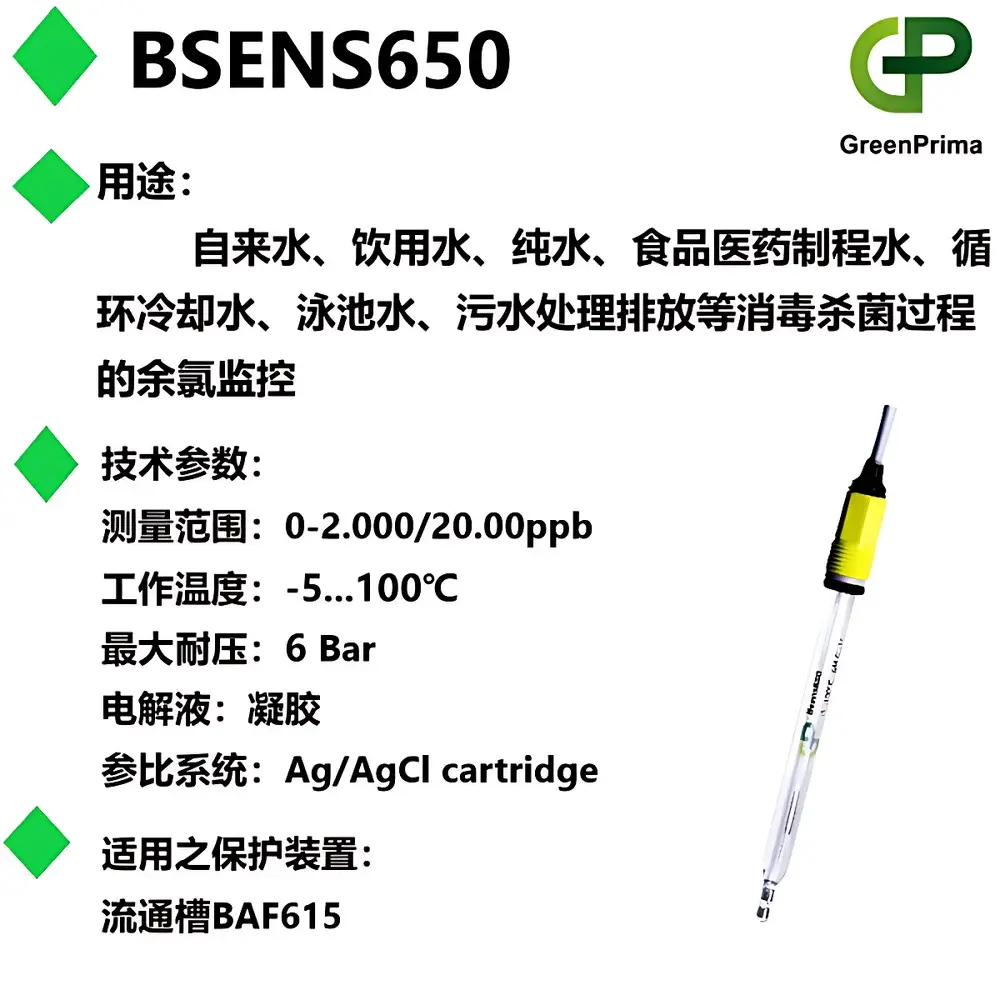
GreenPrima Bsens650 Residual Chlorine Electrode
| Brand | GreenPrima |
|---|---|
| Origin | Switzerland |
| Manufacturer Type | Original Equipment Manufacturer (OEM) |
| Product Category | Imported Instrument |
| Model | Bsens650 |
| Instrument Type | Online Analyzer |
| Measurement Principle | Amperometric Electrochemical Sensor (Constant Voltage Method) |
| Measured Parameters | Free Chlorine, Ozone, Chlorine Dioxide |
| Range | 0–2.000 mg/L and 0–20.00 mg/L |
| Accuracy | ≤1% of reading |
| Repeatability | ±0.01 mg/L (low range), ±0.1 mg/L (high range) |
| Resolution | 0.01 mg/L / 0.1 mg/L |
| Limit of Detection | 0.01 mg/L |
| Electrode Body Material | Glass |
| Cable Length | 3 m |
| pH Compensation | Integrated |
| Output Signal | 4–20 mA analog |
| Compliance | Designed for continuous operation in potable water, swimming pool, and disinfection process monitoring per ISO 9001-manufactured quality system |
Overview
The GreenPrima Bsens650 is a high-stability amperometric residual chlorine electrode engineered for continuous, real-time monitoring of free chlorine concentration in aqueous systems. Operating on the constant-voltage electrochemical principle, the sensor generates a diffusion-controlled current proportional to the concentration of hypochlorous acid (HOCl) — the dominant active species in chlorinated water at typical pH ranges (6.0–7.6). Unlike colorimetric or photometric methods, the Bsens650 requires no reagents, zero sample pre-treatment, and delivers direct electrochemical response with minimal drift. Its glass-bodied construction ensures chemical inertness against oxidants, chloramines, and common pipe-scale inhibitors encountered in municipal distribution networks, recirculating cooling systems, and swimming pool circuits. The electrode is specifically calibrated and validated for use with the GreenPrima PM8200CL controller, enabling seamless integration into existing SCADA or PLC architectures via standard 4–20 mA output.
Key Features
- Triple-parameter capability: Simultaneous measurement of free chlorine, ozone (O₃), and chlorine dioxide (ClO₂) using a single electrode platform with configurable calibration protocols.
- pH-compensated measurement architecture: Onboard temperature and pH inputs enable automatic activity correction, ensuring accuracy across variable water matrices without manual adjustment.
- Zero-reagent operation: Eliminates consumables, hazardous chemical handling, and associated maintenance downtime typical of DPD-based analyzers.
- Stable zero-point performance: Engineered membrane and cathode geometry minimize baseline drift over extended deployment cycles (>6 months typical between recalibrations).
- Robust physical design: Chemically resistant glass body, 3-meter shielded coaxial cable with IP68-rated connector, and optional protective flow cell or guard sleeve for abrasive or particulate-laden streams.
- Low-maintenance footprint: No moving parts, no optical components, and no internal fluid reservoirs — optimized for unattended operation in remote or hazardous locations.
Sample Compatibility & Compliance
The Bsens650 is validated for use in potable water, secondary disinfection loops, swimming pool recirculation lines, hospital sterilization effluents, and membrane bioreactor (MBR) discharge streams. It meets functional requirements outlined in ISO 7888 (water quality — determination of free and total chlorine), ASTM D1253 (standard test method for residual chlorine in water), and supports GLP/GMP data integrity when paired with PM8200CL’s audit-trail-enabled firmware (21 CFR Part 11 compliant logging available via optional software module). Electrode response remains stable across conductivity ranges of 50–2000 µS/cm and temperatures from 0 °C to 45 °C. Not recommended for wastewater influent with suspended solids >50 mg/L unless used with an integrated backflushing flow cell.
Software & Data Management
When connected to the GreenPrima PM8200CL controller, the Bsens650 enables full digital diagnostics including sensor health status, polarization voltage stability, membrane integrity alerts, and automatic temperature-compensated calibration validation. All measurements are timestamped and stored locally with ≥30 days of rolling memory. Data export is supported via Modbus RTU (RS-485) and ASCII serial protocol. Optional cloud gateway modules allow secure MQTT transmission to enterprise historian platforms (e.g., OSIsoft PI, Ignition) with TLS 1.2 encryption and configurable alarm thresholds. Calibration logs include operator ID, reference standard traceability, and deviation metrics — fulfilling documentation requirements for regulatory audits.
Applications
- Municipal drinking water distribution: Real-time monitoring at booster station outlets and network endpoints to verify residual disinfectant compliance per WHO and EPA guidelines.
- Swimming pool and spa management: Closed-loop control of chlorine dosing systems to maintain 0.4–2.0 mg/L free chlorine while minimizing THM formation.
- Food & beverage processing: Sanitizing rinse water verification in CIP systems and post-pasteurization cooling towers.
- Hospital central sterile supply departments (CSSD): Monitoring chlorine concentration in instrument washer-disinfectors to ensure EN ISO 15883 compliance.
- Pharmaceutical water-for-injection (WFI) loop surveillance: Low-range detection (0.01–2.000 mg/L) for chlorine breakthrough in pretreatment stages.
FAQ
Does the Bsens650 require daily calibration?
No — under stable operating conditions, field calibration is recommended every 7–14 days using NIST-traceable chlorine standards; zero-point verification can be performed more frequently with deionized water.
Can it measure combined chlorine (chloramines)?
No — the Bsens650 is optimized for free chlorine (HOCl/OCl⁻); combined chlorine requires separate amperometric or iodometric methods.
Is the electrode compatible with seawater or brackish water?
Not without additional conditioning: high chloride concentrations (>5000 mg/L) accelerate silver/silver chloride reference electrode depletion; optional Ag/AgCl reference replacement kits are available.
What flow rate is required for optimal response time?
Minimum linear velocity of 0.3 m/s is recommended in flow cells; response time (t₉₀) is typically <60 seconds at 25 °C.
How often should the electrolyte gel be replaced?
The factory-sealed gel electrolyte is rated for ≥18 months under continuous operation; replacement is only necessary if membrane damage or signal instability is observed.
Related Products







