
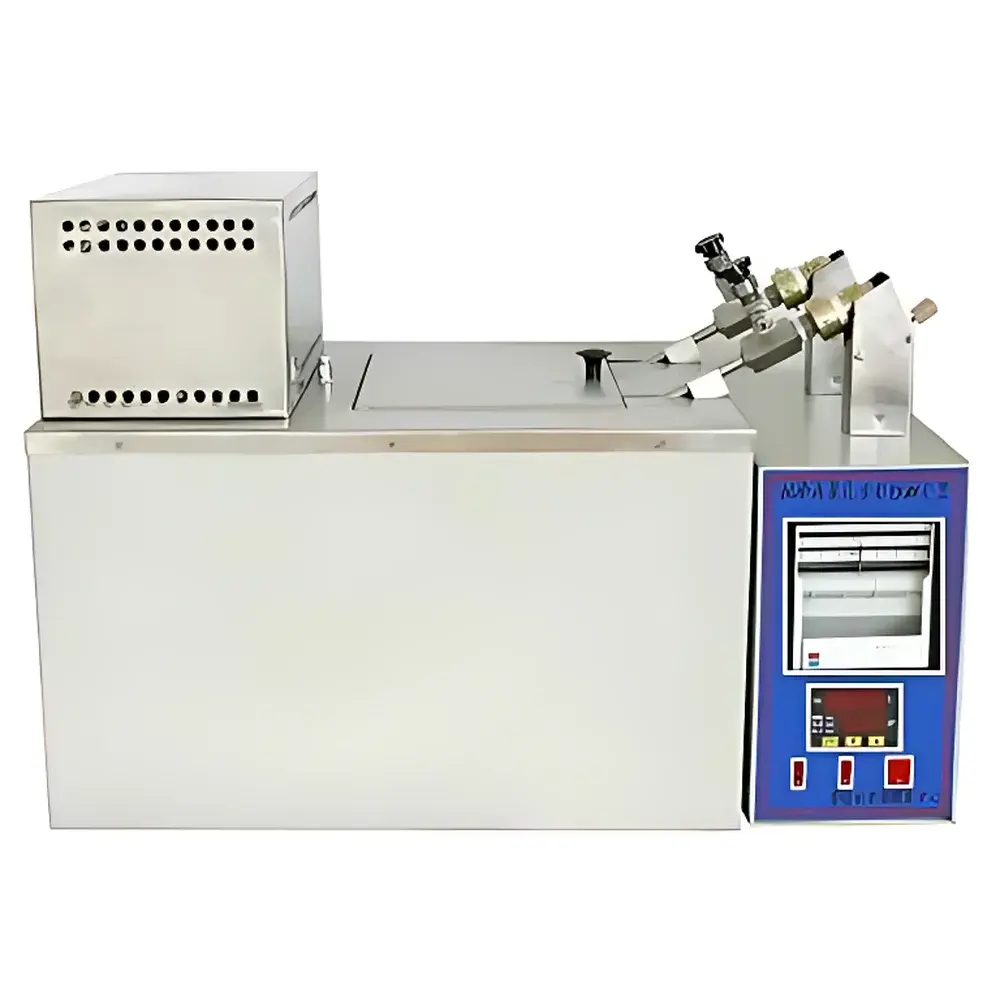
PULUODY PLD-0193A Petroleum Product Oxidation Stability Tester
| Brand | PULUODY |
|---|---|
| Origin | Shaanxi, China |
| Manufacturer Type | Direct Manufacturer |
| Country of Origin | China |
| Model | PLD-0193A |
| Power Supply | AC 220 V ±10%, 50 Hz |
| Main Heating Power | 1500 W |
| Auxiliary Heating Power | 1200 W |
| Pressure Gauge Range | 0–1500 kPa |
| Pressure Gauge Accuracy | ±0.2% FS |
| Oil Bath Temperature Range | 100–160 °C |
| Oil Bath Temperature Stability | ±0.1 °C |
| Printer Model | TpuP-A40PB |
Overview
The PULUODY PLD-0193A Petroleum Product Oxidation Stability Tester is a precision-engineered benchtop instrument designed for quantitative assessment of oxidation resistance in lubricating oils and insulating fluids under accelerated, pressurized oxygen environments. It operates on the principle of the rotating pressure vessel oxidation test (RPVOT), a standardized accelerated aging methodology that subjects oil samples to elevated temperature, high-purity oxygen pressure, and mechanical agitation to simulate long-term oxidative degradation. The system conforms strictly to SH/T 0193 (Chinese National Standard) and ASTM D2272 (Standard Test Method for Oxidation Stability of Steam Turbine Oils by Rotating Pressure Vessel), ensuring regulatory alignment for quality control laboratories in refineries, power generation facilities, and OEM lubricant formulation centers.
Key Features
- Microcontroller-based embedded control architecture with real-time monitoring of temperature, pressure, rotation speed, and elapsed time
- Dual-zone thermal management: primary oil bath heater (1500 W) and auxiliary pre-heating circuit (1200 W) for rapid thermal equilibration and minimized temperature overshoot
- High-stability oil bath with ±0.1 °C temperature regulation across 100–160 °C operating range, verified via calibrated PT100 sensor and PID feedback loop
- Rotating oxygen bomb assembly mounted at precise 30° inclination relative to horizontal plane, driven by low-vibration DC motor at nominal 100 rpm (±1 rpm repeatability)
- Digital pressure monitoring system featuring 0–1500 kPa full-scale transducer with ±0.2% full-scale accuracy and automatic data logging at user-defined intervals
- Integrated thermal-safe design: overtemperature cutoff, pressure relief valve (set at 1550 kPa), and interlocked lid detection to prevent operation during unsafe conditions
- Onboard dot-matrix LCD display with backlight and tactile keypad for standalone operation; optional RS232/USB interface for external data acquisition
Sample Compatibility & Compliance
The PLD-0193A supports testing of new and in-service turbine oils, hydraulic fluids, transformer insulating oils, and other mineral- or synthetic-based lubricants with defined base stock–additive formulations. Sample preparation follows ASTM D2272 protocol: 50 mL oil specimen, 2.5 mL distilled water, and standardized copper catalyst coil are sealed inside a borosilicate glass sample vessel, which is then loaded into the stainless-steel oxygen bomb. The bomb is charged with ≥99.5% purity oxygen to 620 kPa at ambient temperature prior to immersion in the thermostatically controlled oil bath. Test termination occurs upon detection of a specified pressure drop (typically 25.4 kPa or 3.7 psi from initial reading), with results reported as oxidation induction time (OIT) in minutes. All operational parameters satisfy requirements for GLP-compliant data generation and are traceable to national metrology standards.
Software & Data Management
While the PLD-0193A operates autonomously via its embedded controller, it supports ASCII-formatted serial output compatible with laboratory information management systems (LIMS) and custom data logging software. Time-stamped pressure decay curves, temperature profiles, and final OIT values can be exported for statistical process control (SPC) analysis. Optional firmware upgrade enables audit trail functionality compliant with FDA 21 CFR Part 11 requirements—including user authentication, electronic signatures, and immutable event logs—when integrated with validated PC-based acquisition platforms. Calibration records, maintenance logs, and method parameters may be archived in accordance with ISO/IEC 17025 documentation protocols.
Applications
- Quality assurance of virgin turbine oils prior to commissioning in steam or gas turbine systems
- Condition monitoring of in-service lubricants in power plant turbine reservoirs and hydroelectric units
- Formulation development and additive package screening for oxidation inhibitors (e.g., hindered phenols, aromatic amines)
- Comparative stability evaluation between synthetic esters, polyalphaolefins (PAO), and conventional mineral oils
- Regulatory submission support for API, DIN, or IEC specification compliance (e.g., IEC 60296, DIN 51515)
- Root cause analysis of premature varnish formation, sludge deposition, or acid number increase in circulating systems
FAQ
What standards does the PLD-0193A fully comply with?
It is engineered and verified to meet all procedural, dimensional, and performance requirements of SH/T 0193 and ASTM D2272, including oxygen purity, pressure calibration, rotation geometry, and temperature uniformity specifications.
Can the instrument test both new and used oils?
Yes — the method is explicitly validated for comparative assessment of oxidation stability across service life stages, provided samples are filtered to ≤5 µm and free of entrained air or volatile contaminants.
Is operator training required for routine use?
Basic operation requires minimal training; however, interpretation of OIT trends, correlation to remaining useful life (RUL), and troubleshooting of anomalous pressure decay profiles benefit from foundational knowledge in tribology and lubricant chemistry.
How is temperature uniformity verified within the oil bath?
Uniformity is confirmed using three independent, NIST-traceable PT100 probes positioned at center, front-left, and rear-right locations during IQ/OQ validation, with maximum deviation limited to ±0.15 °C across the working volume.
Does the system support multi-sample throughput?
The PLD-0193A is a single-bomb configuration. For higher throughput, parallel operation of multiple units is recommended, synchronized via external timer or LIMS scheduler to maintain inter-unit comparability.




