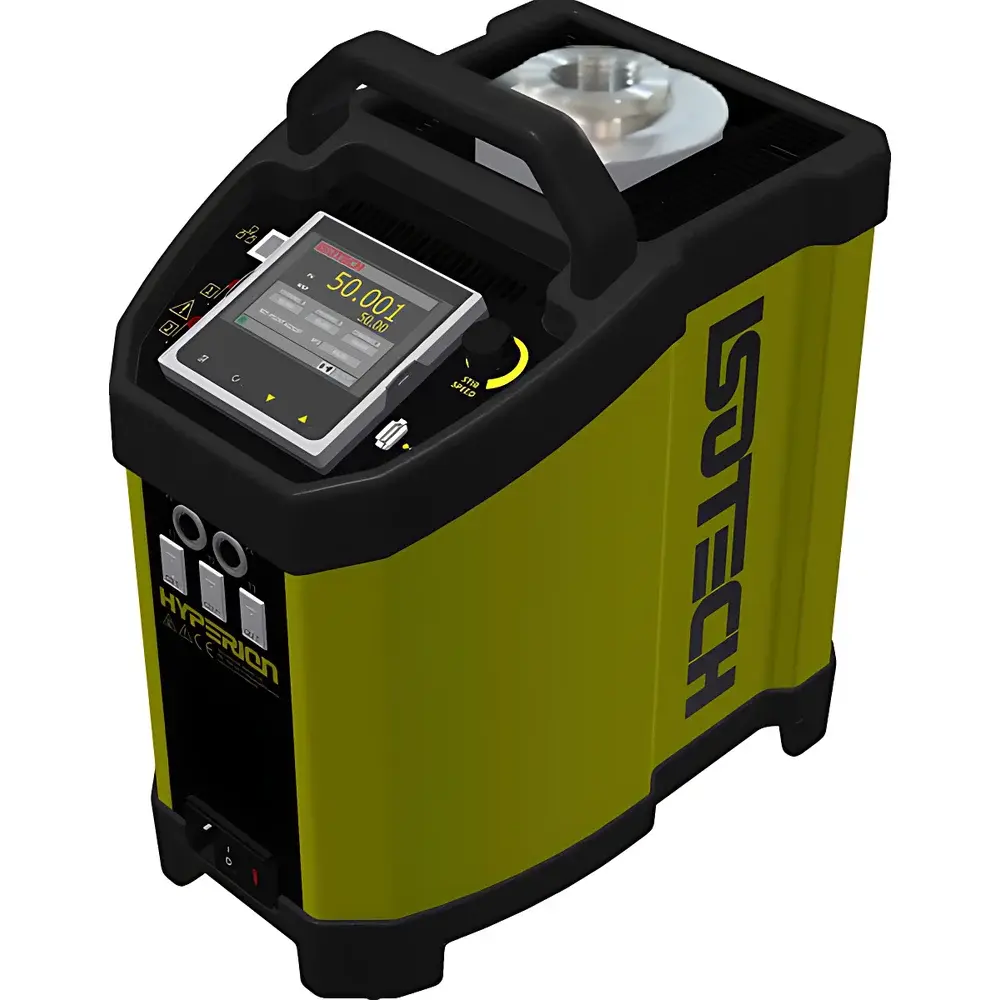
ISOTECH Portable Transformer Oil Thermometer Calibrator
| Brand | ISOTECH |
|---|---|
| Origin | United Kingdom |
| Instrument Category | Temperature Verification and Calibration System |
| Temperature Range | –30 °C to +150 °C |
| Minimum Achievable Temperature | –45 °C |
| Temperature Uniformity | ±0.005 °C |
| Oil Bath Dimensions | Ø65 mm × 160 mm depth |
| Calibration Sleeve Thread Options | M27×1 or G1 |
| Enclosure Material | Stainless Steel |
| External Dimensions | 302 mm (H) × 176 mm (W) × 262 mm (D) |
| Weight | Lightweight, Field-Portable |
Overview
The ISOTECH Portable Transformer Oil Thermometer Calibrator is a purpose-engineered metrological system designed for on-site verification and calibration of oil-immersed transformer temperature indicators—primarily dial-type thermometers, resistance temperature detectors (RTDs), and thermocouple-based sensors installed in power transformers. It operates on the principle of liquid-bath thermal equilibrium, utilizing a precisely controlled oil medium within a high-uniformity stainless-steel bath to establish stable, traceable temperature setpoints across the operational range of –30 °C to +150 °C. Engineered to meet the stringent requirements of Q/GDW 440–2010 (“Field Calibration Specification for Temperature Measuring Devices of Oil-Immersed Transformers”), this calibrator supports compliance-driven workflows in transmission & distribution utilities, substation maintenance teams, and power generation facilities. Its compact footprint, integrated semiconductor thermoelectric modules (Peltier), and robust mechanical architecture enable rapid thermal ramping and exceptional short-term stability—critical for field-deployed calibration where environmental variability and time constraints are inherent.
Key Features
- High-stability oil bath with ±0.005 °C temperature uniformity over the full immersion zone—verified per ISO/IEC 17025-compliant internal validation protocols;
- Dual-mode thermoelectric (Peltier) cooling/heating system enabling rapid thermal transitions: typical ramp rates exceed 1.5 °C/min from –30 °C to +150 °C without external chillers or dry-well accessories;
- Stainless-steel enclosure (IP54-rated) providing mechanical durability, corrosion resistance, and EMI shielding suitable for outdoor substations and switchyard environments;
- Standardized calibration sleeve with interchangeable thread options (M27×1 metric or G1 BSP) matching OEM transformer port specifications per Q/GDW 440–2010 Annex B;
- Compact form factor (302 × 176 × 262 mm) and low mass (<8.5 kg) optimized for single-operator transport and benchtop deployment in mobile calibration vans or control rooms;
- Oil bath geometry (Ø65 mm × 160 mm depth) engineered to accommodate standard probe lengths while ensuring full immersion of sensing elements up to 150 mm—aligned with IEC 60076-2 and IEEE C57.12.00 immersion depth recommendations.
Sample Compatibility & Compliance
This calibrator is validated for use with all common transformer oil temperature sensing technologies, including bi-metallic dial thermometers (Class 1.0 and 1.5 per EN 13190), Pt100 and Pt1000 RTDs (IEC 60751 Class A/B), and Type K and Type T thermocouples (IEC 60584). The oil bath fluid—typically silicone-based transformer-grade oil (viscosity ≤ 100 cSt at 20 °C)—is compatible with both mineral and synthetic insulating oils used in HV equipment. All thermal performance claims are traceable to UKAS-accredited reference standards (NPL-traceable SPRTs and digital thermometers) and documented in the instrument’s factory calibration certificate. The system satisfies functional requirements outlined in Q/GDW 440–2010, as well as broader quality framework expectations for GLP and ISO/IEC 17025 accredited laboratories performing field calibration under Clause 5.4.2 (Equipment Suitability).
Software & Data Management
The calibrator operates in standalone mode with front-panel digital interface; no proprietary software is required for basic operation. However, optional RS-232/USB connectivity enables integration with metrology data management platforms such as MET/CAL, Fluke Calibration Software, or custom SCADA-linked logging systems. When connected, it supports automated data capture—including timestamped temperature setpoint, bath sensor reading, and user-entered DUT ID—formatted to ASTM E29–22 rounding conventions and compliant with FDA 21 CFR Part 11 audit trail requirements when deployed in regulated utility QA/QC environments. Calibration records generated during field use may be exported in CSV or XML format for inclusion in asset lifecycle documentation per ISO 55001 maintenance management systems.
Applications
- On-site periodic calibration of oil temperature gauges prior to scheduled transformer maintenance outages;
- As-found/as-left verification during commissioning of new or retrofitted transformer monitoring systems;
- Root cause analysis of thermal measurement discrepancies reported by SCADA or condition monitoring systems;
- Supporting ISO 55001-aligned asset integrity programs through documented traceability of temperature measurement uncertainty (k = 2) down to ±0.02 °C at 70 °C;
- Training and competency assessment for field technicians under national grid competency frameworks (e.g., UK National Grid Technical Competence Standards, China State Grid SKILLS Programme).
FAQ
Is this calibrator certified to any international metrological standards?
Yes—the unit is supplied with a UKAS-accredited calibration certificate (traceable to NPL) covering the full temperature range, and its design conforms to the technical requirements of ISO/IEC 17025:2017 Clause 6.4 (Equipment) and ISO 17034 for reference material producers.
Can it be used with non-silicone heat transfer fluids?
Only transformer-grade silicone oils meeting IEC 60296 Type H or equivalent viscosity/flash point specifications are recommended; hydrocarbon-based oils are prohibited due to thermal instability above 120 °C and oxidation risk.
Does it support automated calibration sequences per Q/GDW 440–2010 test points?
Yes—predefined temperature points (–20 °C, 0 °C, 50 °C, 70 °C, 90 °C, 110 °C) can be programmed via the front panel or external controller to execute unattended multi-point verification in accordance with Section 6.3.2 of the specification.
What is the recommended recalibration interval?
Annual recalibration is advised under routine field use; however, utilities operating under ISO 55001 or GB/T 19001 may adjust intervals based on usage logs, stability trending, and risk assessment per ISO 10012 Clause 7.2.