
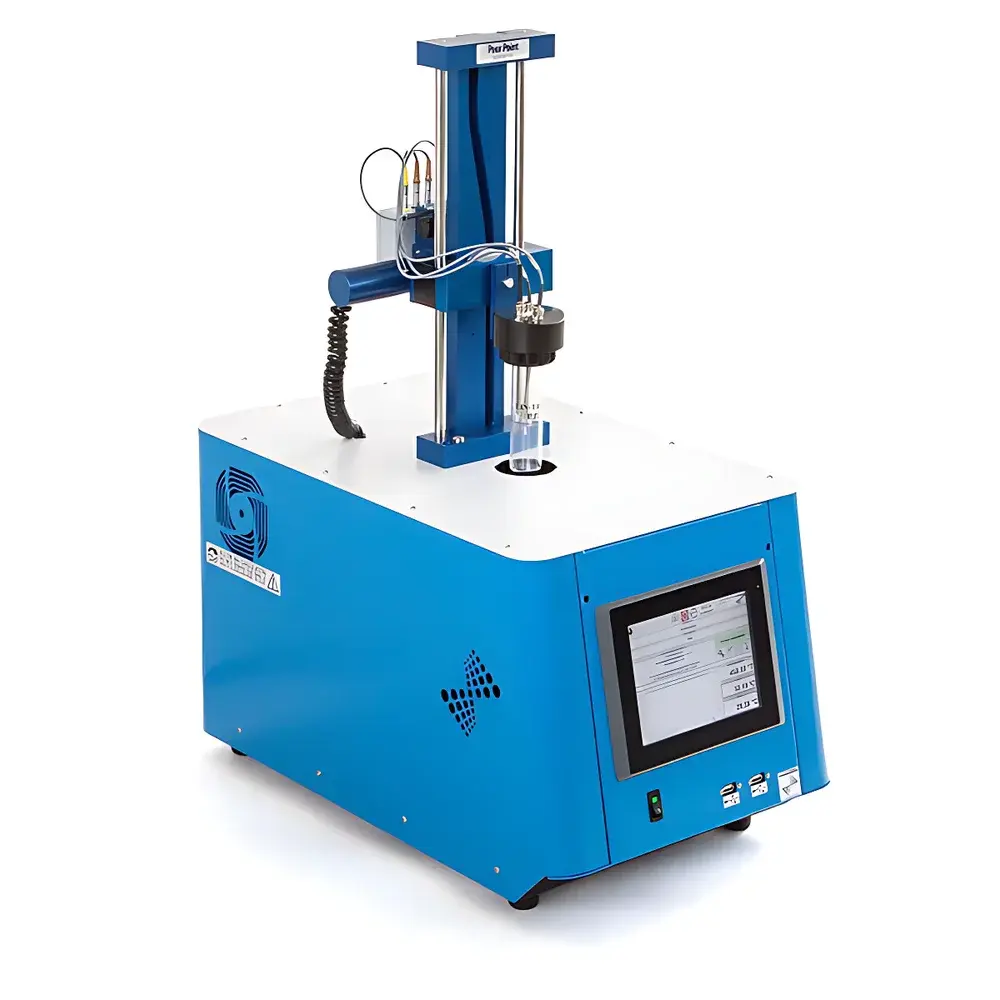
Ducom DPP Automatic Pour Point Tester
| Brand | Ducom |
|---|---|
| Model | DPP |
| Type | Automatic Pour Point Tester |
| Origin | USA |
| Cooling Capacity | Single-stage to –40°C, Dual-stage to –80°C |
| Temperature Range | –80°C to +80°C |
| Resolution | 0.06°C |
| Accuracy | ±0.1°C |
| Repeatability | Compliant with ASTM D5950, ISO 3016, and IP 441 |
| Temperature Sensor | Class A PT100 |
| Display | 12″ TFT/LCD Touchscreen PC |
| Power Supply | 220 V ±15% / 50–60 Hz or 115 V ±15% / 60 Hz |
| Dimensions (W×D×H) | 66 × 60 × 80 cm |
| Weight | 60 kg (max. 6 test heads) |
| Standards Compliance | ASTM D97, D5853, D5950 |
Overview
The Ducom DPP Automatic Pour Point Tester is an engineered solution for precise, standardized determination of the pour point of petroleum-based fluids—including crude oil, lubricating oils, fuel oils, additives, and synthetic base stocks. Based on the principle of sequential cooling and automated mechanical tilt detection, the DPP implements the fundamental thermodynamic criterion defined in ASTM D5950 and ISO 3016: the lowest temperature at which a sample remains mobile under specified conditions after controlled cooling and periodic manual or automated inclination. Unlike manual methods requiring operator intervention at fixed intervals, the DPP integrates a programmable robotic arm that precisely lifts and tilts each test vial at user-defined time/temperature intervals—eliminating subjective judgment and ensuring strict adherence to protocol timing, angle, and dwell duration. Its dual-stage refrigeration system enables reliable operation down to –80°C, making it suitable for arctic-grade fuels and high-wax-content crudes where conventional single-stage units fail to reach required sub-zero endpoints.
Key Features
- Automated mechanical tilt mechanism with programmable lift height, tilt angle (±15°), and hold duration—fully compliant with ASTM D5950’s dynamic inclination requirements
- Dual-configurable test head architecture: selectable single-head or dual-head configurations support parallel analysis without cross-contamination or thermal interference
- High-stability Class A PT100 sensor array with 0.06°C resolution and ±0.1°C accuracy across the full –80°C to +80°C range
- Environmentally compliant refrigeration: fluorocarbon-free, brushless DC compressor with dual-stage cascade design for stable sub-ambient control
- Integrated 12-inch industrial touchscreen PC running embedded Windows OS—no external computer required
- Real-time temperature profiling with automatic event logging: cooling rate, tilt events, flow detection timestamps, and pass/fail status per vial
- Comprehensive hardware safety: pressure-controlled compressor circuit, individual thermal cut-offs per cooling jacket, and motor overload protection
Sample Compatibility & Compliance
The DPP accommodates standard ASTM D97/D5950 sample vials (45 mL nominal volume) and supports viscous, waxy, and paraffinic formulations without modification. It is validated for use with crude oils per ASTM D5853 and IP 441, distillate fuels per IP 15, and finished lubricants per ISO 3016. All firmware and software modules are designed to enforce method-specific ramp rates (e.g., 3°C/h below –24°C per ASTM D5950), dwell times (3 s minimum tilt hold), and observation windows. The system maintains full traceability for GLP/GMP environments: audit trails record user ID, method version, calibration date, and all parameter changes—meeting FDA 21 CFR Part 11 requirements when paired with optional electronic signature modules.
Software & Data Management
The DPP’s native software provides method-driven workflow control, allowing users to define custom cooling profiles, tilt sequences, and pass/fail criteria aligned with internal SOPs or regulatory mandates. Each test generates a timestamped .CSV file compatible with Microsoft Excel, LIMS import protocols, and statistical process control platforms. Raw temperature/time data, tilt event logs, and visual confirmation flags (e.g., “no flow observed at –42.3°C”) are stored locally with configurable retention policies. Remote monitoring via Ethernet is supported; secure HTTP/S access enables real-time status checks and historical report retrieval without compromising network integrity.
Applications
- Refinery QC labs verifying cold-flow performance of pipeline-ready crudes prior to winter transport
- Lubricant formulation R&D assessing wax crystallization inhibition efficacy of pour point depressants (PPDs)
- Independent testing laboratories performing third-party certification to API RP 1172 or ISO 8503-2 specifications
- Aviation fuel quality assurance per ASTM D1655 Annex A3 (Jet A/A-1 low-temperature operability)
- Marine bunker fuel compliance testing against ISO 8217 Table 2 (RMG/RME viscosity and pour point limits)
FAQ
What standards does the DPP fully automate?
ASTM D5950 (automatic tilt method), ASTM D5853 (crude oil), ISO 3016, and IP 441—all executed with hardware-enforced timing, tilt mechanics, and temperature control.
Can the DPP operate unattended overnight?
Yes. With pre-loaded methods and auto-shutdown on completion, the DPP supports unattended multi-sample runs—including extended low-temperature tests down to –80°C.
Is calibration traceable to NIST standards?
All PT100 sensors ship with individual calibration certificates traceable to NIST via A2LA-accredited laboratories; field recalibration tools and procedures are included.
How is data integrity ensured for regulated environments?
Audit trail logging, role-based user access, electronic signature support, and immutable .CSV export meet 21 CFR Part 11 and EU Annex 11 requirements when configured per validation protocol.
What maintenance is required for the dual-stage refrigeration system?
No routine refrigerant servicing is needed; the sealed brushless compressor design requires only annual inspection of condenser airflow and thermal cutoff functionality.





