
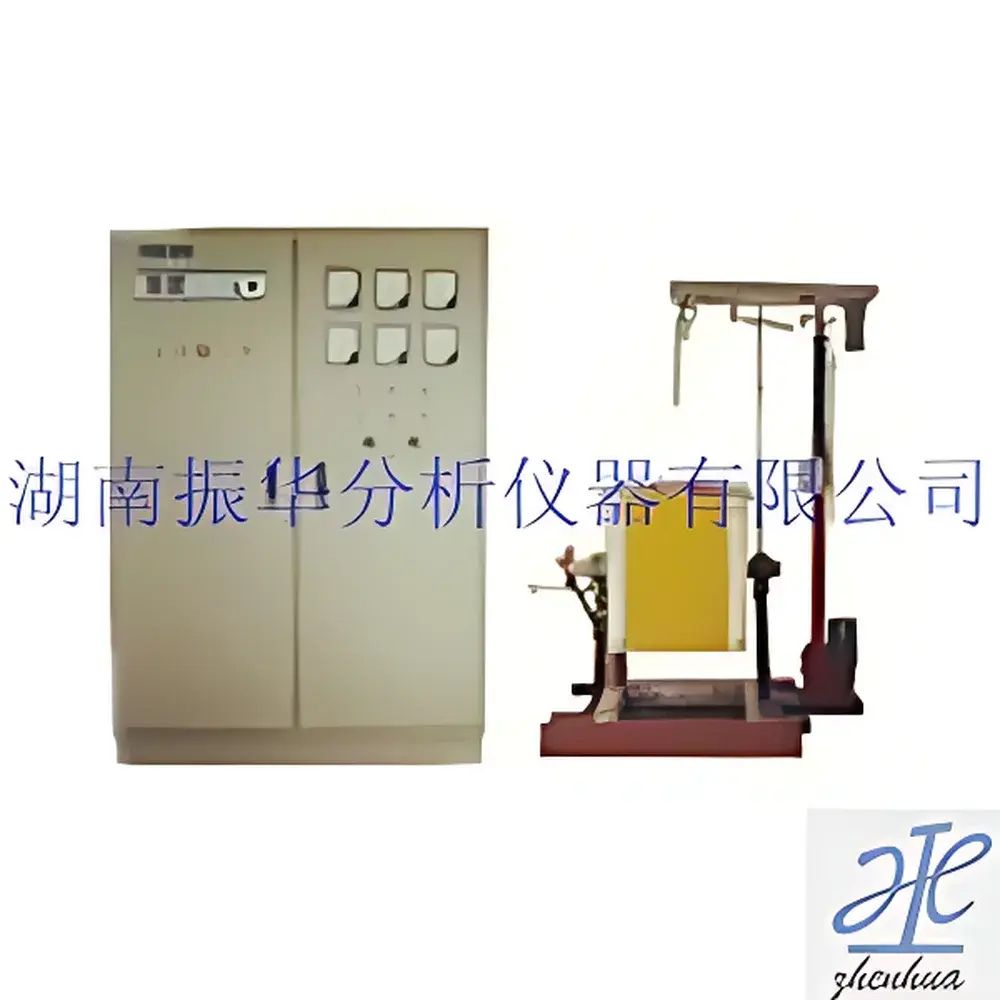
GYH-A High-Temperature Antioxidation Testing Furnace
| Origin | Hunan, China |
|---|---|
| Manufacturer Type | Authorized Distributor |
| Origin Category | Domestic (China) |
| Model | GYH-A |
| Quotation | Available Upon Request |
| Operating Temperature Range | Up to 800 °C (short-term max 1000 °C) |
| Heating Rate | 0–30 °C/min |
| Temperature Uniformity & Stability | ±2 °C at setpoint |
| Rated Power | 10 kW |
| Electrical Supply | 380 V, 50 Hz, 50 A |
Overview
The GYH-A High-Temperature Antioxidation Testing Furnace is a precision-engineered thermal testing system designed for standardized evaluation of oxidation resistance in carbon-containing refractory materials—including magnesia-carbon (MgO-C) bricks and alumina-carbon (Al2O3-C) bricks—under controlled atmospheric and thermal conditions. It operates on the principle of accelerated oxidative degradation under isothermal or programmed heating profiles, enabling quantitative assessment of mass loss, surface degradation kinetics, and structural integrity retention over time. The furnace fully complies with the geometric, thermal, and procedural specifications defined in GB/T 13244–2019 “Test Method for Oxidation Resistance of Carbon-Containing Refractories” and supports parallel compliance with YB/T 4117–2002 “Test Method for Spalling Resistance of Dense Refractory Castables” for thermal shock-induced爆裂 (spalling) evaluation below 1000 °C. Its robust double-layer insulation chamber, PID-controlled heating zone, and integrated thermocouple feedback loop ensure high reproducibility across sequential test cycles.
Key Features
- Programmable temperature control system with ramp-hold-soak capability, supporting heating rates from 0 to 30 °C/min and stable isothermal operation at up to 800 °C (with short-term excursions to 1000 °C for ≤30 min per cycle)
- Dual-zone thermal monitoring: independent measurement of furnace chamber core temperature and specimen surface temperature via calibrated Type S thermocouples
- Automated data logging interface compatible with RS-485/Modbus RTU protocol, enabling real-time acquisition of temperature, time, and optional mass change (when integrated with external microbalance)
- Refractory-lined hot zone constructed from high-purity alumina fiber modules (≥1700 °C service rating), minimizing thermal lag and ensuring uniform axial/radial temperature distribution (±2 °C tolerance at 800 °C)
- Industrial-grade PLC-based controller with password-protected parameter configuration, event logging, and alarm-triggered shutdown (overtemperature, power failure, door interlock breach)
- Front-loading design with water-cooled stainless-steel door seal and inert gas purge port (N2 or Ar) to maintain low-oxygen (<50 ppm O2) test environments during antioxidant evaluation
Sample Compatibility & Compliance
The GYH-A accommodates standard refractory test specimens per GB/T 13244: rectangular prisms (25 mm × 25 mm × 100 mm) or cylindrical cores (Φ25 mm × 50 mm), with optional custom fixtures for irregular geometries. Its chamber dimensions (W × D × H: 300 × 300 × 450 mm) allow simultaneous testing of up to six specimens under identical thermal history. All operational protocols align with national standards for quality assurance in refractory manufacturing and R&D laboratories. The system supports traceable calibration per JJG 702–2001 (Chinese metrological verification regulation for high-temperature furnaces) and provides documentation packages suitable for internal GLP audits and third-party certification reviews.
Software & Data Management
Data acquisition is managed through embedded firmware with configurable sampling intervals (1–60 s). Exported CSV files include timestamped temperature, setpoint deviation, and user-defined analog inputs (e.g., mass signal from external balance). Optional PC-based software (Windows 10/11 compatible) enables graphical trend analysis, comparative overlay of multiple runs, and automated report generation compliant with ISO/IEC 17025 documentation requirements. Audit trails record operator ID, parameter changes, calibration events, and system faults—meeting foundational expectations for FDA 21 CFR Part 11–aligned environments where electronic records are retained for regulatory review.
Applications
- Quantitative ranking of antioxidant additives (e.g., Al, Si, B4C, SiC) in MgO-C brick formulations
- Correlation of oxidation depth profiles (via post-test SEM/EDS cross-sectioning) with furnace-derived kinetic parameters
- Validation of binder carbonization efficiency in Al2O3-C preforms prior to hot-pressing
- Thermal spalling resistance screening of dense castables under rapid heating (YB/T 4117 protocol), including determination of critical heating rate thresholds
- Interlaboratory round-robin testing for refractory material certification programs administered by SAC/TC 141 (Standardization Technical Committee on Refractories)
FAQ
What standards does the GYH-A furnace explicitly support?
GB/T 13244–2019 (oxidation resistance of carbon-containing refractories) and YB/T 4117–2002 (spalling resistance of dense refractory castables).
Can the furnace operate under inert or reducing atmospheres?
Yes—equipped with a dedicated gas inlet/outlet manifold and pressure-regulated purge capability for N2, Ar, or forming gas (5% H2/95% N2).
Is temperature uniformity verified across the working zone?
Yes—uniformity mapping is performed per JJG 702–2001 using a 9-point thermocouple array; certification report available upon request.
Does the system include calibration documentation?
Factory calibration certificate for main thermocouples and controller is supplied; users may perform periodic verification using reference standards traceable to NIM (National Institute of Metrology, China).
What maintenance intervals are recommended for long-term reliability?
Furnace lining inspection every 200 operating hours; thermocouple recalibration every 6 months or after 50 thermal cycles above 900 °C.



