
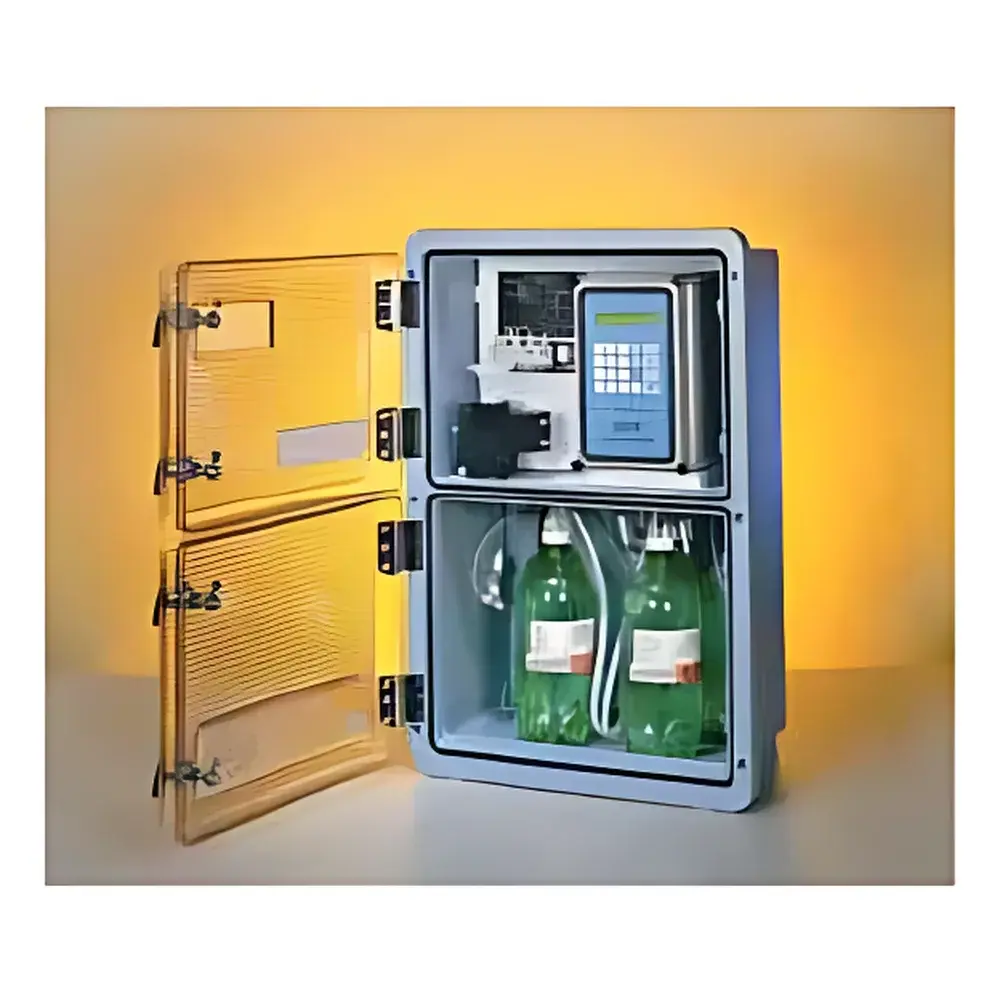
HACH 5000 Series Online Phosphate Analyzer
| Brand | HACH |
|---|---|
| Origin | Imported |
| Manufacturer Type | Manufacturer |
| Model | 5000 Phosphate |
| Measurement Principle | Ascorbic Acid Method (Standard Colorimetric) |
| High-Range Measurement | 0–50.0 mg/L PO₄ |
| Low-Range Measurement | 0–5000 µg/L PO₄ |
| Accuracy (High Range) | ±0.5 mg/L or ±5% of reading (whichever is greater) |
| Accuracy (Low Range) | ±4 µg/L |
| Detection Limit | <0.2 mg/L |
| Resolution (Low Range) | 1 µg/L |
| Reagent Delivery | Patented Pressure-Driven System |
| Calibration Options | Manual, Scheduled Automatic, and Programmable Standard Addition |
| Zero Adjustment | Fully Automated per Cycle |
| Diagnostic Capability | Built-in Self-Diagnostic Alarms |
| Flow Interruption Response | Auto-Shutdown & Recovery Protocol |
| Reagent Consumption | Optimized for Extended Unattended Operation |
Overview
The HACH 5000 Series Online Phosphate Analyzer is a robust, laboratory-grade continuous monitoring system engineered for precise, long-term quantification of orthophosphate (PO₄³⁻) in aqueous matrices. It operates on the internationally standardized ascorbic acid reduction method—compliant with ASTM D515-89 and ISO 6878:2004—where phosphate reacts with ammonium molybdate and potassium antimonyl tartrate under acidic conditions, followed by reduction with ascorbic acid to form a stable blue-colored phosphomolybdenum complex. Absorbance is measured photometrically at 880 nm, enabling trace-level detection without manual sample preparation. Designed for deployment in demanding industrial and municipal environments, the analyzer delivers high reproducibility across two calibrated measurement ranges: low-range (0–5000 µg/L PO₄) for ultra-trace boiler feedwater and condensate applications, and high-range (0–50.0 mg/L PO₄) for activated sludge effluent, tertiary treatment streams, and nutrient removal process control.
Key Features
- Patented pressure-driven reagent delivery system ensures consistent metering, eliminates air entrapment, and extends reagent shelf life by minimizing exposure to ambient atmosphere.
- Automated zero-point adjustment performed at the start of every analysis cycle, compensating for optical drift, cuvette fouling, and baseline variability caused by turbidity or color interference.
- Integrated flow interruption detection triggers immediate shutdown and safe system recovery—preventing erroneous data generation during pump failure or line blockage.
- Triple-mode calibration architecture: user-initiated manual calibration, time-scheduled automatic calibration, and programmable standard addition calibration for matrix-matched verification in variable influent conditions.
- Embedded diagnostic engine continuously monitors critical subsystems—including photometer stability, peristaltic pump performance, valve actuation timing, and reagent depletion status—and logs event-based alerts with timestamped severity codes.
- Optimized reagent consumption profile supports >30 days of unattended operation on standard 500-mL reagent packs, reducing maintenance frequency and operational overhead in remote or hazardous locations.
Sample Compatibility & Compliance
The 5000 Series is validated for use with clarified, filtered, or membrane-preconditioned water samples exhibiting turbidity ≤5 NTU and suspended solids <10 mg/L. It complies with EPA Method 365.1 for phosphate determination and meets functional requirements outlined in ISO/IEC 17025:2017 for automated analytical systems used in accredited environmental testing laboratories. Instrument firmware supports audit-trail logging per FDA 21 CFR Part 11 when integrated with HACH’s SCADA-compliant DataStream™ software, fulfilling GLP/GMP data integrity expectations for regulated utility and pharmaceutical water systems.
Software & Data Management
Data acquisition and configuration are managed via HACH’s web-native DataStream™ interface, accessible through secure HTTPS over standard Ethernet. The system records raw absorbance values, calculated concentrations, calibration history, diagnostic events, and maintenance logs with UTC timestamps. All data exports in CSV or XML format support direct ingestion into LIMS, SCADA, or cloud-based asset management platforms. Optional Modbus TCP and 4–20 mA analog output enable seamless integration with plant-wide DCS architectures without protocol translation hardware.
Applications
- Power generation: Continuous monitoring of phosphate dosing in drum boiler feedwater and steam condensate to prevent scale formation and maintain ASME PTC 19.11 compliance.
- Municipal wastewater treatment: Real-time tracking of phosphate removal efficiency across biological nutrient removal (BNR) and chemical precipitation stages.
- Industrial pretreatment: Regulatory reporting for NPDES discharge permits requiring sub-50 µg/L detection capability in effluent streams.
- Drinking water distribution: Verification of corrosion inhibitor dosing consistency where orthophosphate serves as a lead/copper passivation agent.
- Recycled water reuse facilities: Meeting stringent California Title 22 and Australian Guidelines for Water Recycling phosphate limits prior to irrigation or groundwater recharge.
FAQ
What is the recommended sample filtration requirement prior to analyzer inlet?
A 5-µm absolute-rated cartridge filter is required upstream of the analyzer to prevent particulate clogging of the microfluidic manifold and optical flow cell.
Does the system support remote firmware updates?
Yes—firmware upgrades can be deployed over-the-air via encrypted HTTP POST using signed .bin packages authenticated against HACH’s public key infrastructure.
Can the analyzer operate in high-chloride seawater-influenced brackish water?
Chloride interference is mitigated up to 2000 mg/L Cl⁻; for higher salinity, optional sulfite pretreatment is available to suppress oxidant-induced color quenching.
Is the ascorbic acid reagent supplied as a single-component or multi-part kit?
All reagents are pre-formulated, stabilized, and vacuum-sealed in individual pouches—no on-site mixing or pH adjustment is required.
How does the system handle temperature fluctuations in outdoor cabinet installations?
Internal thermoelectric stabilization maintains reaction chamber temperature within ±0.3°C across an ambient range of –10°C to +50°C, ensuring kinetic consistency of the colorimetric reaction.
Related Products







