
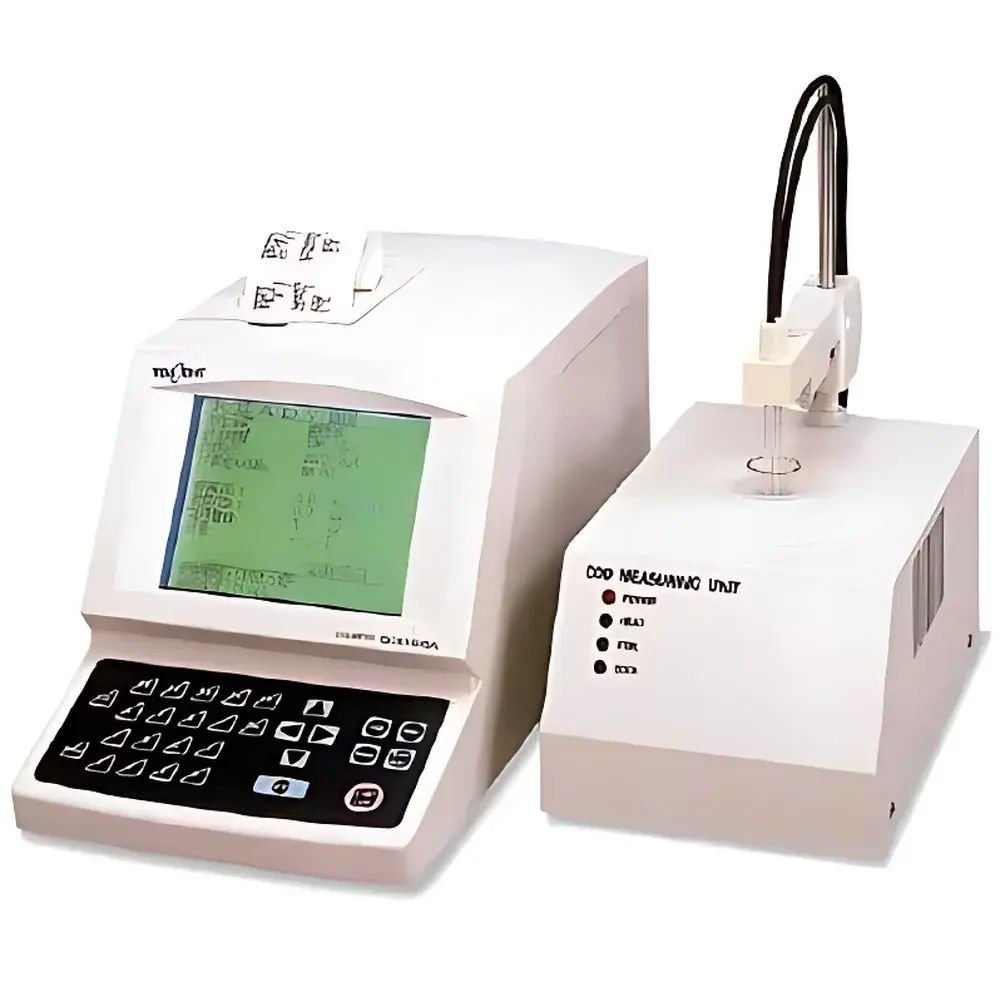
HACH COD-60A Permanganate Index (CODMn) Analyzer
| Brand | HACH |
|---|---|
| Origin | Imported |
| Manufacturer Type | Manufacturer |
| Measurement Principle | Coulometric Titration with Acidic Potassium Permanganate Oxidation |
| Range | 0–20 / 40 / 100 / 200 / 400 / 1000 mg/L as O₂ |
| Repeatability | ±2% RSD |
| Accuracy | ±5% of reading |
| LOD | 0.4 mg/L |
| Resolution | 0.01 mg/L |
| Single-Test Duration | 5–10 min |
| Data Storage | 100 test records |
Overview
The HACH COD-60A Permanganate Index (CODMn) Analyzer is a fully automated benchtop instrument engineered for rapid, precise determination of oxygen demand in water samples using the standardized acidic potassium permanganate oxidation method—aligned with ISO 8467, GB/T 5750.7, and APHA Standard Methods 5210 B. Unlike conventional open-reflux or spectrophotometric COD assays, the COD-60A implements coulometric titration following controlled thermal oxidation, eliminating manual reagent handling, volumetric pipetting, and endpoint visual judgment. The system integrates digestion, temperature-regulated reaction control, electrochemical endpoint detection, and data reporting into a single compact module. Its core architecture employs a self-cleaning polarizable electrode pair operating under potentiostatic control, enabling high reproducibility across matrix-varied samples—including low-ionic-strength drinking water, humic-rich surface water, brackish estuarine samples, and moderately saline industrial effluents.
Key Features
- Fully automated workflow: One-touch initiation executes auto-zeroing, precise heating (adjustable 10–800 s ramp and hold), permanganate oxidation, coulometric back-titration, endpoint recognition, and result calculation.
- Multi-range direct readout: Predefined range selection (0–20 to 0–1000 mg/L as O₂) enables direct display of undiluted sample values; dilution factors are internally compensated without manual conversion.
- Coulometric titration engine: Eliminates standard titrant solutions and burette calibration drift; quantifies consumed permanganate via Faraday-controlled electrolytic generation of ferrous ions, ensuring stoichiometric accuracy traceable to fundamental electrical units.
- Thermal management system: PID-controlled heating block maintains ±0.3 °C stability during oxidation, critical for consistent reaction kinetics across variable chloride and organic load conditions.
- Electrode maintenance suite: Onboard electrode cleaning cycle (electrolytic reversal + ultrasonic agitation) and diagnostic titration mode support routine verification and extended sensor lifetime.
- Regulatory-ready data integrity: Timestamped records include operator ID (optional), method ID, calibration history, raw titration curves, and thermal profile logs—supporting GLP-compliant audit trails.
Sample Compatibility & Compliance
The COD-60A is validated for use with potable water, freshwater, groundwater, seawater (up to 15 g/L Cl⁻ with optional chloride compensation protocol), and non-hazardous industrial process waters. It complies with ISO 8467:2021 (Water quality — Determination of permanganate index), Chinese National Standard GB/T 5750.7-2023 (Standard Examination Methods for Drinking Water — Organic Parameters), and aligns with EPA Method 410.4 principles for oxidizable carbon estimation. For regulatory submissions, results may be correlated to reference methods (e.g., closed-reflux dichromate COD) via user-defined linear regression coefficients stored in method memory—facilitating cross-method equivalence validation per ISO/IEC 17025 requirements.
Software & Data Management
The embedded firmware supports full method configuration, calibration curve registration (up to 5-point multi-level calibration), and coefficient-based conversion to reference laboratory values. All measurements are time-stamped and stored locally (100 entries, non-volatile memory). The integrated thermal printer outputs reports containing sample ID, date/time, range, measured value, %RSD of replicate runs (if enabled), and system status flags. Data export is supported via USB host interface (CSV format) for LIMS integration. Audit log functionality records all parameter changes, calibration events, and maintenance actions—meeting FDA 21 CFR Part 11 foundational requirements for electronic records when deployed in GMP environments.
Applications
- Routine monitoring of source water and finished drinking water for oxidative stability assessment.
- Seasonal tracking of organic loading in rivers, lakes, and reservoirs under eutrophication studies.
- Effluent screening for municipal wastewater treatment plants prior to discharge compliance verification.
- Process water quality control in pharmaceutical manufacturing (PW/DI water systems) where low-level organic contamination must be quantified below 1 mg/L.
- Research applications requiring high-throughput CODMn profiling across large sample sets (e.g., watershed surveys, climate impact modeling).
FAQ
What is the difference between CODMn and dichromate COD (CODCr)?
CODMn uses potassium permanganate under acidic conditions and oxidizes ~50–70% of organic matter—primarily low-molecular-weight compounds—making it suitable for clean water matrices. CODCr employs stronger dichromate oxidation and is preferred for wastewater with complex organics.
Can the COD-60A measure samples with high chloride content?
Yes—up to 15 g/L Cl⁻ with optional chloride interference correction protocol; above this, sample pretreatment (e.g., Ag₂SO₄ precipitation) is recommended per ISO 8467 Annex B.
How often does the electrode require recalibration?
Electrode zero and sensitivity checks are performed automatically before each run; full 3-point calibration is recommended daily or after 20 samples, using certified KHP and blank standards.
Is method validation documentation available?
HACH provides IQ/OQ documentation templates, performance qualification protocols, and ISO 8467 interlaboratory study summary reports upon request for regulated users.
Related Products







