
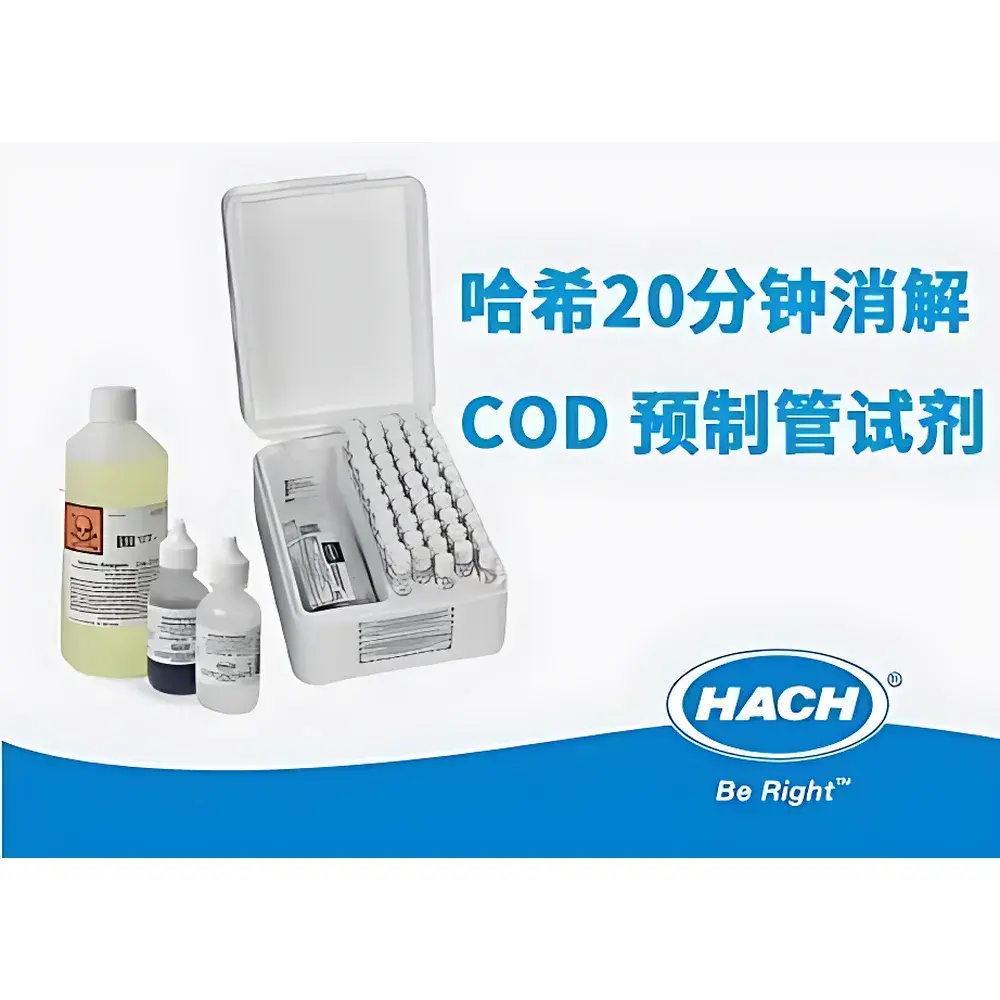
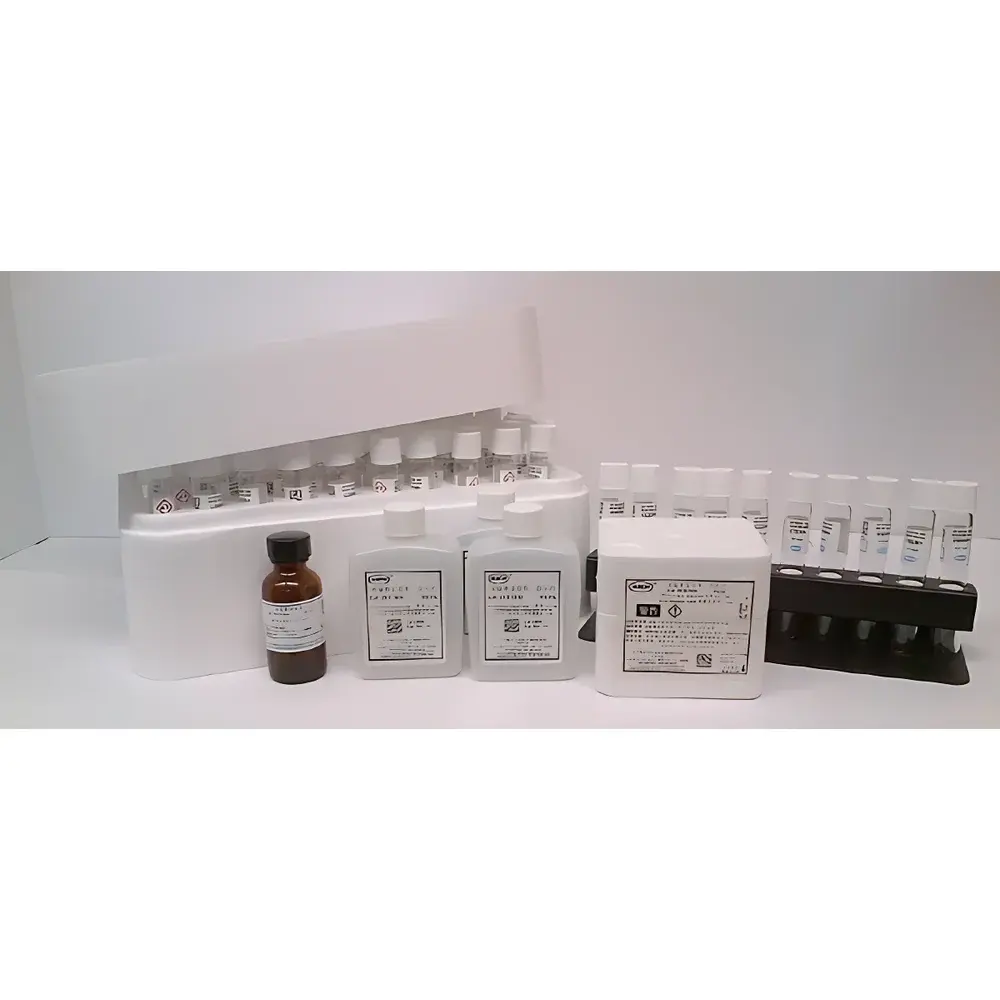
Hach CODMn Pre-dosed Reagent Vials for Permanganate Index Determination
| Brand | Hach |
|---|---|
| Origin | Imported |
| Manufacturer Type | Manufacturer |
| Model | CODMn Pre-dosed Reagent Vials |
| Measurement Range | Low Range 0.50–5.00 mg/L, High Range 4.50–15.00 mg/L |
| Vial Size | 16 mm diameter |
| Package Quantity | 50 vials per kit |
| Digestion Temperature/Time | 100 °C / 30 min |
| Compatibility | DR6000, DR5000, DR3900, DR2800 Spectrophotometers |
| Regulatory Alignment | ASTM D1253, ISO 8467, Standard Methods 5210 B |
Overview
Hach CODMn Pre-dosed Reagent Vials are standardized, factory-sealed analytical reagents designed for the quantitative determination of permanganate index (CODMn) in low-organic-load water matrices. Based on the classical acidic potassium permanganate oxidation method, this test measures the oxygen demand required to oxidize readily oxidizable organic and inorganic substances—primarily under mild thermal conditions (100 °C for 30 minutes). Unlike dichromate-based COD (CODCr) methods, CODMn is specifically recommended for clean water samples including drinking water, potable supplies, source waters, and unpolluted surface waters, where high-strength oxidants would overestimate organic load or cause interference from chloride or nitrite. The method complies with internationally recognized protocols including ASTM D1253 (Standard Test Method for Determining Permanganate Oxidizability of Water), ISO 8467 (Water Quality – Determination of Permanganate Index), and Standard Methods for the Examination of Water and Wastewater (Method 5210 B).
Key Features
- Precision-engineered pre-dosing: Each 16-mm glass vial contains exact, gravimetrically verified quantities of sulfuric acid, potassium permanganate, and sodium oxalate (for back-titration calibration), eliminating manual reagent preparation and associated volumetric errors.
- Dual-range quantification: Two validated concentration ranges—low range (0.50–5.00 mg/L O2) and high range (4.50–15.00 mg/L O2)—enable optimal sensitivity and linearity across typical background levels in municipal and environmental monitoring applications.
- Integrated thermal control: Designed for use with Hach DRB200 digital block digesters, which maintain ±0.5 °C temperature stability at 100 °C and provide automatic 30-minute countdown timing—critical for reaction reproducibility and inter-laboratory comparability.
- Automated photometric readout: Fully compatible with Hach’s UV-Vis and visible spectrophotometers (DR6000, DR5000, DR3900, DR2800), enabling direct absorbance measurement at 525 nm post-digestion without dilution or transfer steps.
- Enhanced operator safety: Eliminates handling of concentrated sulfuric acid and solid KMnO4; sealed vials prevent aerosol generation, splash exposure, and cross-contamination during digestion and cooling phases.
- Reduced environmental footprint: Total waste volume per test remains below 10 mL, significantly lower than conventional open-vessel methods—supporting laboratory sustainability goals and simplifying hazardous waste classification.
Sample Compatibility & Compliance
CODMn analysis using Hach pre-dosed vials is validated for raw and treated drinking water, groundwater, spring water, and oligotrophic surface waters. Samples must be free of suspended solids (>1 µm) prior to analysis (filtration via 0.45-µm membrane recommended). The method is not suitable for wastewater, seawater, or highly colored or turbid samples due to spectral interference and incomplete oxidation kinetics. All reagent lots undergo lot-specific verification against NIST-traceable potassium hydrogen phthalate (KHP) standards and are certified compliant with ISO/IEC 17025-accredited manufacturing controls. Batch-specific certificates of analysis (CoA) include shelf-life validation (typically 24 months unopened, stored at 15–25 °C), pH stability, and blank absorbance limits (<0.010 AU at 525 nm).
Software & Data Management
When used with Hach’s instrument platforms, the CODMn method is embedded in pre-programmed method libraries (e.g., Method No. 8000 for DR6000). Instrument firmware supports full audit trail functionality per FDA 21 CFR Part 11 requirements—including user login tracking, method version logging, raw absorbance data capture, and automatic calculation of results using built-in calibration curves. Data export options include CSV, PDF report generation, and seamless integration with LIMS via Ethernet or USB. Optional Hach LabStation software enables multi-instrument data aggregation, trend analysis, QC charting (X-bar/R), and automated compliance reporting aligned with GLP and ISO 17025 documentation standards.
Applications
- Drinking water quality surveillance per national regulatory frameworks (e.g., US EPA Ground Water Rule, EU Drinking Water Directive 2020/2184)
- Source water characterization for treatment plant intake optimization
- Long-term trend monitoring of oligotrophic lakes and reservoirs
- Verification of granular activated carbon (GAC) or ozone-biofiltration performance
- Compliance testing for bottled water manufacturers (IBWA standards)
- Research-grade assessment of natural organic matter (NOM) reactivity in aquatic systems
FAQ
What is the difference between CODMn and CODCr?
CODMn uses potassium permanganate under acidic, low-temperature conditions and reflects only easily oxidizable organics; CODCr employs potassium dichromate at reflux temperature and oxidizes >95% of organics—including refractory compounds. They are not numerically interchangeable.
Can these vials be used with non-Hach spectrophotometers?
Yes—provided the instrument offers stable 525 nm wavelength selection, 10-mm pathlength capability, and absorbance linearity up to 1.5 AU. However, method validation and calibration verification are the user’s responsibility.
Is filtration mandatory before analysis?
Yes. Particulate matter interferes with both oxidation kinetics and photometric measurement. Filtration through a 0.45-µm membrane filter is required per ISO 8467.
How should opened vials be stored?
Unopened vials require ambient storage (15–25 °C); once opened, vials must be used within 2 hours to prevent atmospheric reduction of permanganate.
Does this method meet regulatory reporting requirements?
Yes—when performed in accordance with ASTM D1253 or ISO 8467, using calibrated instrumentation and documented QC procedures (blanks, duplicates, spikes), results are admissible for regulatory submission in jurisdictions recognizing those standards.







