
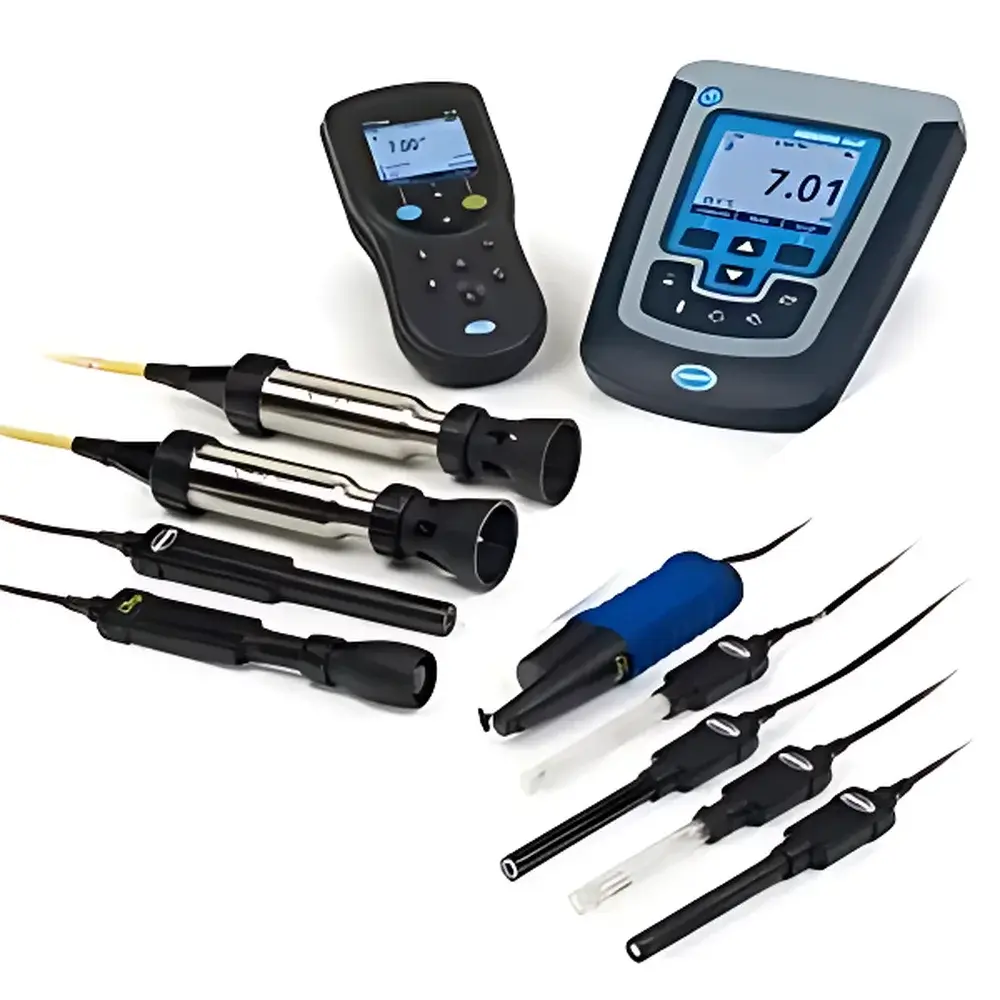
Hach HQd Benchtop/Portable Multiparameter Analyzer
| Brand | Hach |
|---|---|
| Origin | USA |
| Manufacturer Type | Manufacturer |
| Product Origin | Imported |
| Model | HQd Benchtop/Portable Analyzer |
| Detection Parameters | pH, ORP, Conductivity, TDS, Resistivity, Salinity, Dissolved Oxygen (LDO), BOD, Sodium, Ammonium, Ammonia, Fluoride, Nitrate, Chloride |
| Portability | Portable & Benchtop Configurable |
| Conductivity Range | 0.1 µS/cm – 200 mS/cm |
| TDS Range | 0–50,000 mg/L |
| Resistivity Range | 2.5 Ω·cm – 49 MΩ·cm |
| Salinity Range | 0–42 g/kg (ppt) |
| Temperature Range | 0–50 °C |
| pH Accuracy | ±0.01 pH |
| pH Resolution | 0.01 pH |
Overview
The Hach HQd Benchtop/Portable Multiparameter Analyzer is a modular, field- and lab-certified electrochemical platform engineered for precision, traceability, and operational flexibility in water quality assessment. Based on intelligent sensor recognition and digital signal processing architecture, the HQd system employs potentiometric (pH, ORP, ion-selective), conductometric (conductivity, TDS, resistivity, salinity), and optical (Luminescent Dissolved Oxygen, LDO) measurement principles—each calibrated per ASTM D1129, ISO 7888, ISO 5814, and USP . Its dual-form factor supports both controlled laboratory environments and rugged outdoor deployments, with IP67-rated IntelliCAL™ electrode interfaces and automatic electrode ID detection eliminating manual configuration errors. The analyzer operates under ambient temperatures from 0 to 50 °C and meets GLP-compliant data integrity requirements through embedded audit trails, user authentication, and timestamped metadata logging.
Key Features
- Modular multi-parameter capability: Simultaneous or sequential measurement of up to 14 parameters—including pH, ORP, conductivity, TDS, resistivity, salinity, temperature, LDO, BOD, sodium, ammonium, ammonia, fluoride, nitrate, and chloride—using interchangeable IntelliCAL™ electrodes.
- Intelligent electrode recognition: Automatic detection of connected IntelliCAL™ sensors (e.g., PHC101, CDC401, LDO101) ensures correct calibration coefficients, measurement ranges, and unit conversions are applied without user intervention.
- Three measurement modes: Instant-read (single-point), timed-hold (indirect), and continuous real-time monitoring—enabling adaptive sampling strategies for regulatory compliance, process control, or research-grade kinetics.
- GLP/GMP-ready data management: Built-in data logger stores full metadata with each reading—including electrode serial number, calibration history, operator ID, sample ID, date/time stamp, and environmental conditions—ensuring full traceability per FDA 21 CFR Part 11 requirements.
- Configurable temperature compensation: User-defined reference temperatures for conductivity (e.g., 20 °C, 25 °C, or custom) and automatic salinity-based correction for LDO when paired with a conductivity sensor—eliminating manual input errors and improving dissolved oxygen accuracy in estuarine or brackish applications.
- Backlit high-contrast LCD display with font scaling: Optimized for low-light field use; supports enlarged text mode and intuitive icon-driven navigation with contextual help prompts during calibration and diagnostics.
Sample Compatibility & Compliance
The HQd analyzer is validated for aqueous matrices across drinking water, wastewater, surface water, groundwater, industrial process streams, and aquaculture systems. All IntelliCAL™ electrodes comply with NSF/ANSI Standard 61 for potable water contact and meet CE marking requirements under the EU Electromagnetic Compatibility Directive 2014/30/EU and RoHS 2011/65/EU. Calibration protocols align with EPA Method 150.1 (conductivity), EPA Method 150.2 (pH), and ASTM D888-22 (dissolved oxygen). The system supports IQ/OQ documentation packages for regulated laboratories and integrates with LIMS via USB mass storage mode or optional Hach Data Manager software.
Software & Data Management
Data export is supported via USB 2.0 interface to flash drives or Windows-based PCs using Hach’s free Data Manager software (v3.0+), which enables batch report generation compliant with ISO/IEC 17025 Annex A.2. All logged entries include cryptographic hash verification to prevent post-acquisition tampering. Software features include customizable pH buffer sets (beyond standard NIST-traceable buffers), editable calibration checklists with pass/fail thresholds, and configurable alarm triggers for out-of-spec readings. Audit logs record all user actions—including calibration edits, method changes, and data deletions—with immutable timestamps and operator credentials.
Applications
- Drinking water treatment: Real-time monitoring of pH, chlorine residual (via ISE), and conductivity for coagulation optimization and disinfection by-product control.
- Wastewater effluent compliance: Simultaneous measurement of ammonium, nitrate, and ORP to support denitrification process control and NPDES reporting.
- Environmental field surveys: Portable LDO + salinity + temperature profiling in tidal zones, wetlands, and reservoirs per USGS NWIS protocols.
- Pharmaceutical water systems: Resistivity monitoring at ≥18.2 MΩ·cm (Type I water) with temperature-compensated validation per USP and EP 2.2.38.
- Academic and research labs: Multi-ion kinetic studies using programmable measurement intervals and synchronized electrode triggering.
FAQ
Does the HQd analyzer support Good Laboratory Practice (GLP) documentation requirements?
Yes. It provides full electronic records including user ID, electrode serial number, calibration constants, date/time stamps, and sample identifiers—all stored in an encrypted internal log accessible via USB export.
Can I use non-Hach electrodes with the HQd platform?
No. Only Hach IntelliCAL™ electrodes are supported due to proprietary digital communication protocols and embedded calibration memory.
Is the instrument suitable for high-salinity seawater measurements?
Yes. With the CDC401 conductivity cell and automatic salinity compensation enabled, it measures accurately across 0–42 g/kg and applies appropriate LDO corrections per Winkler-derived algorithms.
How often does the system require recalibration?
Calibration frequency follows application-specific QA/QC plans; however, the analyzer includes automated calibration reminder alerts based on user-defined intervals or drift thresholds.
What power options are available for field use?
The portable configuration operates on four AA alkaline or rechargeable NiMH batteries (up to 1,000 hours), while the benchtop version uses an external 12 V DC adapter.
Related Products





