
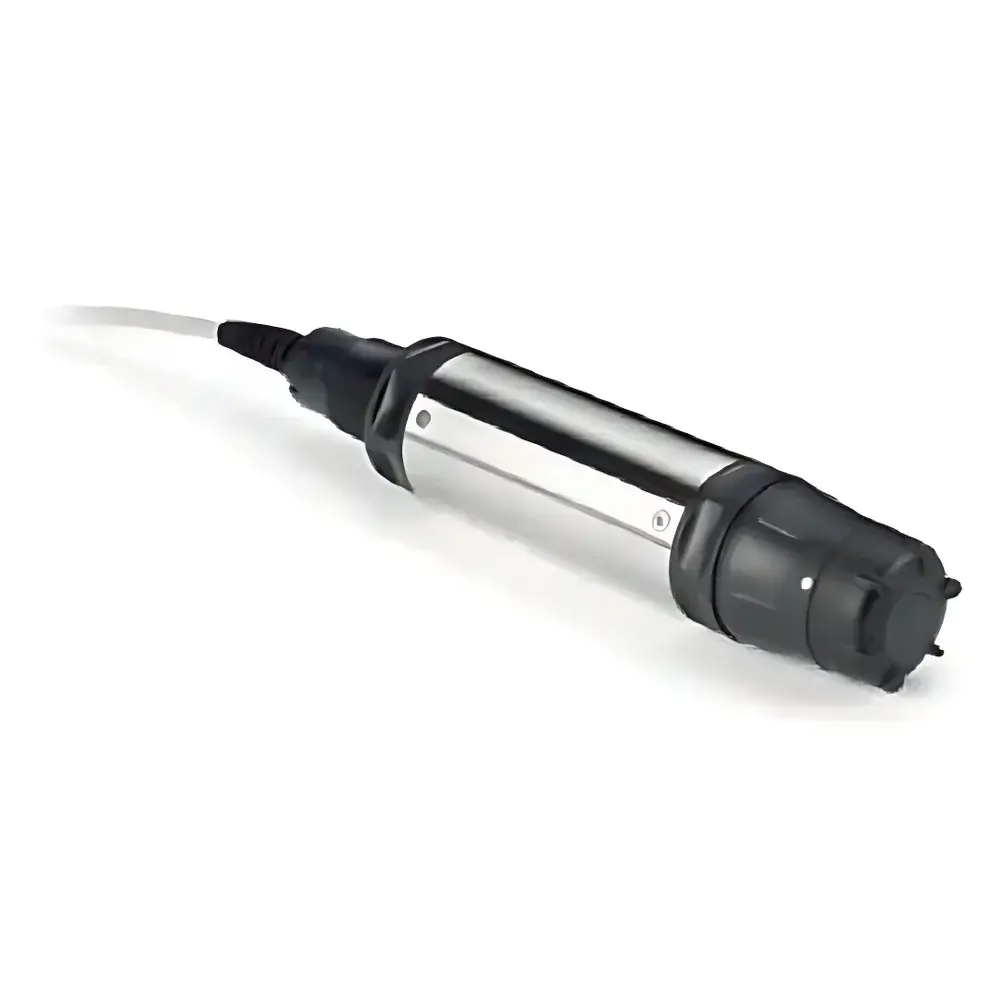
Hach LDO II Fluorescent Dissolved Oxygen Sensor
| Brand | Hach |
|---|---|
| Origin | Imported |
| Manufacturer Type | Manufacturer |
| Model | LDO II Probe |
| Instrument Type | Online |
| Measurement Principle | Fluorescence Quenching |
| Range | 0.11–20.00 mg/L (ppm) or 0–200% saturation |
| Accuracy | ±0.1 ppm at [O₂] <5 ppm |
| Temperature accuracy | ±0.2°C |
| Repeatability | ±0.1 ppm (mg/L) |
| Detection Limit | 0 ppm |
| Calibration | Factory-calibrated, zero user calibration required |
| Maintenance Interval | Up to 24 months for fluorescent cap |
Overview
The Hach LDO II Fluorescent Dissolved Oxygen Sensor is an online, maintenance-optimized analytical probe engineered for continuous, high-reliability dissolved oxygen (DO) monitoring in demanding water and wastewater applications. Unlike electrochemical DO sensors—such as Clark-type amperometric or polarographic probes—the LDO II employs fluorescence quenching technology, eliminating the need for oxygen-permeable membranes, electrolyte solutions, or cathode/anode polarization. This fundamental design shift removes oxygen consumption during measurement, rendering the sensor insensitive to sample flow velocity, mixing intensity, or localized stagnation. The optical detection principle also confers immunity to common interferents—including sulfides, chlorine residuals, hydrogen sulfide, and heavy metal ions—that frequently compromise electrochemical sensor stability and longevity. As a result, the LDO II delivers stable, drift-free output under variable process conditions typical of activated sludge basins, bioreactors, drinking water distribution systems, and industrial cooling towers.
Key Features
- Factory-calibrated with integrated 3D calibration matrix—no field calibration required throughout its operational lifetime.
- Fluorescent sensing cap rated for up to 24 months of continuous service, eliminating membrane replacement, electrolyte refills, and electrode polishing.
- Dual-sealed housing using advanced elastomeric O-rings and ultrasonic welding—certified IP68-rated for submersion and corrosion resistance in aggressive wastewater matrices.
- Self-diagnostic service prompting: configurable cleaning alerts triggered by time-based or performance-degradation thresholds ensure consistent fouling management without manual scheduling.
- Compact, low-profile probe geometry (reduced diameter vs. prior-generation LDO) improves installation flexibility in confined piping, submerged chambers, and retrofit applications.
- Temperature-compensated output with integrated Pt1000 RTD (±0.2°C accuracy) enabling precise DO reporting across dynamic thermal environments.
Sample Compatibility & Compliance
The LDO II is validated for use in municipal wastewater influent/effluent, secondary clarifier overflow, biological nutrient removal (BNR) zones, potable water storage reservoirs, and recirculating industrial process streams. It complies with ASTM D888-22 (Standard Test Methods for Dissolved Oxygen in Water) for optical DO measurement protocols and supports GLP/GMP data integrity requirements when paired with Hach SC1000 or HQd series controllers featuring audit-trail logging and 21 CFR Part 11-compliant user access controls. No reagent consumption or hazardous waste generation occurs during operation, aligning with ISO 14001 environmental management system objectives.
Software & Data Management
When interfaced with Hach’s SC1000 Multi-Parameter Controller or HQd platform, the LDO II enables real-time DO trending, alarm threshold configuration (e.g., low-O₂ alerts in aerobic zones), and automated data export via Modbus TCP, 4–20 mA analog output, or Hach’s proprietary HachLink™ software. All calibration metadata—including factory traceability certificates, date-stamped validation logs, and cap life-cycle counters—are embedded in the sensor’s non-volatile memory and accessible through controller diagnostics menus. Firmware updates are performed remotely via controller USB or Ethernet interfaces, supporting long-term regulatory compliance without on-site technician visits.
Applications
- Activated sludge process control: real-time DO feedback for aeration blower modulation in WWTPs.
- Membrane bioreactor (MBR) monitoring: stable DO measurement in high-solids, low-flow environments where membrane fouling would impair electrochemical sensors.
- Drinking water reservoir destratification: long-duration deployment without recalibration drift due to seasonal temperature gradients.
- Industrial cooling water systems: interference-free operation in chlorinated or sulfide-containing return streams.
- Research-grade environmental monitoring: high-precision DO profiling in mesocosms, wetland outfalls, and aquaculture recirculation units.
FAQ
Does the LDO II require zero or span calibration during routine operation?
No. The sensor is fully factory-calibrated using a three-dimensional (3D) temperature–pressure–oxygen matrix and requires no user-initiated calibration throughout its service life.
What maintenance is necessary to sustain measurement accuracy?
Periodic mechanical cleaning of the optical window is recommended based on site-specific fouling rates; the sensor provides programmable cleaning alerts to support predictive maintenance planning.
Can the LDO II be used in seawater or brackish water applications?
Yes—its corrosion-resistant titanium body and dual-sealed construction are suitable for salinities up to 35 g/kg, though long-term immersion beyond 24 months may necessitate cap replacement per manufacturer guidelines.
How does fluorescence quenching differ from electrochemical DO measurement in terms of response time?
The LDO II achieves T90 response times of ≤30 seconds across its full range, independent of flow rate—a critical advantage over membrane-dependent sensors whose response degrades significantly under low-flow or stagnant conditions.
Is the fluorescent cap replaceable in the field?
Yes. Replacement caps are field-installable using standard torque tools and do not require recalibration; each new cap retains full traceability to NIST-traceable standards via embedded RFID chip.







