
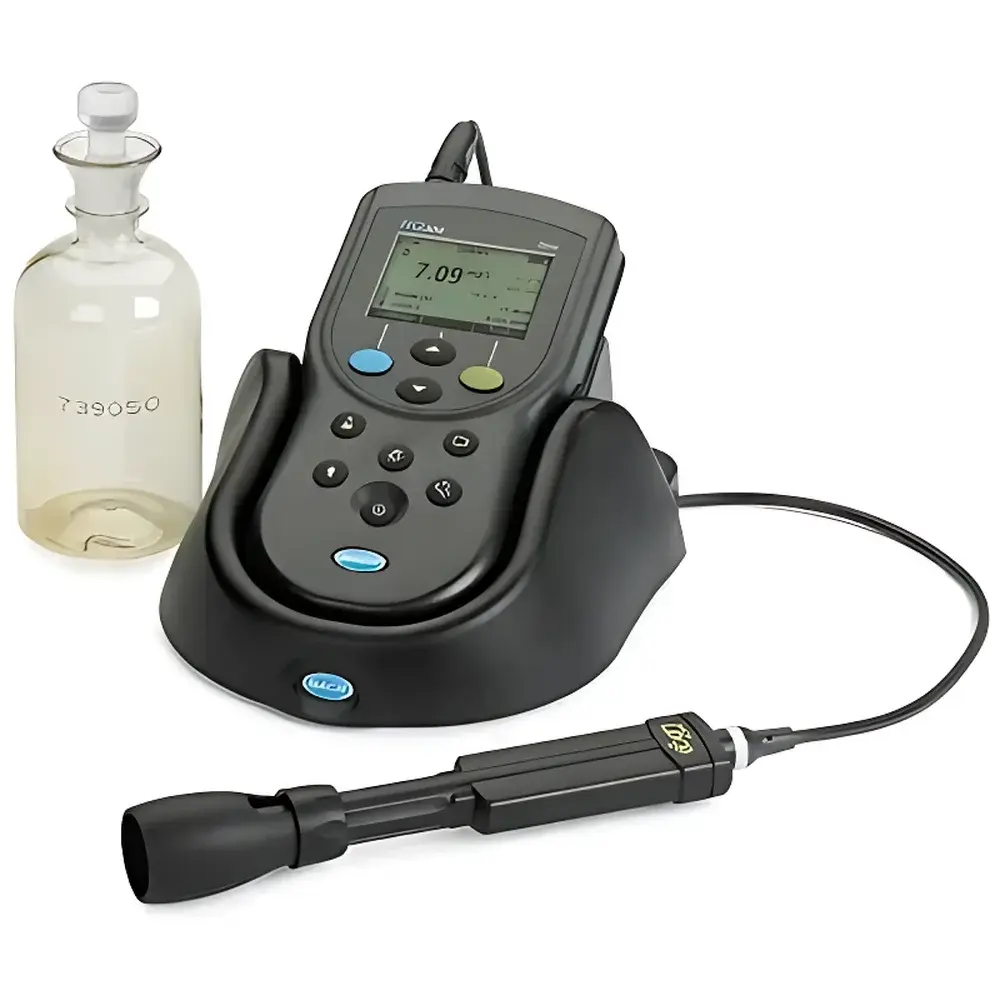
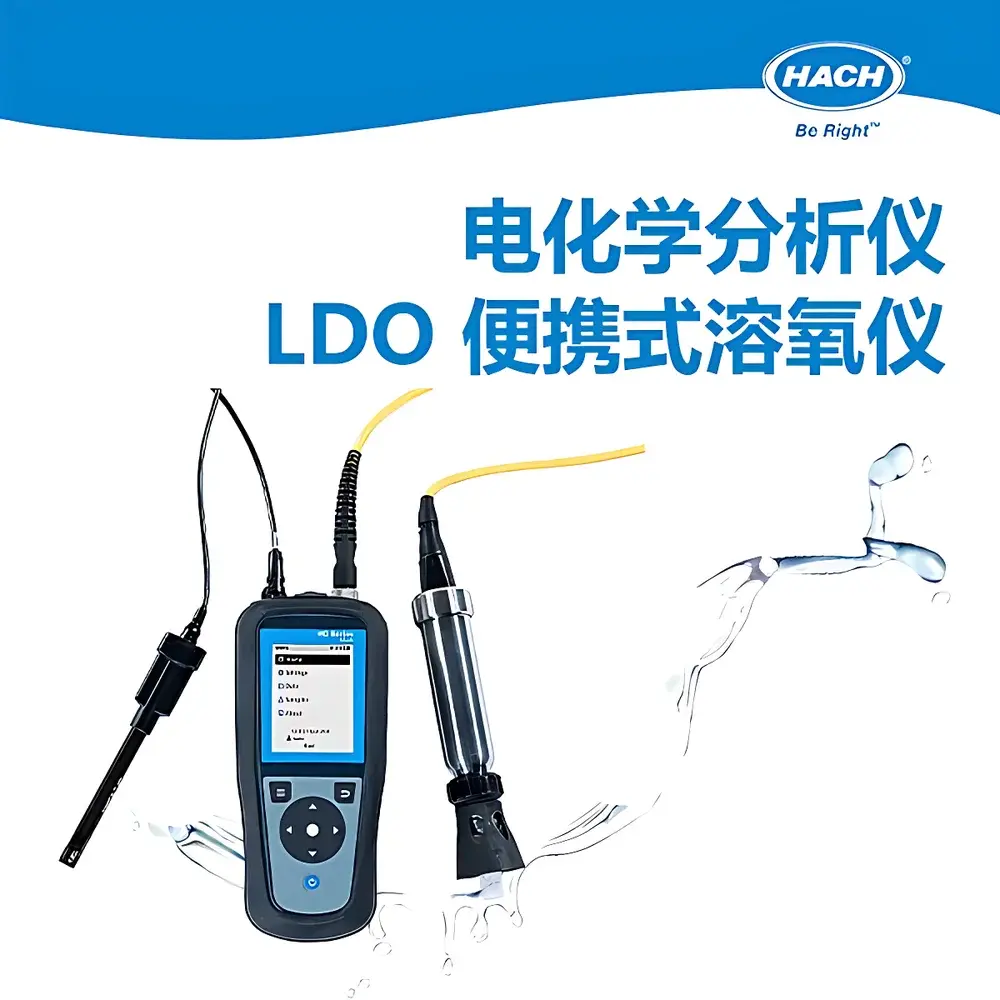
HACH LDO Portable Dissolved Oxygen Meter
| Brand | HACH |
|---|---|
| Origin | Imported |
| Manufacturer | HACH Company |
| Instrument Type | Portable |
| Measurement Principle | Fluorescence Quenching |
| Range | 0.01–20 mg/L (ppm) |
| Accuracy | ±0.01 mg/L |
| Repeatability | ±0.1 mg/L (0–8 mg/L), ±0.2 mg/L (>8 mg/L) |
| Detection Limit | 0.01 mg/L |
Overview
The HACH LDO Portable Dissolved Oxygen Meter is an engineered field- and lab-grade instrument designed for rapid, reliable quantification of dissolved oxygen (DO) concentration and saturation in aqueous samples. Unlike electrochemical sensors based on Clark-type amperometry or polarographic principles, the LDO employs optical fluorescence quenching — a non-consumptive, membrane-free measurement technique grounded in Stern–Volmer kinetics. A blue LED excites a proprietary ruthenium-based fluorophore immobilized on the sensor surface; molecular oxygen quenches the resulting phosphorescent emission, shortening its lifetime. The meter precisely measures this decay time (in nanoseconds) and converts it linearly to DO concentration via factory-established calibration curves. This physics-based approach eliminates diffusion limitations, electrolyte dependency, and electrode drift — delivering inherently stable, zero-maintenance performance across diverse water matrices including wastewater, surface water, aquaculture systems, and process streams.
Key Features
- Fluorescence-based sensing with no membrane, electrolyte, or cathode/anode assembly — eliminating consumables and polarization delays.
- Factory-calibrated sensor with traceable NIST-traceable certification; no user calibration required under standard operating conditions.
- Rugged, IP67-rated housing with integrated rechargeable lithium-ion battery supporting >100 hours of continuous operation.
- Self-diagnostic sensor health monitoring: real-time signal-to-noise ratio assessment and fluorophore integrity verification.
- Auto-compensated temperature and salinity correction using built-in thermistor and user-input salinity value (0–70 g/kg).
- High-contrast backlit LCD display with dual-unit readout (mg/L and % saturation) and graphical trend logging capability.
Sample Compatibility & Compliance
The LDO sensor demonstrates robust performance across a wide range of sample types — from low-conductivity freshwater (<50 µS/cm) to high-salinity seawater (up to 45 ppt), and from clarified effluent to suspended-solids-laden wastewater (up to 10,000 mg/L TSS). Its membraneless design prevents fouling by sulfides, chlorine, hydrogen sulfide, heavy metals, or organic solvents — common interferents in conventional amperometric DO probes. The instrument complies with ASTM D888-22 (Standard Test Methods for Dissolved Oxygen in Water) and supports GLP/GMP data integrity requirements through audit-trail-enabled firmware (optional USB export with timestamped metadata). Sensor housing meets ISO 9001-certified manufacturing standards and is compatible with HACH’s validated method packages for EPA Method 360.1 and ISO 5814:2012.
Software & Data Management
Data capture and reporting are supported via HACH’s LogR software (Windows-compatible), enabling configuration, firmware updates, and batch export of measurement logs in CSV or PDF formats. Each stored reading includes DO concentration, saturation %, temperature, atmospheric pressure (if barometer-equipped), salinity input, sensor ID, operator ID, and GPS coordinates (when paired with optional Bluetooth GNSS module). All data files support digital signature and encryption per FDA 21 CFR Part 11 requirements when deployed in regulated environments. Internal memory retains up to 5,000 timestamped readings with automatic overflow protection and cyclic overwrite logic.
Applications
- Wastewater treatment plant monitoring: aeration basin optimization, return activated sludge (RAS) control, and final effluent compliance verification.
- Environmental field surveys: stream health assessments, lake stratification studies, and wetland restoration projects.
- Aquaculture and fisheries management: real-time DO profiling in recirculating aquaculture systems (RAS) and hatchery tanks.
- Drinking water distribution system evaluation: detecting stagnation zones and assessing reaeration potential.
- Industrial process water monitoring: boiler feedwater deaeration validation, cooling tower efficiency analysis, and bioreactor DO control.
FAQ
Does the LDO sensor require recalibration during routine use?
No — the sensor is factory-calibrated against gravimetrically prepared air-saturated and nitrogen-purged standards. Recalibration is only recommended after physical damage to the fluorophore cap or exposure to extreme pH (12) or solvent immersion.
Can the LDO be used in high-turbidity or oily water samples?
Yes — the optical design is insensitive to particulate scattering and hydrocarbon films. However, persistent biofilm accumulation on the sensor window should be removed using isopropyl alcohol and lint-free wipes to maintain optical clarity.
Is pressure compensation supported?
Barometric pressure compensation is enabled via manual entry or optional external barometer integration; altitude-derived pressure estimation is not supported.
What is the service life of the fluorescent sensor cap?
Under normal field conditions, the fluorophore cap maintains metrological integrity for ≥24 months. Accelerated aging occurs only under continuous UV exposure or repeated mechanical abrasion with abrasive cleaning agents.
How does the LDO comply with regulatory data integrity requirements?
Firmware v3.2+ implements role-based access control, electronic signatures, and immutable audit trails for all configuration changes and measurement events — meeting core ALCOA+ principles for data reliability in environmental compliance reporting.
Related Products







