
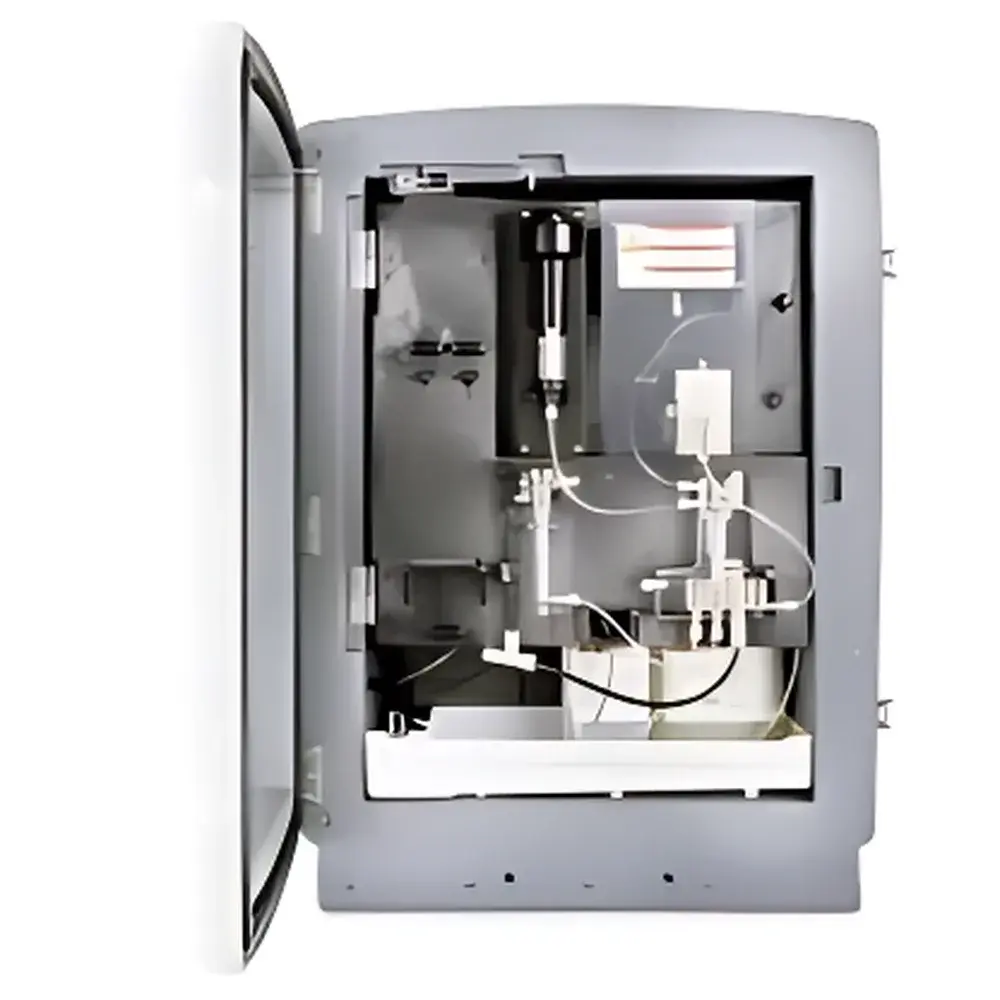
HACH Phosphax sc Orthophosphate Analyzer
| Brand | HACH |
|---|---|
| Origin | Imported |
| Manufacturer Type | Manufacturer |
| Model | Phosphax sc |
| Instrument Type | Online Analyzer |
| Measurement Principle | Colorimetric (Ascorbic Acid Reduction Method) |
| Detection Limit | <0.01 mg/L PO₄–P |
| Range | 0–2.0 mg/L and 0–10.0 mg/L (selectable) |
| Response Time | <15 minutes (typical cycle time) |
| Output | 4–20 mA, Modbus RTU, Ethernet/IP |
| Sample Inlet | 6–10 bar pressure rating |
| Cleaning | Automatic air-pulse and brush-based cleaning system |
| Controller | Integrated digital sc controller (plug-and-play) |
| Optional Pre-treatment | Filterprobe sc suspended solids removal module |
| Compliance | Designed for continuous operation in wastewater treatment environments per ISO 5667-3, ASTM D515-88, and EN ISO 15681-1 |
Overview
The HACH Phosphax sc Orthophosphate Analyzer is an online, process-grade analytical instrument engineered for continuous, real-time quantification of orthophosphate (PO₄–P) in municipal and industrial wastewater streams. It employs the standardized ascorbic acid reduction colorimetric method—aligned with ISO 15681-1 and ASTM D515-88—to convert soluble orthophosphate into a stable blue molybdenum-blue complex, measured photometrically at 880 nm. This principle ensures high specificity for orthophosphate in the presence of polyphosphates or organic phosphorus compounds, provided hydrolysis pretreatment is not required. The analyzer is purpose-built for integration into biological nutrient removal (BNR) control loops, particularly at critical points such as anaerobic/anoxic zone effluents, tertiary filtration discharge, or final effluent monitoring stations. Its robust architecture supports unattended operation under variable hydraulic and particulate load conditions typical of activated sludge, MBR, and oxidation ditch processes.
Key Features
- Two selectable measurement ranges (0–2.0 mg/L and 0–10.0 mg/L as PO₄–P) optimized for both low-level effluent compliance and higher-concentration process stream monitoring.
- Automatic air-pulse and rotating brush cleaning system minimizes fouling on optical windows and flow cells—reducing manual intervention intervals to ≤30 days under typical secondary-treated wastewater conditions.
- Integrated sc digital controller with plug-and-play connectivity; supports local display (graphical trend + numeric readout), alarm configuration, and diagnostics via intuitive web interface.
- Modular design allows field-upgradable firmware, configurable output protocols (4–20 mA analog, Modbus RTU over RS-485, EtherNet/IP), and seamless integration with DCS/SCADA systems.
- Low reagent consumption (≤1.2 mL per analysis cycle) and long-life reagent packs (up to 30 days at 1-hour sampling interval) contribute to predictable operational cost profiles.
- IP66-rated enclosure with corrosion-resistant wetted materials (316L SS, PTFE, borosilicate glass) ensures durability in humid, chemically aggressive plant environments.
Sample Compatibility & Compliance
The Phosphax sc is validated for use with clarified secondary effluent, membrane bioreactor (MBR) permeate, sand-filtered water, and low-turbidity tertiary streams (turbidity < 25 NTU). When paired with the optional Filterprobe sc—featuring backwashable 50 µm stainless steel mesh and integrated turbidity compensation—the system extends reliable operation to raw influent or high-solids return activated sludge (RAS) sidestreams. All measurements comply with the performance criteria defined in ISO 5667-3 (water sampling) and EN ISO 15681-1 (orthophosphate determination by flow analysis). Data integrity meets GLP-aligned audit requirements through built-in timestamped event logging, calibration history tracking, and user-accessible audit trails—supporting regulatory reporting under EPA Clean Water Act NPDES permits and EU Urban Wastewater Treatment Directive Annex I monitoring obligations.
Software & Data Management
The embedded sc controller provides native support for HACH’s Intelligence Platform (via optional LAN/Wi-Fi gateway), enabling remote configuration, firmware updates, and diagnostic telemetry. All measurement data—including raw absorbance values, temperature-compensated concentration outputs, reagent depletion alerts, and cleaning cycle logs—are stored locally (≥30 days at 15-minute resolution) and exportable via CSV or OPC UA. For enterprise-level deployment, the analyzer integrates with HACH Asset Insight or third-party MES platforms using standard Modbus mapping tables. Full 21 CFR Part 11 compliance—including electronic signatures, role-based access control, and immutable audit trails—is achievable when deployed with validated HACH Data Manager software in GMP-regulated water reuse applications.
Applications
- Real-time feedback control of ferric chloride or aluminum sulfate dosing in tertiary chemical phosphorus removal systems.
- Monitoring orthophosphate release in anaerobic zones to optimize VFA uptake and enhance biological phosphorus removal efficiency.
- Compliance verification for discharge permits requiring sub-0.1 mg/L PO₄–P limits (e.g., sensitive watershed outfalls).
- Trend analysis of phosphorus mass balance across primary sedimentation, biological treatment, and final disinfection stages.
- Supporting digital twin modeling of nutrient dynamics in smart wastewater treatment plants (WWTPs).
FAQ
What sample pretreatment is required for accurate orthophosphate measurement?
No acid digestion or UV oxidation is needed—only filtration (via Filterprobe sc or equivalent) for samples with suspended solids >25 mg/L. The method measures only soluble reactive phosphorus (SRP), consistent with regulatory orthophosphate definitions.
Can the Phosphax sc distinguish orthophosphate from total phosphorus?
No—it measures orthophosphate specifically. Total phosphorus requires separate instrumentation (e.g., HACH DR3900 with persulfate digestion) or lab-based ICP-OES analysis.
How frequently does the system require calibration verification?
Factory-calibrated with NIST-traceable standards; field verification recommended every 7 days using certified reference materials (CRM) per ISO/IEC 17025 QA protocols.
Is the analyzer compatible with existing SCADA infrastructure?
Yes—native Modbus RTU (RS-485) and EtherNet/IP drivers are included; no protocol converters required for most Allen-Bradley, Siemens, or Honeywell DCS platforms.
What maintenance tasks are performed during routine servicing?
Reagent replacement, optical window inspection, cleaning mechanism function test, and flow path leak check—typically completed in <25 minutes by trained plant technicians.







