
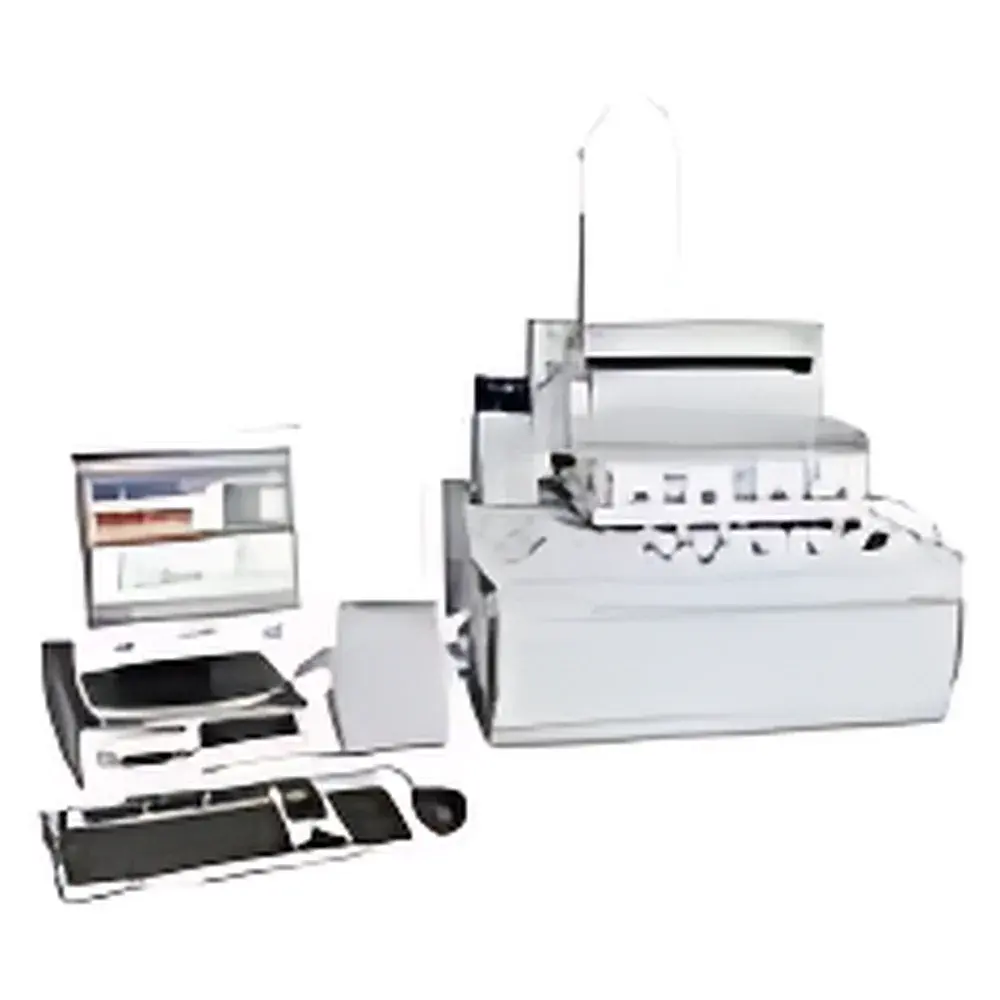
Hach QC8500 Flow Injection Analyzer
| Brand | Hach |
|---|---|
| Origin | USA |
| Manufacturer Type | Original Equipment Manufacturer (OEM) |
| Product Origin | Imported |
| Model | QC8500 |
| Instrument Type | Laboratory Water Quality Analyzer |
| Analyte Scope | Water Quality Parameters (e.g., Nitrate, Nitrite, Phosphate, Ammonia, Silica, Cyanide, Phenol, etc.) |
| Analysis Method | Flow Injection Analysis (FIA) |
| Number of Channels | Up to 8 simultaneous analytical channels per system (2 systems controllable via one PC) |
| Sample Injection Volume | 2–250 µL |
| Heating Module Range | 25–160 °C |
| Sample Introduction Valve | High-precision 6-port injection valve |
| Detection Principle | Photometric (UV-Vis), with 10-mm pathlength flow cell |
| Quantification Method | Peak area integration |
| Accuracy & Repeatability | ±0.5% RSD |
| Sample Throughput | 20–90 determinations per hour per channel |
| System Footprint (4-channel configuration including PC and printer) | 2.72 × 0.74 × 0.58 m |
Overview
The Hach QC8500 Flow Injection Analyzer is a fully automated, modular laboratory instrument engineered for high-throughput, trace-level quantification of inorganic and organic water quality parameters using standardized Flow Injection Analysis (FIA) methodology. Developed from foundational principles established by J. Ruzicka and E.H. Hansen in 1974, FIA leverages controlled laminar flow, precise reagent/sample segmentation, and reproducible dispersion dynamics within narrow-bore tubing to enable rapid, low-volume, high-reproducibility chemical reactions and optical detection. Unlike segmented continuous-flow systems, the QC8500 employs programmable injection timing, variable loop volumes, and thermally regulated reaction zones—enabling method flexibility across diverse EPA, ISO, and ASTM standard methods (e.g., EPA 353.2, ISO 15681-1, ASTM D3869). Its architecture eliminates manual pipetting, reduces analyst exposure to hazardous reagents, and minimizes carryover through optimized flow path geometry and integrated air-segmentation protocols.
Key Features
- Modular hardware design supporting scalable deployment—from single-parameter validation to multi-analyte, 8-channel parallel analysis;
- Integrated high-precision 6-port injection valve with ceramic rotor and PTFE stator for >500,000 actuations without degradation in sealing performance;
- Programmable heating module (25–160 °C) with PID-controlled thermal stability (±0.3 °C) for temperature-critical reactions such as diazotization or persulfate digestion;
- Automated dilution module (optional) enabling on-the-fly preparation of calibration series and sample pre-dilution with <1.2% volumetric error (ISO/IEC 17025-compliant uncertainty budget);
- Real-time leak detection via pressure monitoring at critical junctions (pump head, valve manifold, detector cell), triggering audible/visual alerts and automatic pump shutdown;
- Self-diagnostic firmware that logs operational anomalies—including flow rate deviation (>±3%), valve positioning failure, or photometric baseline drift—into timestamped audit trails;
- Robust peristaltic pumping system with chemically resistant silicone/pharmed tubing, rated for continuous operation at flow rates from 0.2 to 5.0 mL/min.
Sample Compatibility & Compliance
The QC8500 is validated for use with raw surface water, wastewater effluents, drinking water, groundwater, and industrial process streams—with matrix tolerance enhanced by built-in filtration (0.45 µm inline filter option) and optional UV digestion (for total phosphorus/nitrogen). All hardware components comply with IEC 61000-6-3 (EMC) and UL 61010-1 safety standards. Software operation adheres to FDA 21 CFR Part 11 requirements for electronic records and signatures, including role-based access control, full audit trail logging (user actions, parameter changes, result modifications), and electronic signature capture for report finalization. Method protocols are aligned with ISO/IEC 17025:2017 clause 7.2.2 (validation of non-standard methods) and support GLP/GMP documentation workflows required by environmental testing laboratories accredited under NELAC or UKAS.
Software & Data Management
Control and data acquisition are managed through Hach’s proprietary QuickChem Software v5.x—a Windows-based application certified for Windows 10/11 (64-bit) and compatible with SQL Server 2019+ backends. The software provides method editor functionality for custom FIA sequence programming (injection timing, heater ramp profiles, detector integration windows), real-time chromatogram visualization, and automated calibration curve generation (linear, quadratic, or weighted least-squares fitting). Raw signal data (absorbance vs. time) are stored in vendor-neutral .csv and .hdf5 formats; processed results export to LIMS via ASTM E1384-compliant HL7 or direct ODBC connectivity. All analytical sessions generate immutable PDF reports containing metadata (instrument ID, operator ID, environmental conditions, reagent lot numbers), raw peak integrals, QC flagging (e.g., % recovery, control chart violations), and digital signatures.
Applications
The QC8500 serves as a primary platform for regulatory compliance testing in environmental laboratories performing analyses under U.S. EPA Contract Laboratory Program (CLP) guidelines and EU Water Framework Directive (WFD) monitoring programs. Typical applications include: nitrate/nitrite determination in potable water (EPA 353.2); orthophosphate quantification in wastewater (ISO 6878); ammonia analysis via indophenol blue (ASTM D1426); cyanide speciation after distillation (ISO 6703-1); phenol detection by 4-aminoantipyrine (APHA 3500-P); and silica measurement via molybdenum blue (ISO 10303). Its modularity also supports research applications—such as kinetic profiling of ligand-metal complexation or enzyme-catalyzed reactions—by enabling precise residence time control and sequential reagent addition.
FAQ
What regulatory standards does the QC8500 support for environmental testing?
The system implements pre-validated methods aligned with U.S. EPA, ISO, and ASTM standards—including EPA Methods 353.2, 365.4, and 4500-NH3—and supports full documentation for ISO/IEC 17025 accreditation.
Can the QC8500 interface with laboratory information management systems (LIMS)?
Yes—via ODBC drivers, HL7 messaging, or direct file export (.csv, .pdf, .hdf5) with configurable metadata fields to meet LIMS ingestion requirements.
Is method development possible without vendor assistance?
The QuickChem Software includes a graphical method builder with drag-and-drop timing logic, allowing experienced users to develop and validate custom FIA protocols in accordance with ISO 17025 method validation guidelines.
What maintenance intervals are recommended for routine operation?
Peristaltic pump tubing should be replaced every 3–6 months depending on usage; injection valve rotor seals every 12 months; and optical flow cell cleaned weekly with 10% nitric acid followed by deionized water rinse.
Does the system support remote monitoring or troubleshooting?
Remote desktop access (via IT-approved secure gateway) enables Hach Field Service Engineers to diagnose firmware, hardware, or software issues while maintaining full audit trail integrity per 21 CFR Part 11.







