
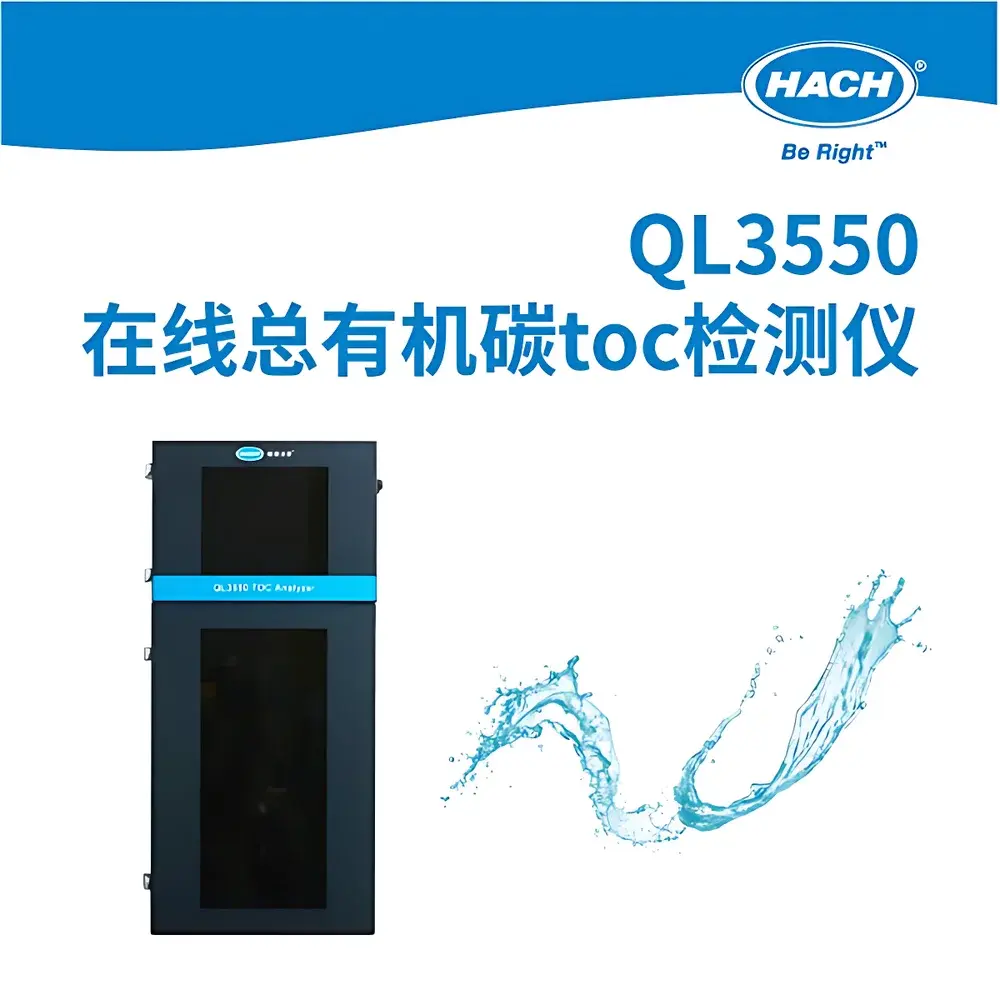
Hach QL3550 Online Total Organic Carbon (TOC) Analyzer
| Brand | Hach |
|---|---|
| Origin | USA |
| Manufacturer | Hach Company |
| Product Type | Online TOC Analyzer |
| Model | 8653700 |
| Detection Principle | Non-Dispersive Infrared (NDIR) Absorption |
| Oxidation Method | UV/Persulfate with Optional Hydroxyl Radical Enhancement |
| Measurement Range | 0–100 µg C/L and 0–2000 µg C/L (Auto-Ranging) |
| Accuracy | ±10 µg C/L or ±3% of reading (whichever is greater) |
| Resolution | 0.001 ppb C |
| Detection Limit | <10 µg C/L |
| Repeatability | ±10 µg C/L or ±2% of reading (whichever is greater) |
| Carrier Gas Options | High-Purity Oxygen (for enhanced oxidation) or Instrument Air (for standard operation) |
| Sample Pathway | Integrated 4-mm ID flow cell, no pretreatment required |
| Reagent-Free Operation | No alkaline reagents used in CO₂ detection pathway |
Overview
The Hach QL3550 Online Total Organic Carbon (TOC) Analyzer is an industrial-grade, real-time water quality monitoring instrument engineered for high-precision, low-level TOC quantification in ultrapure and process water systems. It operates on the principle of catalytic UV/persulfate oxidation followed by non-dispersive infrared (NDIR) detection of liberated CO₂ — a method standardized under ASTM D5903, ISO 8245, and USP . Unlike combustion-based analyzers, the QL3550 eliminates the need for high-temperature furnaces or metal catalysts, delivering stable performance with minimal thermal drift and zero risk of catalyst poisoning. Its dual-oxidation configuration — configurable for either high-purity oxygen or instrument air as carrier gas — enables optimized oxidation efficiency across diverse sample matrices: oxygen-enhanced mode activates hydroxyl radical generation for recalcitrant organics (e.g., humic acids, EDTA), while air-based mode provides robust, maintenance-light operation for routine ultrapure water streams.
Key Features
- Auto-ranging dual-scale measurement (0–100 µg C/L and 0–2000 µg C/L) ensures sub-ppb resolution and linear response across semiconductor-grade UPW to utility boiler feedwater.
- Integrated 4-mm internal diameter fluidic path with built-in flow-through NDIR cell eliminates external sample conditioning, reducing particulate fouling and eliminating membrane filtration or degassing requirements.
- Reagent-free CO₂ detection architecture avoids alkaline reagent addition, thereby eliminating carbonate interference from atmospheric CO₂ dissolution and removing operator-dependent reagent preparation steps.
- High-resolution 7-inch capacitive touchscreen interface supports multi-level user access control (operator, supervisor, administrator), audit-trail-enabled configuration changes, and encrypted local data storage compliant with FDA 21 CFR Part 11 requirements.
- Embedded diagnostics include real-time lamp intensity monitoring, CO₂ baseline stability tracking, oxidation efficiency validation via potassium hydrogen phthalate (KHP) spike recovery, and automatic zero/scale verification cycles.
Sample Compatibility & Compliance
The QL3550 is validated for continuous monitoring of low-conductivity (95% of common organic contaminants referenced in EP 2.2.44 and JP 6.03, including methanol, sucrose, and glycine. All firmware and calibration protocols support GLP/GMP-aligned documentation workflows, including electronic signature capture and revision-controlled method storage.
Software & Data Management
Hach Insight™ embedded software provides secure, role-based web access (HTTPS/TLS 1.2) for remote configuration, trend visualization, and alarm management. Raw sensor outputs (CO₂ absorbance, UV lamp voltage, temperature-compensated conductivity) are logged at 1-second intervals and archived locally for ≥30 days. Data export supports CSV, PDF report generation, and OPC UA server integration for connection to DCS, SCADA, or MES platforms. Firmware updates are delivered via signed package files with SHA-256 hash verification; all configuration changes generate immutable audit logs with timestamp, user ID, and parameter delta.
Applications
- Real-time TOC surveillance in nuclear and fossil-fuel power plant steam/water cycles — specifically condensate polishers, feedwater heaters, and turbine bypass lines.
- In-line verification of UPW system integrity in semiconductor fabs, ensuring compliance with SEMI F63 Class A (≤100 ppt TOC) and Class B (≤500 ppt) specifications.
- Pharmaceutical water-for-injection (WFI) and purified water (PW) distribution loop monitoring per USP , EP 2.2.44, and JP 6.03.
- Monitoring of reclaimed water reuse streams where low-level organic contamination poses biofouling or disinfection-byproduct formation risks.
- Validation support for cleaning-in-place (CIP) rinse cycle endpoint determination in biopharmaceutical manufacturing.
FAQ
What oxidation methods does the QL3550 support, and how do they differ in application?
The QL3550 offers two oxidation configurations: UV/persulfate with instrument air (standard mode) for routine UPW and PW monitoring; and UV/persulfate + hydroxyl radical enhancement using high-purity oxygen (advanced mode) for challenging matrices containing refractory organics such as chelants or polymeric residues.
Is the QL3550 compliant with regulatory data integrity requirements?
Yes — firmware v3.2+ implements full 21 CFR Part 11 functionality, including electronic signatures, audit trails with immutable timestamps, and role-based access control. All calibration events, method changes, and alarm acknowledgments are cryptographically logged.
Does the analyzer require acidification or sparging prior to analysis?
No — the integrated flow cell and NDIR detector operate without acid addition or inert gas sparging. Inorganic carbon (IC) is measured separately via acidification in a dedicated IC channel, enabling accurate TOC = TC − IC calculation without manual intervention.
How often is preventive maintenance required?
Under normal UPW conditions, scheduled maintenance is recommended every 6 months and includes UV lamp replacement, NDIR window inspection, and flow path integrity verification. No consumable reagents or catalysts are used in the core measurement process.
Can the QL3550 be integrated into existing plant automation systems?
Yes — it supports Modbus TCP, OPC UA, and 4–20 mA analog output (with HART) for seamless integration into DCS, PLC, or centralized asset management platforms. Configuration and diagnostics are accessible via standard web browser over Ethernet.







