
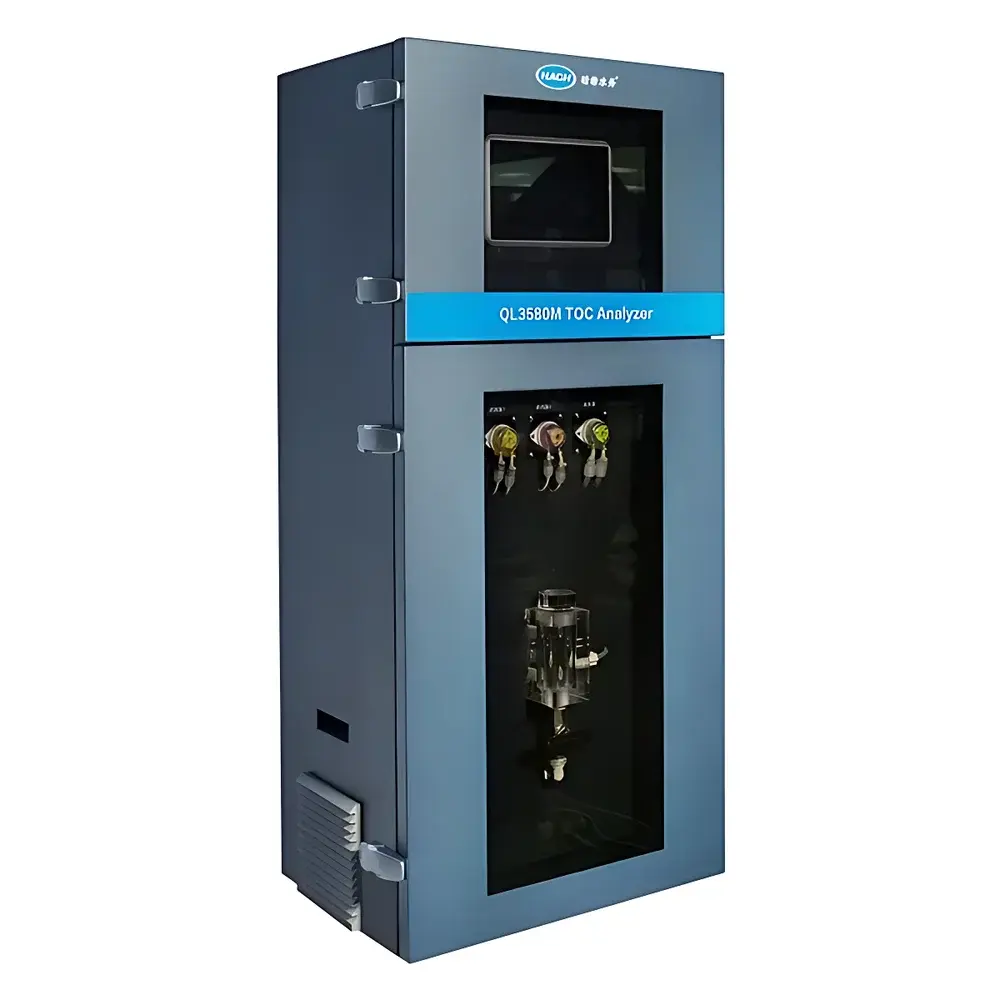
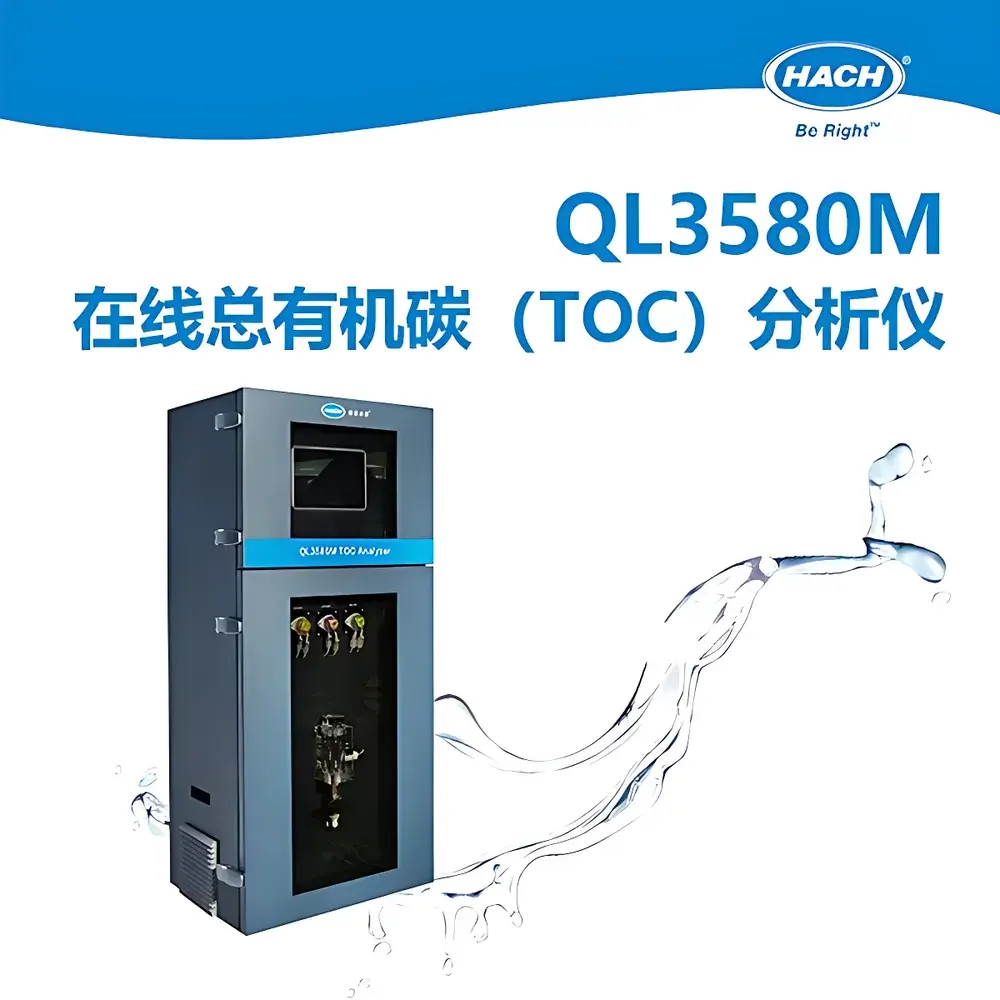
HACH QL3580M Online Total Organic Carbon (TOC) Analyzer
| Brand | HACH |
|---|---|
| Origin | Imported |
| Manufacturer Type | Manufacturer |
| Instrument Type | Online TOC Analyzer |
| Model | QL3580M |
| Detection Principle | Non-Dispersive Infrared (NDIR) Absorption |
| Oxidation Method | UV/Persulfate with Hydroxyl Radical Enhancement |
| Measurement Range | 0–10 mg C/L |
| Accuracy | ±3% of reading or ±0.05 mg C/L (whichever is greater) |
| Resolution | 0.5 mg C/L |
| Detection Limit | 0.5 mg C/L |
| Repeatability | ±2% of reading or ±0.05 mg C/L (whichever is greater) |
Overview
The HACH QL3580M Online Total Organic Carbon (TOC) Analyzer is a robust, field-deployable instrument engineered for continuous, real-time quantification of organic carbon content in potable water, distribution system networks, and industrial process water streams. It operates on the fundamental principle of catalytic oxidation followed by non-dispersive infrared (NDIR) detection of evolved CO₂ — a method standardized under ASTM D5905, ISO 8245, and USP . The analyzer sequentially measures total inorganic carbon (TIC) and total organic carbon (TOC) through a dual-phase acidification–oxidation protocol. First, sample acidification liberates inorganic carbon as CO₂, which is purged and quantified via NDIR. Subsequently, the same sample undergoes advanced oxidation using combined UV irradiation and persulfate chemistry enhanced by hydroxyl radical generation, ensuring complete mineralization of refractory organic compounds—even at sub-mg/L concentrations. This two-step differential measurement eliminates cross-interference between TIC and TOC, delivering metrologically traceable results compliant with regulatory reporting requirements for drinking water utilities and pharmaceutical water systems.
Key Features
- Enhanced oxidation architecture integrating 185/254 nm UV lamps with sodium persulfate and in-situ hydroxyl radical activation—achieving >95% oxidation efficiency across diverse organic matrices including humic acids, low-molecular-weight organics, and chlorinated byproducts.
- 4 mm internal diameter fluidic pathway with integrated flow-through cell; accommodates suspended solids up to 2 mm in diameter without pre-filtration, reducing clogging risk and operational downtime in raw or minimally treated water applications.
- Two-point automated calibration using certified potassium hydrogen phthalate (KHP) and inorganic carbonate standards—executed without manual reagent handling or external PC intervention.
- Batch-mode measurement cycle minimizes reagent consumption and waste generation; typical reagent usage is ≤1.2 mL per analysis, supporting >30 days of unattended operation with standard 500 mL reagent reservoirs.
- Reagent-free TIC removal step: CO₂ purge utilizes CO₂-scrubbed air or oxygen carrier gas, eliminating alkaline reagents (e.g., NaOH) that otherwise introduce carbonate contamination and drift during long-term deployment.
- Industrial-grade 7-inch capacitive touchscreen interface with IP65-rated front panel; supports multi-level user access control (operator, technician, administrator), audit-trail-enabled configuration logging, and secure firmware updates via USB or Ethernet.
Sample Compatibility & Compliance
The QL3580M accepts aqueous samples with conductivity ≤5 mS/cm, turbidity ≤100 NTU, and chloride concentration ≤500 mg/L—covering municipal finished water, groundwater sources, cooling tower makeup, and purified water (PW) loops in biopharmaceutical facilities. Its measurement methodology conforms to EPA Method 415.3, ISO 20674:2016 (Water quality — Determination of total organic carbon), and supports data integrity requirements under FDA 21 CFR Part 11 when deployed with optional HACH DataStream™ Secure Edition software. Instrument design meets IEC 61326-1 (EMC) and IEC 61010-1 (safety) standards for industrial environments.
Software & Data Management
Embedded firmware provides local data storage for ≥12 months of 5-minute interval measurements (TOC, TIC, conductivity, temperature, system status). Data export is supported via Modbus TCP, 4–20 mA analog outputs (isolated), and RS-485 serial interface. Optional integration with HACH IntelliLink™ cloud platform enables remote monitoring, predictive maintenance alerts, and automated report generation aligned with GLP/GMP documentation workflows. All configuration changes, calibration events, and error logs are timestamped and digitally signed to satisfy audit readiness criteria.
Applications
- Real-time TOC surveillance at drinking water treatment plant effluent points and distribution system entry points to verify disinfection byproduct precursor removal.
- Monitoring of surface water intakes and groundwater wells for early detection of organic contamination events (e.g., algal blooms, agricultural runoff).
- Validation and routine control of purified water (PW) and water for injection (WFI) systems in pharmaceutical manufacturing per USP and EU Annex 1.
- Process water quality assurance in semiconductor fab ultrapure water (UPW) sub-loops where TOC excursions directly impact wafer yield.
- Compliance reporting for ISO 14001 environmental management systems and corporate sustainability disclosures requiring quantitative carbon load tracking.
FAQ
Does the QL3580M require daily manual calibration?
No. The analyzer performs fully automated two-point calibration at user-defined intervals (e.g., every 24 hours) using onboard standard solutions; no operator intervention is required beyond periodic reagent replenishment.
Can it operate reliably in high-chloride industrial wastewater?
The QL3580M is optimized for low-conductivity potable and process waters. For chloride concentrations exceeding 500 mg/L, HACH recommends the QL3580M-Cl variant with corrosion-resistant wetted materials and modified oxidation parameters.
Is raw data accessible for third-party LIMS integration?
Yes. Full-resolution TOC, TIC, temperature, pressure, and diagnostic values are available via Modbus TCP register mapping or ASCII over RS-485, enabling seamless ingestion into laboratory information management systems (LIMS) or SCADA platforms.
What maintenance is required beyond reagent replacement?
Annual verification of NDIR detector stability and UV lamp output intensity is recommended; all diagnostics and performance checks can be initiated remotely or via the front-panel interface.
Does the instrument support alarm relay outputs for process shutdown triggers?
Yes. Two programmable dry-contact relays are provided—one for TOC high-limit alarm, one for system fault condition—with configurable hysteresis and delay timers to prevent nuisance tripping.







