
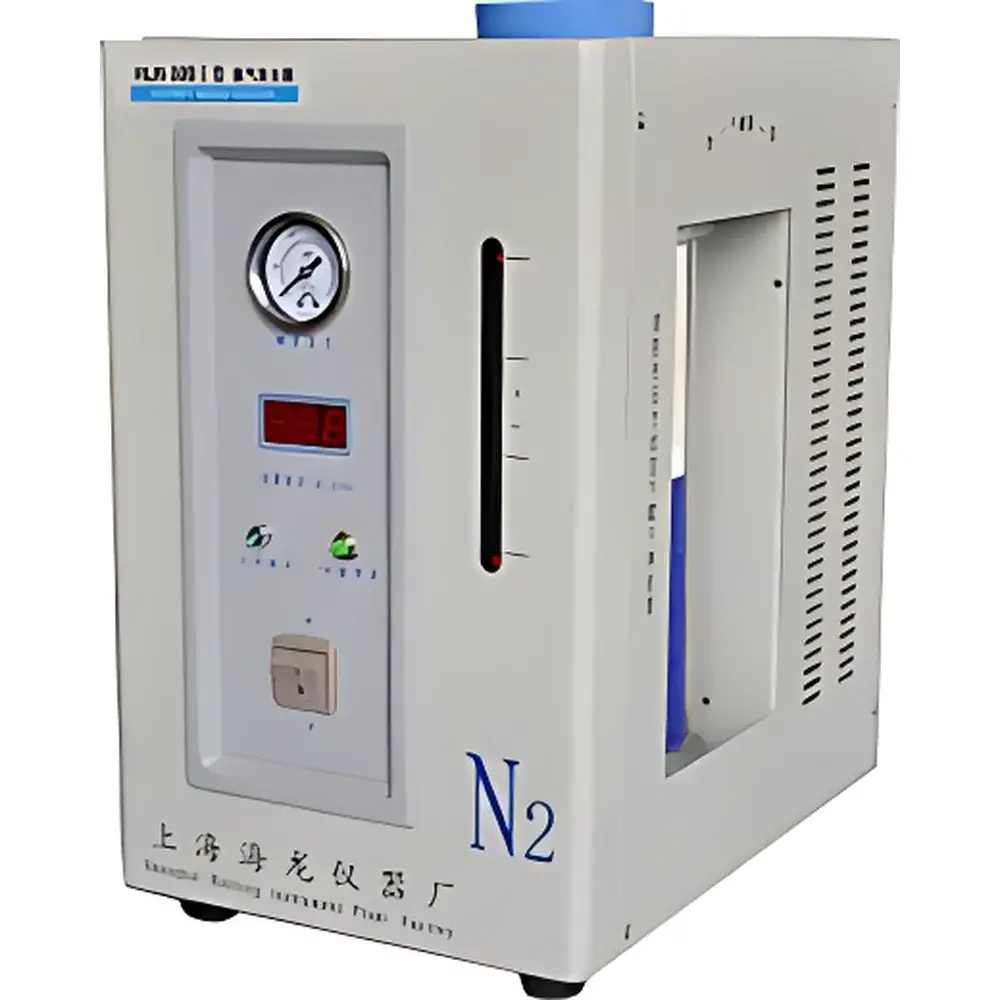
Hailong HLN-300II High-Purity Nitrogen Generator
| Brand | Hailong |
|---|---|
| Model | HLN-300II |
| Purity | >99.999% |
| Flow Rate | 0–300 mL/min |
| Output Pressure | 0–0.5 MPa (factory-set at 0.4 MPa) |
| Power Supply | 220 V ±10%, 50 Hz ±5% |
| Max. Power Consumption | 85 W |
| Operating Temperature | 10–40 °C |
| Relative Humidity | ≤85% RH |
| Dimensions | 320 × 180 × 350 mm |
| Weight | 12 kg |
| Electrolytic Cell Warranty | 3 years |
| System Warranty | 1 year |
Overview
The Hailong HLN-300II High-Purity Nitrogen Generator is an on-demand, membrane-assisted alkaline electrolytic nitrogen generator engineered for continuous, reliable production of ultra-high-purity nitrogen gas (≥99.999%) in laboratory environments. It employs a dual-cathode stainless-steel electrolytic separation cell operating on the principle of water electrolysis: deionized water is decomposed into hydrogen and oxygen gases at the anode and cathode, while nitrogen is selectively extracted from ambient air via pressure-swing adsorption (PSA) or, in this configuration, purified through electrochemical oxygen removal—ensuring oxygen is actively scavenged during electrolysis to yield nitrogen with sub-1 ppm O₂ residual. Unlike compressed-air-fed PSA systems, the HLN-300II integrates electrolytic oxygen depletion with optimized gas separation dynamics, eliminating dependence on inlet air quality and delivering consistent purity without carbon molecular sieve degradation. Designed for integration with GC, LC-MS, FTIR, and other analytical instrumentation requiring inert purge or carrier gas, it meets stringent requirements for trace-level oxygen sensitivity in applications such as residual solvent analysis, headspace sampling, and controlled-atmosphere sample preparation.
Key Features
- Dual-cathode stainless-steel electrolytic separation cell with enlarged electrode surface area—enhancing current distribution, reducing localized heating, and improving long-term thermal stability and gas yield consistency.
- Integrated anti-backflow protection mechanism—mechanically and pneumatically interlocked to prevent electrolyte back migration under transient pressure differentials or system shutdown conditions.
- Automatic pressure regulation and fail-safe shut-off circuitry—maintains stable output pressure (factory preset at 0.4 MPa, adjustable up to 0.5 MPa) and initiates immediate gas-line isolation upon power loss or overtemperature detection.
- High-efficiency switching-mode power supply—optimized for low ripple, precise voltage control, and improved electrolytic conversion efficiency across the full 0–300 mL/min flow range.
- Compact benchtop footprint (320 × 180 × 350 mm) and lightweight aluminum-chassis construction (12 kg)—facilitating deployment in space-constrained labs, fume hoods, or mobile analytical platforms.
Sample Compatibility & Compliance
The HLN-300II delivers nitrogen suitable for Class 5 (ISO 8573-1:2010) compressed gas quality—meeting ASTM D6352 and ISO/IEC 17025 method validation prerequisites for carrier gas in chromatographic applications. Its ≥99.999% purity (≤1 ppm O₂, ≤1 ppm H₂O, ≤0.1 ppm total hydrocarbons) supports compliance with USP , ICH Q3C(R8), and EP 2.4.24 for residual solvent testing. The unit requires only deionized water (resistivity ≥1 MΩ·cm) as feedstock—no external air compressors, dryers, or nitrogen cylinders. All electrical components conform to IEC 61010-1 safety standards; CE marking applies for EMC and low-voltage directive compliance. While not inherently 21 CFR Part 11 compliant, audit-ready operation is supported when paired with validated LIMS or CDS software enabling electronic record retention and user-access logging.
Software & Data Management
The HLN-300II operates as a standalone hardware module with no embedded microcontroller or digital interface. All operational parameters—including real-time pressure, flow status, and thermal sensor feedback—are indicated via analog gauges and LED status indicators. For laboratories requiring automated monitoring or integration into centralized facility management systems, optional analog 4–20 mA output modules (sold separately) enable connection to PLCs or SCADA platforms for remote pressure/flow trending and predictive maintenance alerts. No proprietary software is required; however, instrument logs (e.g., runtime hours, service intervals) should be maintained manually per GLP documentation standards.
Applications
- Carrier gas supply for capillary gas chromatography (GC) and GC-MS systems requiring baseline stability and minimal oxidative column bleed.
- Purge gas for headspace autosamplers, especially in volatile organic compound (VOC) quantification where oxygen interference affects derivatization kinetics.
- Inert blanketing in sample vial storage, reagent dispensing stations, and glovebox antechambers to prevent oxidation of air-sensitive standards or catalysts.
- Zero-air generation support—when coupled with catalytic oxidizers—for calibration gas preparation in environmental air monitoring labs.
- On-site nitrogen supply for portable Raman spectrometers and laser-based particle analyzers requiring vibration-free, oil-free gas sources.
FAQ
What feedstock does the HLN-300II require?
Deionized water with resistivity ≥1 MΩ·cm. No compressed air, nitrogen cylinders, or external dryers are needed.
Is the output pressure adjustable?
Yes—the regulator is factory-set to 0.4 MPa but can be manually adjusted within the 0–0.5 MPa range using the front-panel pressure knob.
How often does the electrolyte require replacement?
The unit uses a closed-loop circulating KOH-based electrolyte; under normal operation and proper water quality, no scheduled replacement is required within the 3-year electrolytic cell warranty period.
Can the HLN-300II be used in GMP-regulated environments?
It meets physical and purity specifications for GMP-compliant labs; however, formal qualification (IQ/OQ/PQ) must be performed per internal SOPs, including flow accuracy verification, purity certification via GC-TCD, and alarm response testing.
Does it generate hydrogen as a byproduct?
Yes—hydrogen is produced at the cathode during electrolysis and safely vented through a dedicated exhaust port; installation requires adequate ventilation per local chemical safety codes.



