
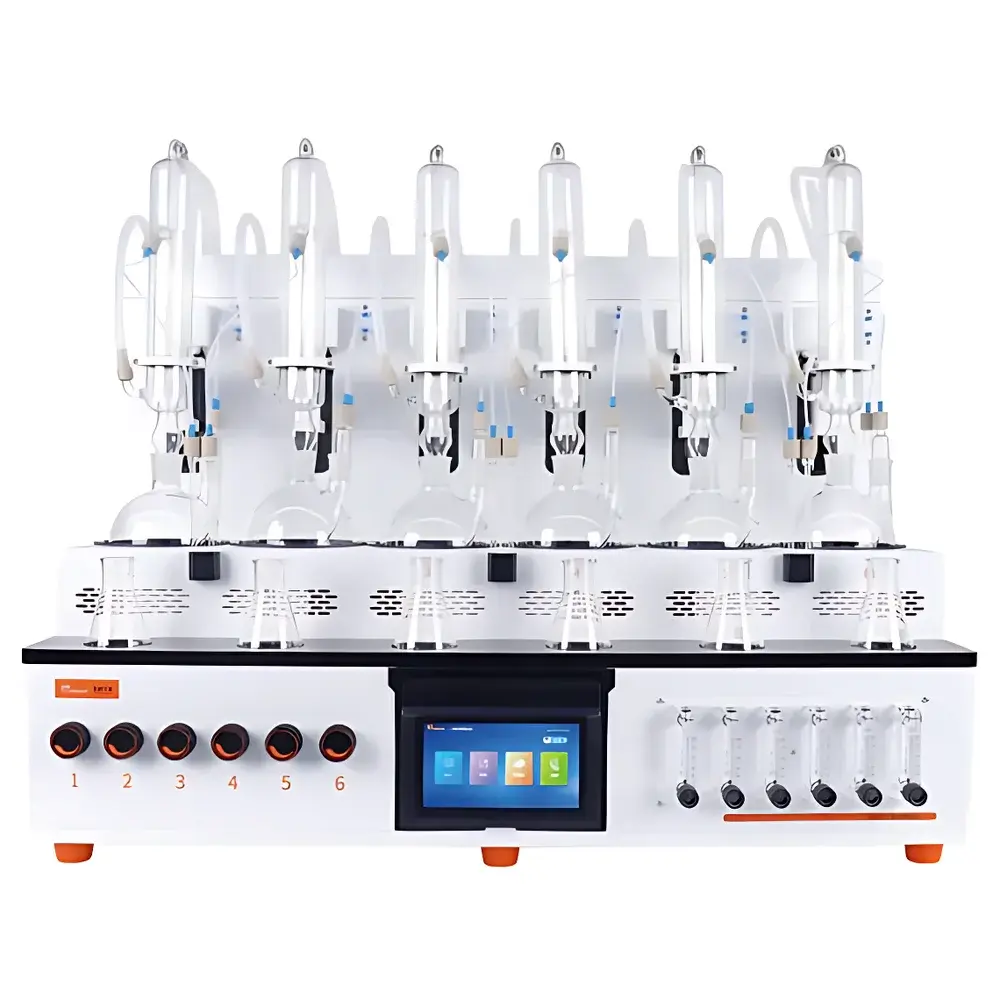
Hanon SOA600 Automated Sulfur Dioxide Distillation Analyzer
| Brand | Hanon |
|---|---|
| Origin | Shandong, China |
| Model | SOA600 |
| Type | Intelligent Automated SO₂ Distillation System |
| Max. Sample Capacity | 6 channels |
| Distillation Time Range | 1–999 min |
| N₂ Flow Rate | 50–2000 mL/min per channel |
| Distillation Flask Volume | 1000 mL |
| Power per Channel | 0–500 W |
| Total Rated Power | 3100 W |
| Dimensions (W×D×H) | 970 × 500 × 470 mm |
| Net Weight | 75 kg |
Overview
The Hanon SOA600 Automated Sulfur Dioxide Distillation Analyzer is a dedicated pharmaceutical and food safety instrument engineered for precise, reproducible quantification of sulfur dioxide (SO₂) in complex matrices—primarily herbal medicines, dried fruits, wine, seafood, and processed food products. It operates on the principle of acid distillation followed by iodometric or para-rosaniline colorimetric titration, fully compliant with the core methodology defined in GB 5009.34–2022 *National Food Safety Standard – Determination of Sulfur Dioxide in Foods* and the *Chinese Pharmacopoeia* (ChP) General Chapter 0832 *Determination of Sulfur Dioxide Residues*. Unlike manual or semi-automated setups, the SOA600 integrates controlled thermal distillation, programmable nitrogen purging, reagent dosing, and condensate collection into a single synchronized platform—eliminating operator-dependent variability and significantly reducing analytical turnaround time.
Key Features
- Six independent distillation channels with individual heating control, enabling parallel analysis of heterogeneous samples under customized protocols without cross-channel interference.
- Hemispherical ceramic infrared heating modules ensure rapid, uniform thermal transfer to 1000 mL round-bottom flasks—minimizing localized overheating and enhancing SO₂ recovery consistency.
- Per-channel digital mass flow-controlled nitrogen delivery (50–2000 mL/min), supporting method-specific purge optimization for volatile SO₂ liberation and carrier gas-assisted transfer to the absorption trap.
- Android-based embedded OS with intuitive touchscreen interface; supports both preloaded SOP-driven automated runs and manual stepwise operation with real-time parameter adjustment.
- Integrated reagent dispensing system for automatic addition of phosphoric acid and distilled water—reducing human error and exposure risk during hazardous acid handling.
- Self-cleaning fluidic pathway with programmable rinse cycles using deionized water or ethanol, preventing carryover between analyses and ensuring long-term system integrity.
- Articulating condenser assembly with threaded quick-release couplings—facilitating ergonomic positioning, efficient vapor condensation, and routine maintenance without tools.
Sample Compatibility & Compliance
The SOA600 is validated for use with solid, semi-solid, and liquid samples across regulated pharmaceutical and food testing environments. Its design accommodates high-fat, high-sugar, and matrix-rich botanicals—including traditional Chinese medicinal herbs (e.g., *Glycyrrhiza*, *Lonicera*, *Paeonia*)—where SO₂ residues may bind tightly to carbohydrates or proteins. All operational parameters—including temperature ramp profiles, nitrogen flow sequencing, and distillation duration—are configurable to meet matrix-specific extraction requirements. The system complies with GLP and GMP documentation standards: audit trails record user actions, method versions, timestamps, and parameter changes; electronic signatures are enforced per FDA 21 CFR Part 11 Annex 11 requirements. It supports alignment with ISO/IEC 17025 clause 7.2.2 (method validation) and USP Analytical Instrument Qualification protocols.
Software & Data Management
The onboard software features a built-in method library containing pre-validated procedures aligned with GB 5009.34, ChP 0832, and AOAC Official Method 990.28. Users can clone, modify, and version-control methods with full metadata logging. Data export options include CSV, PDF analytical reports, and structured XML for LIMS integration. Cloud connectivity via LAN or Wi-Fi enables secure remote monitoring, method synchronization across laboratory sites, and encrypted backup of raw data, calibration logs, and QC records. Role-based access control (RBAC) enforces three-tier authentication (administrator, analyst, reviewer), with session timeouts and password complexity policies meeting NIST SP 800-63B guidelines.
Applications
- Quantitative SO₂ residue testing in raw herbal materials and finished TCM formulations prior to batch release.
- Routine quality control of sulfited dried fruits (e.g., apricots, raisins), wines, and frozen seafood in food manufacturing QA labs.
- Stability study support—monitoring SO₂ degradation kinetics under accelerated storage conditions.
- Method development and validation studies for alternative SO₂ detection workflows requiring precise distillation control.
- Regulatory submission support—generating auditable, ALCOA+ compliant data packages for CFDA/NMPA, FDA, or EMA review.
FAQ
What regulatory standards does the SOA600 directly support?
It is designed to execute distillation protocols specified in GB 5009.34–2022 and ChP 0832, with full traceability features satisfying FDA 21 CFR Part 11, ISO/IEC 17025, and EU GMP Annex 11 requirements.
Can the SOA600 be integrated into an existing LIMS environment?
Yes—via standardized CSV export, HL7-compatible metadata tagging, and optional API-enabled data push to common LIMS platforms (e.g., LabWare, Thermo Fisher SampleManager).
Is method validation documentation provided with the instrument?
A comprehensive IQ/OQ/PQ protocol package—including installation checklist, operational verification tests, and performance qualification templates—is supplied with each unit.
How is cross-contamination prevented between sequential runs?
Automated post-run rinsing of all fluid-contact surfaces (distillation head, condenser, absorption tube) using programmable solvent sequences ensures <0.1% carryover as verified by blank spike recovery tests.
What maintenance intervals are recommended for optimal performance?
Daily visual inspection of seals and tubing; monthly calibration of nitrogen mass flow controllers and temperature sensors using NIST-traceable references; annual full-system verification per manufacturer’s PQ checklist.




