
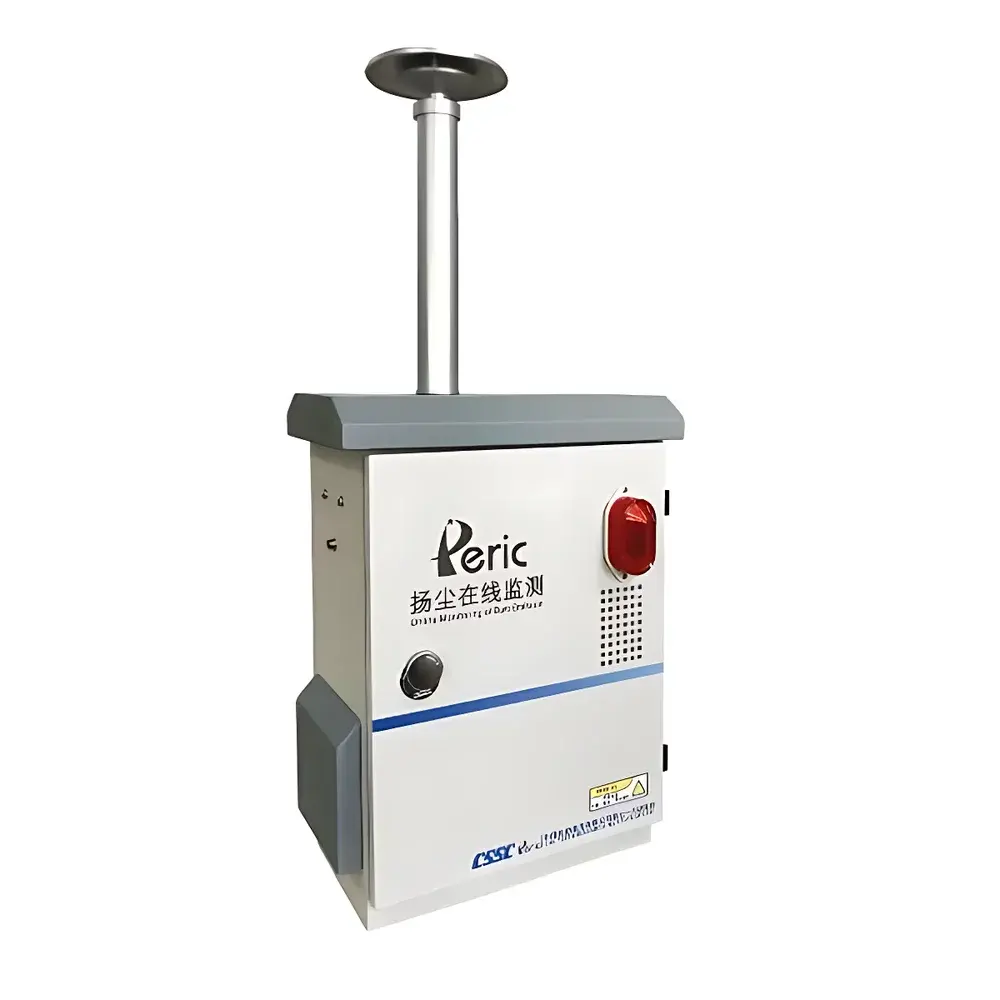
PERIC EMO-YC Industrial-Grade Real-Time Dust & Meteorological Monitoring System
| Brand | PERIC |
|---|---|
| Model | EMO-YC |
| Origin | Hebei, China |
| Manufacturer Type | Direct Manufacturer |
| Country of Origin | China |
| Certification | CCEP, CPA, CMA |
| Measurement Principle | Laser Light Scattering |
| Particle Range | TSP/PM10/PM2.5: 0–10 mg/m³ |
| LOD | 0.001 mg/m³ |
| Accuracy | ±10% |
| Temp. Range | −40–80 °C (±0.3 °C) |
| RH Range | 0–100% RH (±3% RH) |
| Wind Speed | 0–30.0 m/s (0.1 m/s res.) |
| Wind Direction | 0–360° (8-sector) |
| Barometric Pressure | 300–1100 hPa (1 Pa res.) |
| IP Rating | IP54 |
| Power Input | AC 220 V |
| Data Transmission | 4G Cellular + Optional Wired Ethernet |
| Operating Temp. | −20–70 °C |
| Humidity Limit | ≤95% RH non-condensing |
Overview
The PERIC EMO-YC Industrial-Grade Real-Time Dust & Meteorological Monitoring System is a purpose-engineered environmental monitoring station designed for continuous, unattended operation in demanding outdoor and industrial settings. It employs the laser light scattering principle to quantify airborne particulate mass concentrations—including total suspended particles (TSP), PM10, and PM2.5—with high repeatability and low detection limits (0.001 mg/m³). Complementing particle measurement, the system integrates calibrated meteorological sensors for temperature, relative humidity, atmospheric pressure, wind speed, wind direction, and ambient noise—enabling comprehensive source attribution, dispersion modeling, and correlation analysis between particulate levels and local weather dynamics. Its robust architecture supports long-term deployment under extreme ambient conditions (−20 °C to 70 °C; ≤95% RH non-condensing), making it suitable for fixed-site monitoring, mobile deployment on construction vehicles or haul trucks, and integration into regional air quality management platforms.
Key Features
- Multi-parameter real-time sensing: Simultaneous acquisition of TSP, PM10, PM2.5, temperature, humidity, barometric pressure, wind speed/direction, and noise level
- Laser-based optical particle detection with factory-calibrated response curves and automatic zero-point compensation
- Integrated high-brightness LED display for on-site visibility of critical metrics without external interface
- Dual-mode data transmission: Embedded 4G LTE module for cellular telemetry + optional RJ45 Ethernet port for fiber or LAN backbone integration
- Remote configuration and firmware update capability via secure HTTPS-based web interface or MQTT protocol
- IP54-rated enclosure ensuring protection against dust ingress and water splashing—certified for permanent outdoor mounting
- Compliance-ready architecture supporting audit trails, parameter change logs, and timestamped raw data export for regulatory reporting
Sample Compatibility & Compliance
The EMO-YC system is validated for ambient air sampling in open environments, including urban roadside zones, industrial perimeters, construction sites, material stockpiles, and landfill boundaries. It meets the technical requirements stipulated in Chinese Environmental Protection Standards HJ 653–2013 (for PM2.5/PM10 monitors) and HJ 964–2018 (for integrated environmental monitoring stations). Certified by the China Environmental Protection Industry Association (CCEP), the State Administration for Market Regulation (CPA Type Approval), and accredited testing laboratories (CMA), the system satisfies national metrological verification protocols and supports traceable calibration using NIST-traceable reference aerosols. While not CE-marked or EPA EQVM-listed, its modular sensor design permits future adaptation to ISO 12103-1 A2 test dust protocols and ASTM D6245-22 guidance for indoor/outdoor particulate assessment.
Software & Data Management
Data from the EMO-YC is structured according to IEC 61850-8-1 MMS conventions and ingested into cloud-hosted platforms via TLS 1.2–secured RESTful APIs or MQTT v3.1.1 brokers. The embedded firmware supports configurable sampling intervals (1–60 min), local SD-card buffering (up to 30 days at 1-min resolution), and automated alarm triggers based on user-defined thresholds (e.g., PM10 > 150 µg/m³ for 15 consecutive minutes). Cloud dashboards provide GIS-mapped visualization, time-series trend analysis, statistical summaries (hourly/daily/weekly averages), and PDF report generation compliant with GB/T 32210–2015 documentation standards. Audit logs record all configuration changes, calibration events, and communication status—supporting GLP-aligned operational integrity for municipal environmental bureaus and third-party compliance auditors.
Applications
- Unorganized emission monitoring at thermal power plants, cement kilns, steel mills, and aggregate processing facilities
- Construction site boundary monitoring per local “Dust Control Regulations” and Ministry of Ecology and Environment (MEE) Notice No. 31 (2020)
- Urban micro-grid air quality surveillance—deployed at traffic intersections, schools, hospitals, and residential districts
- Real-time feedback control of dust suppression systems (e.g., triggering fog cannons or water sprinklers upon threshold exceedance)
- Baseline ambient air characterization prior to brownfield redevelopment or new infrastructure projects
- Research-grade longitudinal studies correlating particulate exposure with meteorological drivers (e.g., inversion layer formation, wind sector analysis)
FAQ
Does the EMO-YC support remote calibration or zero-check procedures?
Yes—the system includes an onboard zero-air purge cycle activated via remote command; field calibration requires certified reference instruments per JJF 1659–2017.
Can the device be integrated with existing SCADA or BMS platforms?
Yes—it provides Modbus TCP and ASCII serial output (RS485) alongside HTTP/MQTT endpoints for seamless interoperability with industrial control systems.
What is the recommended maintenance interval for optical components?
Optical windows require cleaning every 30–90 days depending on local dust loading; full sensor recalibration is advised annually or after exposure to >10 mg/m³ sustained particulate events.
Is historical data export available in CSV or JSON format?
Yes—raw 1-minute interval data and aggregated hourly summaries can be downloaded programmatically via API or manually through the web portal in UTF-8 encoded CSV, with optional ISO 8601 timestamps and UTC/GMT timezone tagging.
How does the system handle signal loss during network outages?
All measurements are buffered locally on a removable industrial-grade microSD card (supplied); data syncs automatically upon network restoration without gaps or duplication.







