
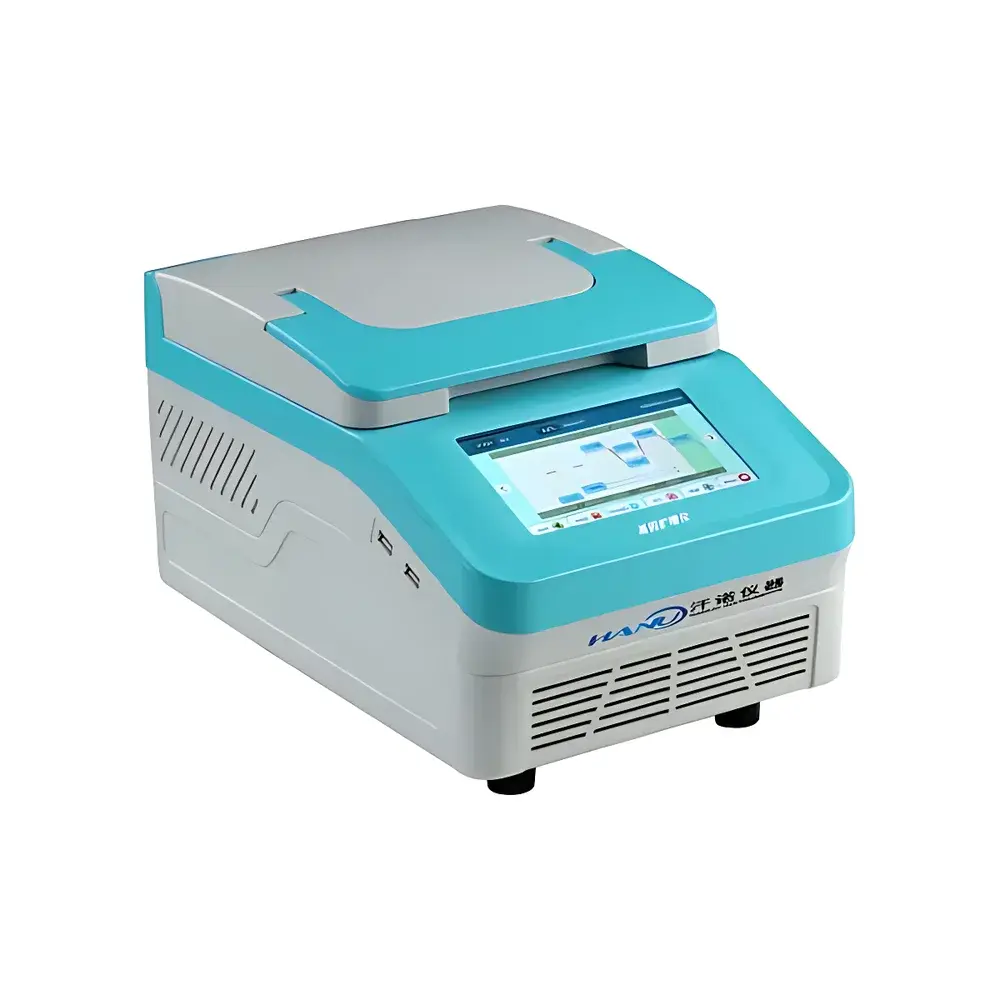
Hanuo HN-SP96G Gradient Thermal Cycler for PCR
| Brand | Hanuo |
|---|---|
| Origin | Shanghai, China |
| Model | HN-SP96G |
| Instrument Type | Gradient PCR Thermal Cycler |
| Sample Capacity | 96-well (0.2 mL tubes and 8-tube strips) |
| Heating Rate | 5 °C/s |
| Cooling Rate | 4 °C/s |
| Temperature Accuracy | ±0.2 °C |
| Temperature Uniformity (Well-to-Well) | ≤±0.2 °C |
| Gradient Range | 30–105 °C |
| Gradient Span | 0.1–30 °C |
| Block Material | Anodized Aluminum |
| Heat Lid Temperature Range | 30–115 °C |
| Heat Lid Pressure | Auto-adjusting spring-loaded mechanism |
| Display | 7-inch resistive touchscreen (800 × 480 resolution) |
| Onboard Storage | >10,000 protocols |
| Data Interface | Dual USB 2.0 ports |
| Power Input | AC 100–240 V, 50–60 Hz |
| Max Power Consumption | 800 W |
| Dimensions (W×D×H) | 420 × 260 × 245 mm |
| Weight | 11 kg |
Overview
The Hanuo HN-SP96G Gradient Thermal Cycler is a precision-engineered instrument designed for reliable, reproducible polymerase chain reaction (PCR) amplification under tightly controlled thermal conditions. It operates on the principle of Peltier-based thermoelectric heating and cooling, enabling rapid and accurate temperature transitions across a 96-well aluminum block. Unlike conventional water-bath or air-heated cyclers, the HN-SP96G employs three independently controlled semiconductor zones to minimize thermal lag and ensure uniform heat distribution—critical for multiplex assays, optimization of annealing temperatures, and high-fidelity amplification of GC-rich or secondary-structure-prone templates. Its gradient functionality allows simultaneous testing of up to 12 distinct annealing temperatures across the block, accelerating assay development without requiring repeated runs. The system is calibrated per ISO/IEC 17025 traceable procedures and meets essential performance benchmarks defined in ASTM E2596 (Standard Guide for Validation of Thermal Cyclers), making it suitable for routine QC, academic research, and regulated pre-clinical workflows.
Key Features
- Triple-zone Peltier module architecture ensures independent thermal control of upper, center, and lower block regions—enhancing ramp fidelity and reducing edge effects.
- Anodized aluminum reaction block with optimized thermal mass delivers high conductivity, corrosion resistance, and long-term dimensional stability under repeated thermal cycling.
- Auto-adjusting pressure-sensitive heat lid applies consistent, programmable contact force to tube caps—eliminating condensation-related evaporation and ensuring seal integrity across diverse tube types (0.2 mL single tubes, 8-strip, and 96-well plates).
- High-resolution 7-inch resistive touchscreen with intuitive icon-driven UI supports glove-compatible operation and real-time parameter adjustment during run execution.
- Embedded Linux-based operating system provides deterministic response latency (<100 ms), robust multitasking, and seamless firmware updates via USB flash drive.
- Programmable Tm calculation engine integrates nearest-neighbor thermodynamic models for primer pair analysis—supporting manual override and batch editing of annealing profiles.
- Dual USB 2.0 ports enable simultaneous data export (CSV-formatted run logs, thermal profiles, error reports) and secure firmware upgrades—no external PC dependency required.
- Comprehensive safety architecture includes overtemperature cutoff, open-lid detection, power-fail recovery with auto-resume, and hardware-level watchdog monitoring.
Sample Compatibility & Compliance
The HN-SP96G accommodates standard 0.2 mL thin-wall PCR tubes, 8-tube strips, and full-skirted 96-well plates—compatible with all major enzyme chemistries (Taq, Hot Start, Q5, Phusion, and reverse transcriptases). Its thermal calibration conforms to ISO 13485-aligned manufacturing controls, and temperature accuracy/uniformity specifications meet the minimum requirements outlined in CLSI EP10-A3 for analytical equipment verification. While not FDA 510(k)-cleared, the instrument’s design documentation, change control records, and validation support packages are structured to facilitate integration into GLP-compliant laboratories and ISO 15189-accredited molecular pathology environments. Audit trails for protocol edits, user logins, and critical parameter changes can be exported for regulatory review.
Software & Data Management
No proprietary desktop software is required: all configuration, method creation, and data retrieval occur natively on-device. Protocol libraries support hierarchical folder organization, version timestamping, and password-protected access levels (Operator, Supervisor, Administrator). Run logs include cycle-by-cycle temperature deviation metrics, real-time graphing of block vs. simulated tube temperature, and automatic detection of thermal anomalies (e.g., overshoot, dwell instability). Exported files comply with MIAME-compliant metadata conventions and are compatible with LIMS ingestion via standard CSV parsers. Optional Wi-Fi module (field-installable) enables remote status polling and scheduled report push to network storage—configured without exposing the device to enterprise domain authentication.
Applications
- Optimization of PCR annealing temperatures using linear or stepped gradients across 12 columns.
- Routine genotyping, SNP detection, and methylation-specific PCR where precise thermal control directly impacts specificity.
- cDNA synthesis and qRT-PCR setup requiring stable 16 °C hold steps for enzyme equilibration.
- Enzymatic reactions beyond PCR—including restriction digestion, ligation, and dephosphorylation—leveraging programmable incubation profiles.
- Teaching laboratories requiring rugged, low-maintenance instrumentation with visual feedback and error diagnostics.
FAQ
Does the HN-SP96G support remote monitoring via Ethernet or cloud platforms?
No native Ethernet port is included; however, optional Wi-Fi add-on modules enable local network connectivity for status queries and log exports—not cloud synchronization or vendor-hosted dashboards.
Can I validate temperature performance per ISO/IEC 17025 requirements?
Yes—the instrument ships with a NIST-traceable calibration certificate and supports third-party probe insertion (via dedicated port) for on-site verification using accredited thermocouple systems.
Is the USB interface compatible with Windows, macOS, and Linux hosts?
Yes—USB mass storage mode requires no drivers; exported logs are plain-text CSV files readable by any spreadsheet or data analysis application.
What maintenance is required for long-term reliability?
Annual inspection of heat-lid spring tension and block surface oxidation is recommended; no consumables or recalibration intervals are mandated under normal usage conditions.
How does the “simulated tube temperature” algorithm differ from block-sensor readings?
The embedded model estimates actual sample temperature by compensating for thermal lag, tube wall thickness, and liquid volume—displayed alongside raw block sensor data for method troubleshooting.






