
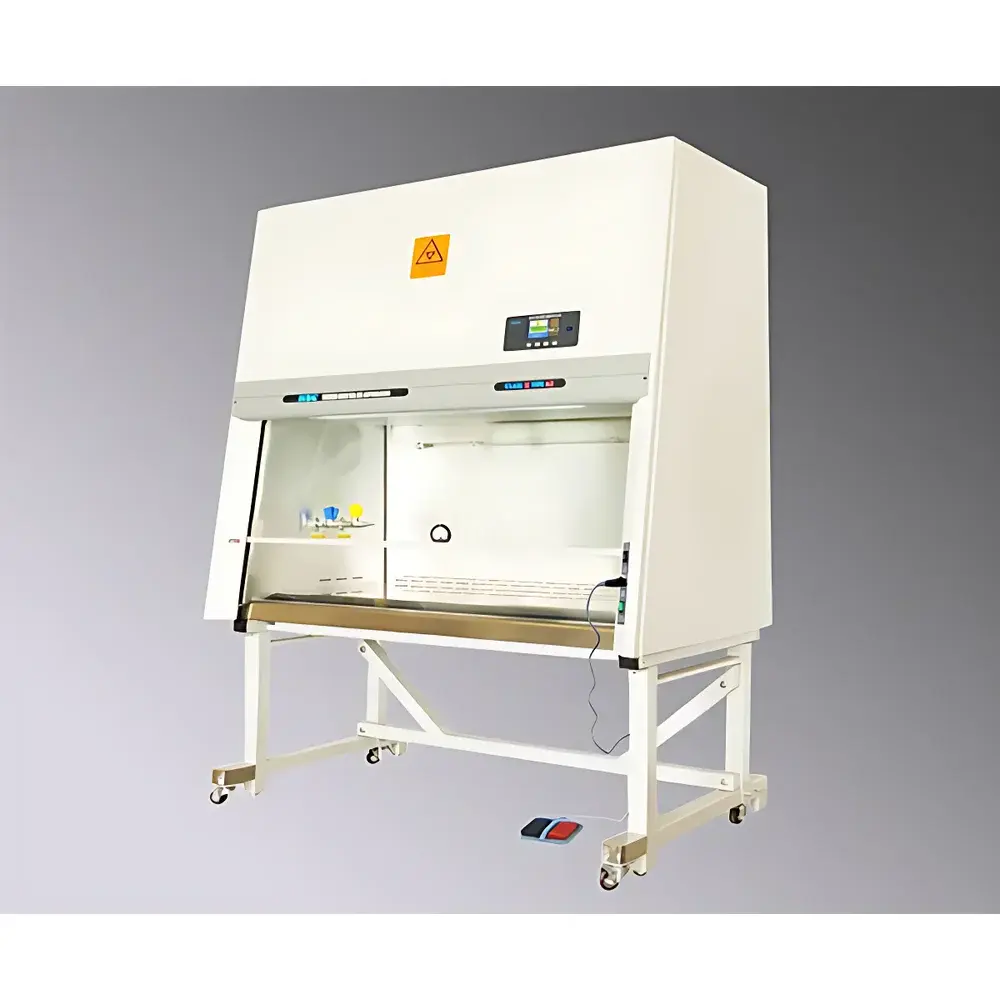
HD-Lab BSC-1100 II A2 Class II Biological Safety Cabinet
| Brand | HD-Lab (HDL) |
|---|---|
| Origin | Beijing, China |
| Model | BSC-1100 II A2 |
| Cabinet Class | NSF/ANSI 49–2022 & EN 12469:2000 Compliant Class II Type A2 |
| External Dimensions (L×W×H) | 1080 × 790 × 2150 mm |
| Internal Work Area (L×W×H) | 915 × 600 × 680 mm |
| ULPA Filter Efficiency | ≥99.9995% @ 0.1–0.2 µm |
| Filter Penetration Rate | ≤0.005% |
| Inflow Velocity | ≥0.5 m/s |
| Downflow Velocity | 0.25–0.5 m/s |
| Noise Level | ≤62 dB(A) |
| Illumination | ≥700 lux |
| Power Supply | 220 V AC, 50 Hz |
| Max. Power Consumption | 1.85 kW |
| Net Weight | 290 kg |
| Compliance | YY 0569–2005, NSF/ANSI 49–2022, EN 12469:2000, ISO 14644–1 Class 5 (ISO Class 5 Equivalent) |
Overview
The HD-Lab BSC-1100 II A2 is a rigorously engineered Class II, Type A2 biological safety cabinet designed for containment of low- to moderate-risk biological agents (BSL-2 and select BSL-3 applications under validated protocols). It operates on the principle of inward airflow (inflow) for personnel protection and downward laminar airflow (downflow) across the work surface for product protection—both streams filtered through certified ULPA (Ultra-Low Penetration Air) media. Approximately 30% of total air volume is exhausted externally via ducted connection, while 70% is recirculated after dual-stage filtration (pre-filter + ULPA), ensuring energy-efficient operation without compromising containment integrity. The cabinet meets the structural, performance, and certification requirements of YY 0569–2005 (China), NSF/ANSI 49–2022 (USA), and EN 12469:2000 (Europe), and is validated for ISO 14644–1 Class 5 cleanroom-equivalent conditions within the work area.
Key Features
- ULPA filtration system with ≥99.9995% efficiency at 0.1–0.2 µm particle size; certified filter penetration rate ≤0.005% — verified via DOP/PAO scanning or integral leak testing per ISO 14644–3.
- Micro-differential pressure-based variable-frequency drive (VFD) control for real-time, closed-loop regulation of inflow and downflow velocities — maintaining ±5% stability under dynamic load and ambient pressure fluctuations.
- Integrated 7.68万-pixel full-color LCD controller with animated airflow simulation, simultaneous display of inflow/downflow velocity, filter lifetime, UV lamp runtime, lighting hours, and fan operational status.
- Multi-modal alarm architecture: visual (LED indicators), audible (adjustable volume voice prompts), and tactile (vibration feedback optional) — triggered upon sash height deviation >±5 cm, airflow deviation >±20% of nominal setpoint, or filter saturation threshold.
- Full ergonomic design: seated-height pressure gauge, motorized sash with foot-switch/manual override, integrated power outlets (2 × 1000 W max), and UV interlock preventing accidental exposure during operation.
- Structural integrity validated per NSF/ANSI 49: cabinet shell withstands 500 Pa overpressure for 30 min with ≤10% decay; work surface supports 23 kg central load without measurable deflection (≤0.1 mm).
- Corrosion-resistant construction: seamless 304 stainless steel inner chamber with R15 radius corners; double-wall insulated enclosure ensuring four-sided negative pressure containment zone.
Sample Compatibility & Compliance
The BSC-1100 II A2 is suitable for handling non-volatile, low-to-moderate aerosol-generating procedures involving Risk Group 2 (RG2) microorganisms (e.g., E. coli BL21, S. cerevisiae, mammalian cell lines) and select RG3 agents when used in conjunction with supplementary engineering controls and SOPs. It is not intended for volatile toxic chemicals or radionuclides without supplemental exhaust scrubbing. All materials contacting the work surface—including pipettes, centrifuge rotors, and culture vessels—must be compatible with 70% ethanol, hydrogen peroxide vapor (HPV), or UV-C (254 nm) decontamination. Certification documentation includes third-party test reports for personnel protection (≤10 CFU/plate by impactor sampling), product protection (≤5 CFU/plate), and cross-contamination control (≤2 CFU/plate), fully traceable to ISO 14698–1:2003 biocontamination guidelines.
Software & Data Management
The embedded controller firmware supports GLP-compliant data logging: cumulative runtime for fan, UV lamp (500 h service alert), and illumination system (5000 h replacement alert); all timestamps are RTC-synchronized and retained across power cycles. Audit trail functionality records operator-initiated events (sash movement, UV activation, parameter changes) with user ID stamping — compliant with FDA 21 CFR Part 11 when deployed with external network authentication. Remote operation is enabled via IR-based handheld controller (IP65-rated) supporting sash positioning, lighting/UV toggling, and emergency shutdown. Exportable logs (CSV format) include date/time stamps, airflow deviations, alarm triggers, and maintenance milestones — compatible with LIMS integration via RS-485 or optional Ethernet module.
Applications
This cabinet is routinely deployed in academic core facilities, pharmaceutical QC labs, vaccine development units, and clinical diagnostic centers for tasks including: aseptic transfer of primary cells and stem cultures; preparation of sterile injectables and gene therapy vectors; microbial isolation and subculturing under BSL-2 containment; CRISPR plasmid transfection workflows; and RNA extraction from clinical specimens. Its stable downflow profile and uniform illumination support high-precision micromanipulation and long-duration microscopy-assisted procedures. When paired with validated decontamination cycles (e.g., formaldehyde or HPV), it supports periodic re-certification per ISO 14644–3 and annual recertification per NSF/ANSI 49.
FAQ
Is this cabinet certified to current NSF/ANSI 49 standards?
Yes — independently tested and certified to NSF/ANSI 49–2022, including full airflow mapping, filter integrity verification, and containment validation.
Can it be installed as a recirculating (non-ducted) unit?
No — Type A2 cabinets require hard-ducted exhaust to outside atmosphere or connection to a dedicated thimble system; recirculation-only mode is prohibited per standard.
What maintenance intervals are recommended for ULPA filters?
Filter replacement is determined by real-time differential pressure monitoring and cumulative runtime; typical service life ranges from 18–36 months depending on usage intensity and ambient particulate load.
Does the controller support network connectivity for centralized lab monitoring?
Standard configuration includes RS-485; optional Ethernet/Wi-Fi module enables SNMP-based integration into facility-wide BMS or lab infrastructure management platforms.
Is UV irradiation dose validated per ISO 15714 for surface decontamination?
Yes — delivered UV-C fluence at work surface exceeds 40,000 µJ/cm² over 30 min cycle, validated using radiometric dosimetry and biological indicators (Bacillus atrophaeus spores).





