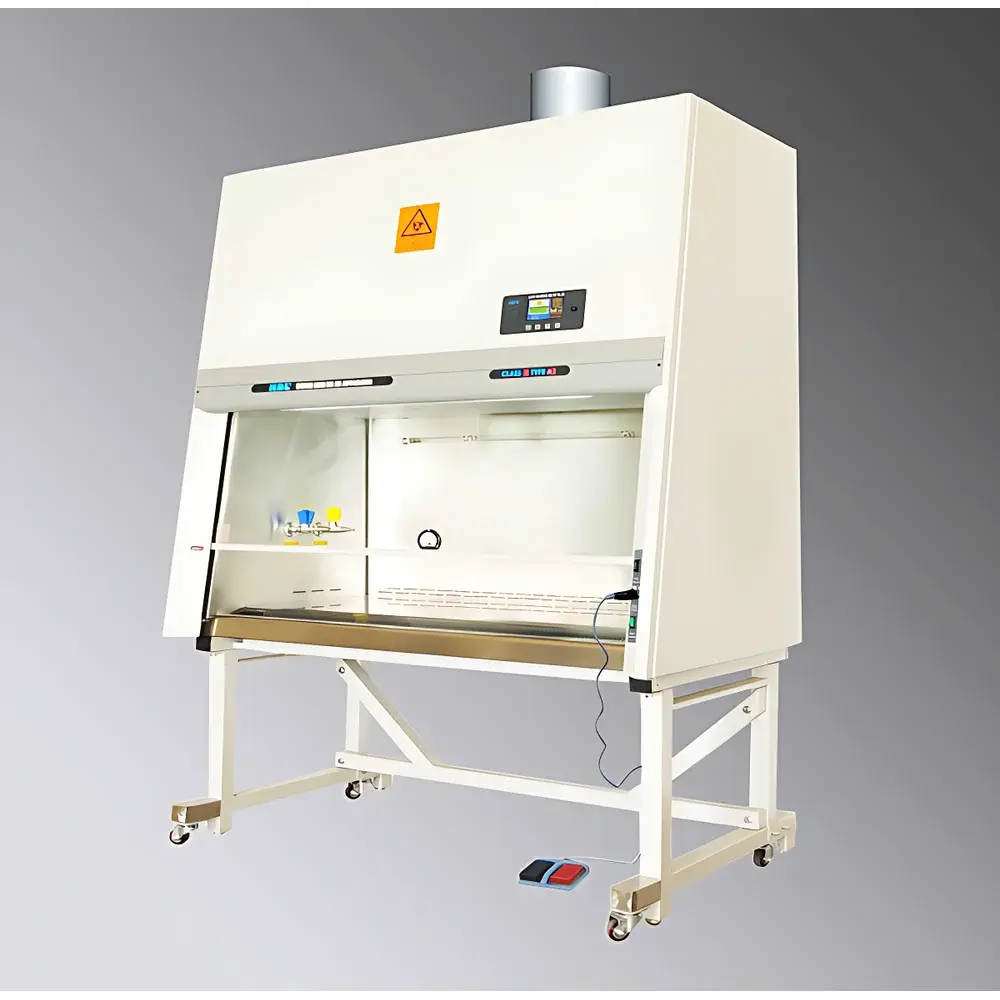
HDL BSC-1100-L II B2 Class II Type B2 Biological Safety Cabinet
| Brand | HDL (Harbin Donglian) |
|---|---|
| Origin | Beijing, China |
| Model | BSC-1100-L II B2 |
| Cabinet Type | Class II, Type B2 (100% Exhaust, Zero Recirculation) |
| External Dimensions (L×W×H) | 1382 × 790 × 2210 mm |
| Internal Work Area Dimensions (L×W×H) | 1220 × 600 × 680 mm |
| ULPA Filter Efficiency | ≥99.9995% for particles ≥0.1–0.2 µm |
| Filter Penetration Rate | ≤0.005% |
| Noise Level | ≤62 dB(A) |
| Inflow Velocity | >0.5 m/s |
| Downflow Velocity | 0.25–0.5 m/s |
| Vibration (RMS) | ≤3 µm |
| Illuminance | ≥700 lx |
| Power Supply | 220 V AC / 50 Hz |
| Rated Power Consumption | 1.95 kW |
| Max Power Consumption | 2.95 kW |
| Weight | 310 kg |
| Compliance | YY 0569-2005, NSF/ANSI 49-2002, EN 12469:2000 |
Overview
The HDL BSC-1100-L II B2 Biological Safety Cabinet is a certified Class II, Type B2 (total exhaust) cabinet engineered for high-containment applications requiring absolute protection of personnel, product, and environment. Unlike Class II A2 cabinets, the B2 configuration eliminates internal air recirculation entirely—100% of the airflow is drawn through the work surface, passed through dual ULPA filters (supply and exhaust), and expelled externally via dedicated ductwork. This design ensures zero cross-contamination risk from aerosolized biological agents, making it suitable for handling volatile toxic chemicals in conjunction with infectious agents (e.g., BSL-2+ with chemical co-exposure), as well as sensitive cell culture operations where environmental integrity is non-negotiable. The cabinet operates on the principle of laminar downflow and inward inflow velocity control, maintaining negative pressure across all four sides of the work area through a precisely balanced dual-blower system. Its structural integrity, leak-tightness (tested at 500 Pa for 30 min, pressure retention ≥450 Pa), and mechanical stability (work surface deflection ≤0.5 mm under 23 kg central load) conform rigorously to YY 0569-2005, NSF/ANSI 49-2002, and EN 12469:2000—enabling audit readiness for GLP, GMP, and ISO 17025-accredited laboratories.
Key Features
- ULPA filtration system with ≥99.9995% efficiency for 0.1–0.2 µm particles; certified penetration rate ≤0.005% per scan and non-scan test protocols.
- Dual independent blower system: three-phase asynchronous motor for supply air and dedicated exhaust motor—ensuring stable airflow, low noise (≤62 dB[A]), reduced power consumption, and extended service life.
- High-precision micro-differential pressure sensor coupled with variable-frequency drive (VFD) control for real-time, automatic regulation of inflow and downflow velocities within specified tolerances (inflow >0.5 m/s; downflow 0.25–0.5 m/s).
- Full stainless-steel interior: seamless 304-grade one-piece work chamber with R15 radius corners and integrated liquid collection trough—designed for decontamination compatibility and microbial ingress prevention.
- Motorized, infrared-remote-controlled sash: programmable height positioning with footswitch and manual override; interlocked UV lamp activation prevents exposure during operation.
- Comprehensive operational logging: cumulative runtime tracking for fan, fluorescent lighting (≥5000 h alert), UV germicidal lamp (≥500 h alert), and filter service life—supporting preventive maintenance scheduling per ISO 13485 and FDA 21 CFR Part 11 data integrity requirements.
- Multi-modal alarm system: simultaneous audible tone, visual LED indicators, and synthesized voice alerts triggered by sash deviation, airflow excursion (>±20% nominal), or filter degradation.
Sample Compatibility & Compliance
The BSC-1100-L II B2 accommodates standard biosafety workflows involving primary human cells, recombinant DNA constructs, viral vectors, and low-to-moderate risk pathogens (BSL-2). Its total-exhaust architecture permits concurrent use with volatile organic solvents (e.g., ethanol, acetone) and low-vapor-pressure hazardous compounds—unlike recirculating cabinets that pose explosion or vapor accumulation risks. All structural materials—including 5 mm tempered optical glass sash, 304 stainless steel inner walls, and epoxy-coated outer chassis—meet biocompatibility and cleanability standards per ISO 10993-5. Leak integrity testing (500 Pa hold test), HEPA/ULPA filter scanning per IEST-RP-CC001.4, and operator protection validation (≤10 CFU/plate via agar撞击 sampler) are performed pre-shipment and documented in the Certificate of Conformance. The cabinet supports regulatory alignment with USP , CLSI M29-A4, and EU Annex 1 (2022) requirements for aseptic processing environments.
Software & Data Management
The embedded controller features a high-resolution color LCD interface with animated status visualization—displaying real-time airflow vectors, sash position, UV dose accumulation, and filter differential pressure. All operational logs—including timestamped sash movements, alarm events, lamp runtime, and user-initiated sterilization cycles—are stored locally with tamper-resistant write-once memory. Export is supported via USB 2.0 to CSV format for integration into LIMS or electronic lab notebooks (ELN). Remote control functionality includes infrared-based actuation of lighting, UV irradiation, sash positioning, and fan speed—all logged with user ID and timestamp. Audit trail capabilities comply with ALCOA+ principles and satisfy data governance requirements under 21 CFR Part 11 (electronic signatures optional via external authentication module).
Applications
- Aseptic preparation of monoclonal antibodies and viral vaccines under BSL-2 containment with chemical compatibility assurance.
- Handling of genetically modified organisms (GMOs) requiring strict environmental release prevention per OECD Guideline 208.
- Stem cell expansion and CRISPR-Cas9 editing workflows where particulate-free laminar flow is critical to clonal fidelity.
- Pharmaceutical quality control labs performing sterility testing per USP in compliance with Annex 1 sterile manufacturing provisions.
- Academic and clinical research facilities conducting dual-hazard experiments involving both infectious agents and cytotoxic drugs.
FAQ
What distinguishes a Type B2 cabinet from Type A2 or Type C1?
Type B2 provides 100% exhausted airflow with zero recirculation, eliminating any risk of chemical vapor buildup or cross-contamination between samples. It requires hard-ducted external exhaust and cannot operate in recirculation mode.
Is this cabinet compatible with existing laboratory ductwork?
Yes—provided static pressure loss does not exceed 250 Pa at rated exhaust volume (100% of intake). Duct design must comply with ASHRAE 110 tracer gas testing methodology for verification.
How often must ULPA filters be replaced?
Filter service life depends on usage intensity and ambient particulate load. The built-in differential pressure monitor and runtime counter provide predictive maintenance guidance; typical replacement interval ranges from 3–5 years under normal BSL-2 operating conditions.
Does the cabinet support integration with building management systems (BMS)?
Analog 4–20 mA outputs for airflow and sash position are available via optional I/O module; Modbus RTU communication can be enabled for centralized monitoring.
Can the UV lamp be scheduled independently of manual activation?
Yes—the system supports programmable start/stop times and duration-based irradiation cycles, with dose tracking logged alongside operational history.