
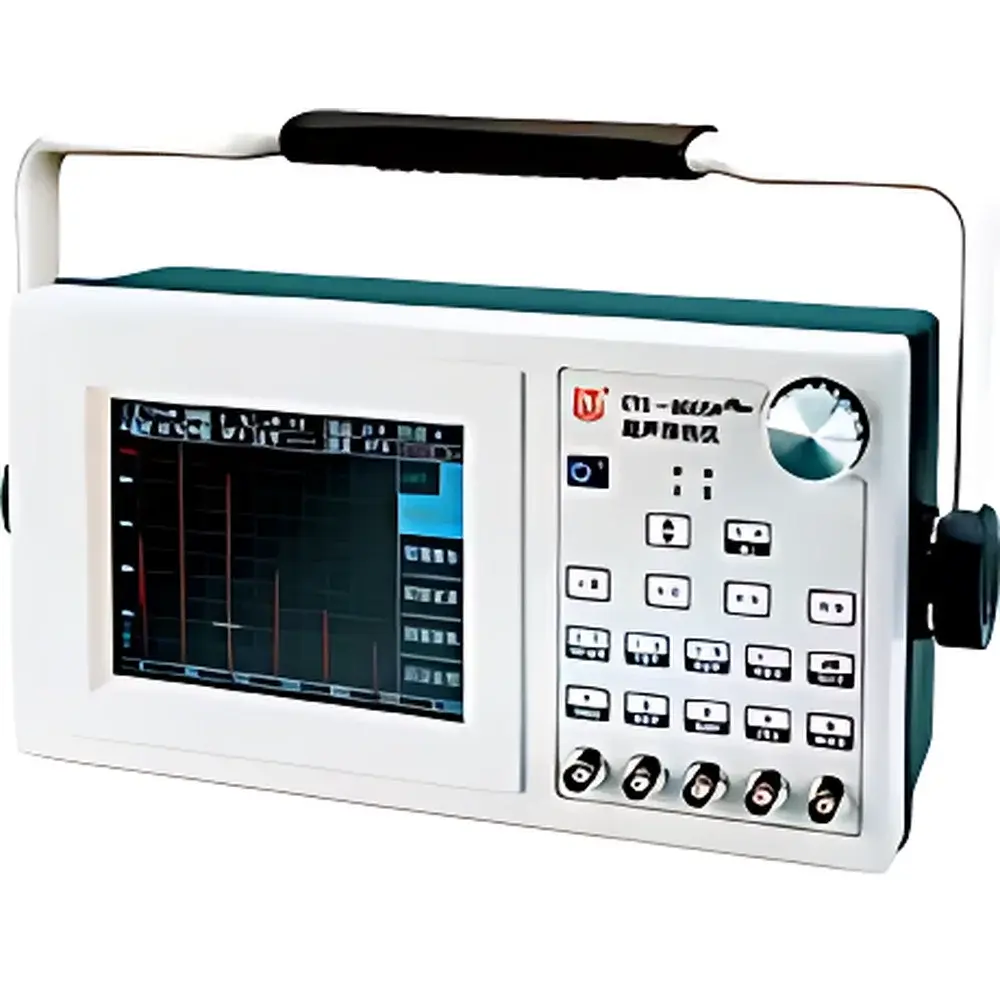
CTS-8005Aplus Railway Vehicle Ultrasonic Flaw Detector
| [Origin | Beijing, China |
|---|---|
| Manufacturer Type | Authorized Distributor |
| Origin Category | Domestic (China) |
| Model | CTS-8005Aplus |
| Pricing | Available Upon Request |
| Operating Frequency | 0.5–15 MHz (dual-band wide/narrow mode) |
| Gain Range | 110 dB with step options of 0.1 / 1.0 / 2.0 / 6.0 dB |
| Detection Range | 0–5000 mm (steel longitudinal wave) |
| Pulse Shift | −20 to 3000 µs |
| Sound Velocity | 1000–9999 m/s |
| Pulse Repetition Frequency | 25–800 Hz (adjustable) |
| Vertical Linearity | ≤4% |
| Horizontal Linearity | ≤0.5% |
| Resolution | ≥28 dB |
| Sensitivity Margin | ≥60 dB (200 mm–φ2 mm flat-bottom hole) |
| Dynamic Range | ≥32 dB |
| Electrical Noise Level | ≤10% |
| Suppression | 0–80% (linear) |
| Detection Modes | Full-wave, Positive half-wave, Negative half-wave |
| Alarm Output | Audio + visual |
| Interface | High-speed USB 2.0, 25-pin parallel printer port |
| Display | 6.5″ TFT color LCD, 640×480 resolution, ambient-light-adaptive color scheme |
| Power Supply | AC 220 V charger + rechargeable lithium-ion battery (no memory effect, >6 h continuous operation) |
| Operating Temperature | −30°C to +50°C |
| Dimensions (L×W×H) | 250 × 186 × 59 mm |
| Weight | ~2.0 kg] |
Overview
The CTS-8005Aplus Railway Vehicle Ultrasonic Flaw Detector is a portable, fully digital ultrasonic testing (UT) instrument engineered specifically for in-service inspection of railway vehicle wheelsets and axle components. Designed to meet the stringent requirements of China’s National Railway Administration and aligned with international UT principles—pulse-echo and through-transmission modalities—the instrument employs high-fidelity, real-time signal processing architecture centered on a 160 MHz hardware sampling rate. Its low-noise, broadband amplifier chain ensures high signal-to-noise ratio across the full 0.5–15 MHz operating bandwidth, enabling reliable detection of subsurface discontinuities—including fatigue cracks, inclusions, and forging defects—in axle steel (e.g., LZ50, CL60, and EA4T grades). The system adheres to fundamental ultrasonic beam physics, including Snell’s law-based angle beam calibration and time-of-flight diffraction (TOFD)-compatible gating logic, supporting both manual and semi-automated scanning protocols used in depot-level wheelset maintenance.
Key Features
- Real-time digital signal acquisition at 160 MHz sampling rate, ensuring precise echo timing and amplitude fidelity for critical flaw sizing.
- 6.5-inch high-brightness TFT color display (640 × 480 pixels) with adaptive backlight and grayscale/color mapping optimized for indoor depot lighting and outdoor daylight conditions.
- Dual-frequency band amplification (wide/narrow) with 110 dB gain control and selectable step increments (0.1/1.0/2.0/6.0 dB) for fine-tuned sensitivity adjustment per inspection procedure.
- Embedded regulatory workflow engine compliant with China Railway Rolling Stock Inspection Regulations (TB/T 1618, TB/T 2983, and TB/T 2634), including built-in quarterly and daily calibration verification routines with guided prompts in Simplified Chinese.
- Multi-user account management system: one public profile plus nine password-protected private accounts—each preserving individual setup configurations, gate positions, DAC/TCG curves, and inspection history.
- Integrated probe calibration module supporting transducer characterization (e.g., delay, K-value, beam spread) and automatic generation of standardized reporting templates required by railway maintenance documentation systems.
- Onboard storage capacity for up to 1,000 flaw records and 1,000 management reports, with direct thermal or dot-matrix printing via 25-pin parallel interface.
- Advanced waveform analysis tools: peak-hold memory, freeze-on-trigger, dynamic gate tracking, and intelligent maximum-amplitude search within user-defined time gates.
Sample Compatibility & Compliance
The CTS-8005Aplus is validated for use with standard piezoelectric contact and immersion probes (single-element, dual-element, and angle-beam configurations) operating in the 0.5–15 MHz range. It supports common rail-grade coupling media (e.g., glycerin, water-based gels) and accommodates curved surface scanning via custom wedge assemblies. While not certified to EN 12668-1:2010 or ASTM E114-20 as a standalone unit, its core measurement performance—including vertical/horizontal linearity, resolution, and sensitivity margin—meets or exceeds minimum thresholds defined in those standards for portable digital flaw detectors. The instrument’s software architecture enables traceable data logging compatible with GLP/GMP-aligned quality management systems; audit trails for calibration events, parameter changes, and report generation can be exported via USB for integration into enterprise document control platforms.
Software & Data Management
Data exchange is facilitated through a high-speed USB 2.0 interface, enabling bidirectional transfer of A-scan waveforms, setup files (.cfg), and ASCII-formatted reports (.csv/.txt) to Windows-based PCs. The included PC utility software supports waveform replay, comparative overlay analysis, and batch export for statistical process control (SPC) applications. All stored records include metadata timestamps, operator ID, probe ID, material velocity setting, and gate configuration—ensuring full procedural traceability. Chinese character input is supported via GB2312-compliant pinyin and zone-code entry methods, permitting unambiguous annotation of defect locations (e.g., “left axle journal, 120° circumferential position”). No cloud connectivity or remote firmware updates are implemented; all configuration and reporting remain locally controlled to satisfy railway cybersecurity policies.
Applications
- In-service ultrasonic inspection of railway locomotive and passenger/freight car wheel axles per TB/T 1618 (axle ultrasonic acceptance criteria).
- Manual scanning of axle journals, dust shields, brake discs, and hollow shaft sections using angle-beam or normal-incidence probes.
- Quarterly verification of system linearity, sensitivity, and time-base accuracy in accordance with TB/T 2983 (railway vehicle ultrasonic testing procedures).
- Documentation of non-conforming findings for root cause analysis and maintenance decision support within CMMS environments.
- Training and qualification of NDT Level 1/2 personnel under the China National Certification Board for Non-Destructive Testing (CNCB-NDT) framework.
FAQ
Does the CTS-8005Aplus support TOFD or phased array ultrasonic testing (PAUT)?
No. It is a conventional pulse-echo and through-transmission UT instrument designed for single-channel or five-channel sequential scanning. TOFD and PAUT require dedicated hardware architectures not present in this model.
Is the device compliant with ISO 9712 or EN 473 for personnel certification?
The instrument itself is not certified under ISO 9712; however, it is routinely employed in training and assessment scenarios aligned with ISO 9712 Annex A requirements for equipment used in Level 2 practical examinations.
Can inspection data be exported in XML or PDF format?
Native export is limited to ASCII text (.csv) and proprietary binary waveform files. Third-party conversion tools may generate PDF reports from exported data, but no embedded PDF/XML generator is included.
What is the warranty coverage and service support structure?
Standard warranty is 12 months from commissioning date, covering parts and labor. Technical support and calibration services are provided by authorized distributors in mainland China; overseas support requires prior coordination with regional service partners.
Is battery replacement user-serviceable?
Yes. The lithium-ion battery pack is field-replaceable using standard Torx T8 tools; replacement units are available through authorized channels with full CE/UN38.3 safety certification documentation.





