
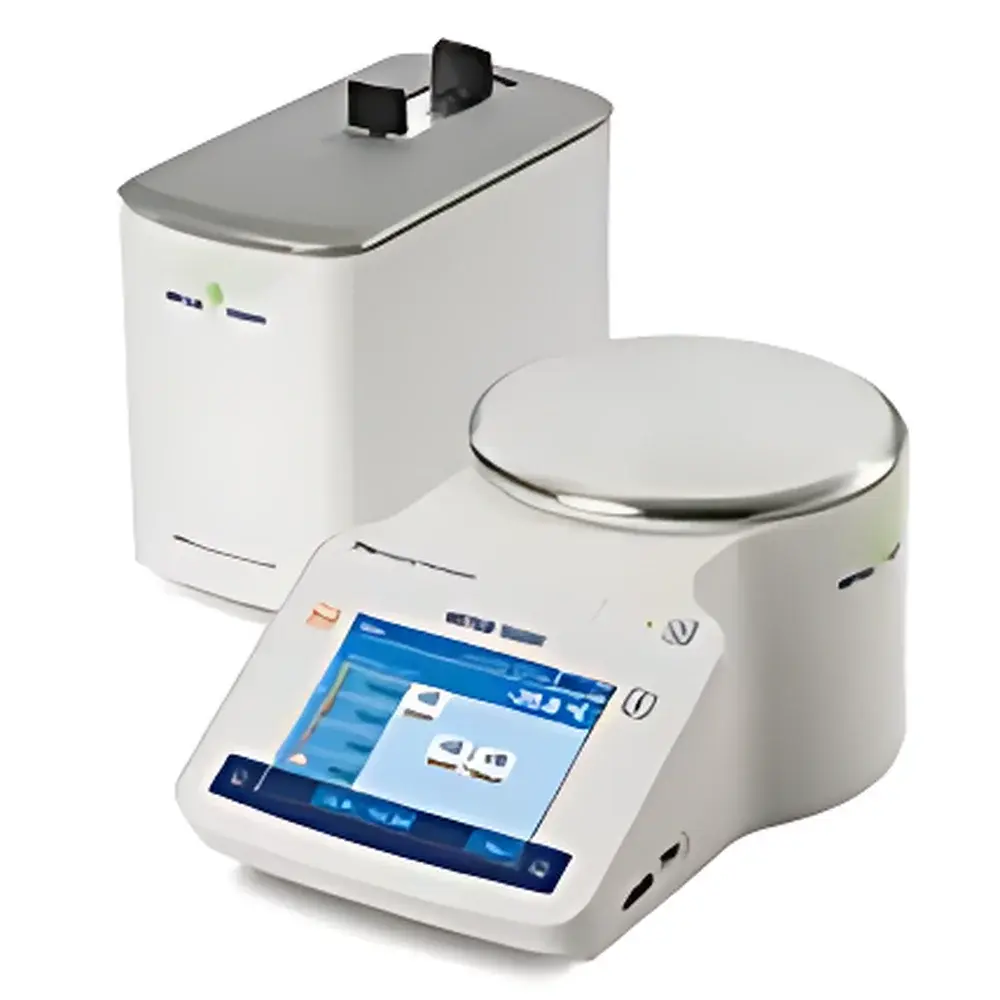
METTLER TOLEDO DP70 Dropping Point System
| Brand | METTLER TOLEDO |
|---|---|
| Origin | Switzerland |
| Model | DP70 |
| Temperature Range | 30–200 °C (standard), up to 400 °C (extended) |
| Heating Rate | 0.1–20 °C/min |
| Measurement Accuracy | ±0.2 °C (≤200 °C), ±0.5 °C (>200 °C) |
| Display | 5.7" VGA Color Touchscreen |
| Compliance | ASTM D3104, D3105, D3461, ISO 4625, USP <741> |
Overview
The METTLER TOLEDO DP70 Dropping Point System is a fully automated, thermally controlled instrument engineered for precise determination of dropping point and softening point of thermoplastic materials—including asphalt, bitumen, polymers, resins, waxes, greases, and pharmaceutical excipients. Based on the principle of controlled linear heating under standardized cup geometry and optical detection, the DP70 adheres to classical capillary tube and open-cup methodologies defined in internationally recognized test standards. The system employs a high-stability Peltier-assisted heating block with active temperature feedback control, ensuring reproducible thermal ramps across the full operating range (30–200 °C standard; extended capability up to 400 °C). Real-time video capture and synchronized thermal profiling enable unambiguous endpoint identification—defined as the temperature at which the first drop of molten material falls from the sample cup or through the capillary opening. This physical transition reflects the onset of macroscopic flow behavior, directly correlating with service temperature limits and formulation stability.
Key Features
- Dual-sample measurement station enabling parallel analysis of two specimens—reducing total assay time and supporting statistical evaluation (mean value, deviation, repeatability per ASTM D3104)
- One Click™ intuitive interface on a 5.7″ VGA color touchscreen—preconfigured methods stored and launched with single tap; no programming expertise required
- High-resolution digital video recording with frame-by-frame playback—facilitates retrospective verification of drop formation, operator-independent endpoint confirmation
- Precision temperature control architecture with ±0.2 °C accuracy up to 200 °C and ±0.5 °C above 200 °C, validated per internal metrology protocols traceable to NIST standards
- Modular thermal block design optimized for rapid cool-down and thermal equilibration between runs—minimizing carryover effects and improving throughput
- Ergonomic benchtop footprint with front-accessible cup holders and tool-free sample loading—designed for routine QC lab environments
Sample Compatibility & Compliance
The DP70 accommodates standard ASTM/ISO-compliant sample cups (e.g., brass or porcelain open cups, capillary tubes per USP ) and supports both dropping point (open-cup) and softening point (ring-and-ball or capillary methods) configurations via optional accessories. It is validated for use with viscous, semi-crystalline, and amorphous thermoplastics exhibiting broad melting transitions. Regulatory compliance includes full alignment with ASTM D3104 (petroleum waxes), D3105 (asphalt), D3461 (resins), ISO 4625 (bituminous binders), and United States Pharmacopeia chapter (softening point of pharmaceuticals). Instrument qualification packages—including Installation Qualification (IQ) and Operational Qualification (OQ)—are available as factory-supplied documentation or as on-site executed services. All firmware and method files support audit trail generation and electronic signature functionality compliant with FDA 21 CFR Part 11 requirements when integrated into validated laboratory information management systems (LIMS).
Software & Data Management
The embedded One Click™ software provides method-driven operation without reliance on external PCs. Each stored method encapsulates complete test parameters: heating rate, detection threshold, video capture duration, pass/fail criteria, and result export format (CSV, PDF). All measurements are timestamped and linked to user ID, instrument serial number, and calibration status. Raw thermal curves and annotated video clips are retained locally on encrypted internal storage and can be exported via USB or network interface. For enterprise integration, optional METTLER TOLEDO LabX® software enables centralized method deployment, remote monitoring, automated report generation, and full GLP/GMP data integrity—supporting electronic records retention, role-based access control, and change history tracking per ALCOA+ principles.
Applications
- Quality control of asphalt binders in road construction materials testing labs
- Batch release testing of polyolefin waxes and EVA copolymers in polymer manufacturing
- Stability assessment of pharmaceutical ointments and suppository bases per USP monographs
- R&D screening of thermal transition behavior in hot-melt adhesives and encapsulation resins
- Regulatory submission support for material safety data sheets (MSDS/SDS) requiring documented softening characteristics
- Teaching laboratories demonstrating phase transition thermodynamics in undergraduate chemistry and materials science curricula
FAQ
What standards does the DP70 comply with?
ASTM D3104, D3105, D3461, ISO 4625, USP , and DIN 51801.
Can the DP70 measure samples below 30 °C?
The DP70 operates from 30 °C upward; for sub-ambient measurements, the DP90 model (-20 to 400 °C) is recommended.
Is video recording mandatory for every test?
Video capture is enabled by default but can be disabled in method settings—though retention of visual evidence is strongly advised for audit readiness.
How often does the system require calibration verification?
Annual calibration verification is recommended; built-in reference checks using certified NIST-traceable metal standards can be performed daily or per shift.
Does the DP70 support 21 CFR Part 11 compliance out-of-the-box?
Yes—when used with LabX software and configured with electronic signatures, audit trails, and secure user authentication.




