
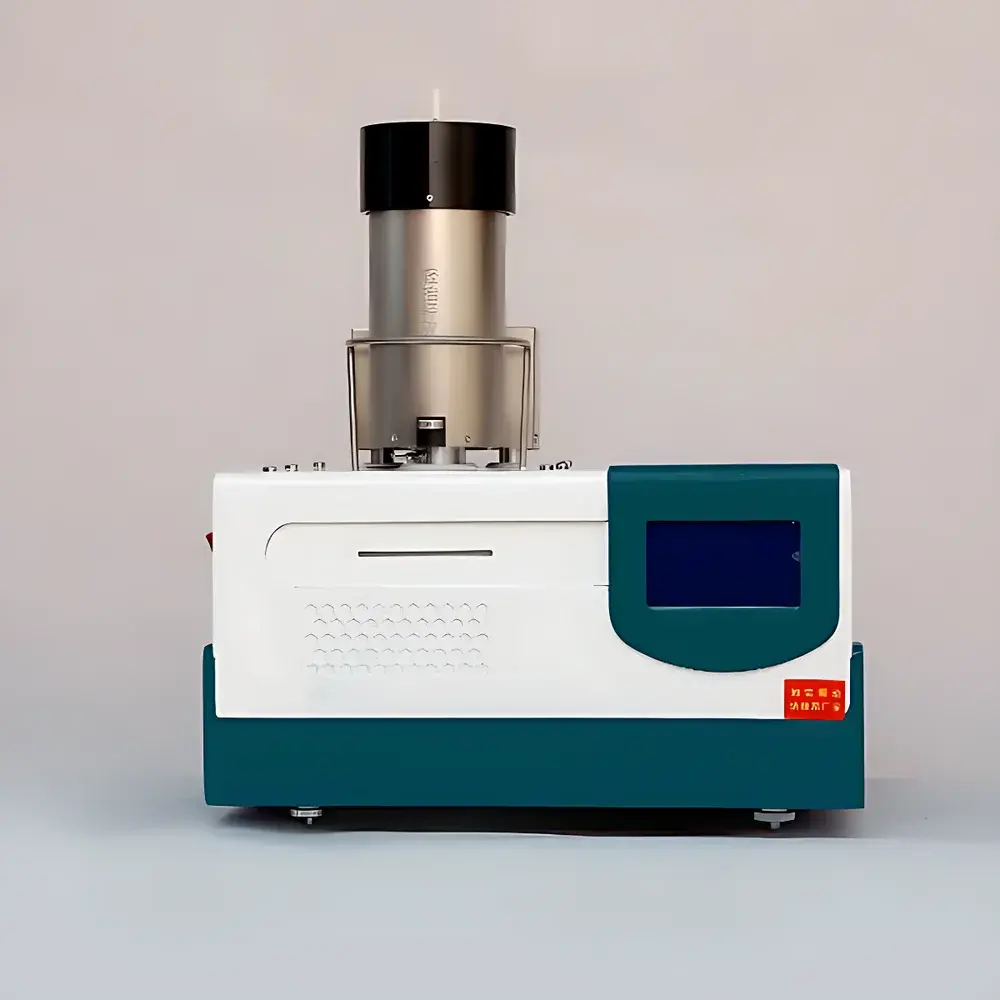
Henven HCT-4 Simultaneous Thermal Analyzer (Microcomputer-Controlled Differential Thermal Balance)
| Brand | Henven |
|---|---|
| Origin | Beijing, China |
| Manufacturer Type | Direct Manufacturer |
| Product Origin | Domestic (China) |
| Model | HCT-4 |
| Heating Rate | 0.1–100 °C/min |
| Temperature Range | Ambient to 1550 °C |
| Temperature Stability | ±0.1 °C |
| Maximum Sample Mass | 5 g |
| Atmosphere Control | Dual-channel mass flow controller (customizable for corrosive gases) |
Overview
The Henven HCT-4 Simultaneous Thermal Analyzer is an integrated thermoanalytical instrument engineered for precision measurement of thermal behavior under controlled atmospheric conditions. It combines thermogravimetric analysis (TGA) and differential thermal analysis (DTA) in a single, synchronized measurement—enabling real-time correlation between mass change and thermal events on the same sample. Based on the principle of simultaneous detection via high-sensitivity microbalance and dual thermocouple differential temperature sensing, the HCT-4 delivers co-registered TG, DTG, DTA, and derivative thermal data with high reproducibility and baseline stability. Designed for materials science laboratories, R&D centers, and quality control environments, it supports fundamental characterization of phase transitions, decomposition kinetics, oxidative stability, glass transition, crystallization behavior, and compositional analysis across ceramics, polymers, metals, pharmaceuticals, and energy materials.
Key Features
- Simultaneous acquisition of thermogravimetric (TG) and differential thermal (DTA) signals with time- and temperature-synchronized data streams.
- Temperature range from ambient to 1550 °C, with programmable heating rates from 0.1 to 100 °C/min and thermal stability maintained within ±0.1 °C.
- High-resolution microbalance with 0.1 µg resolution, 1 mg–200 mg dynamic measurement range, and thermal noise < 0.1 µg.
- Dual independent thermocouples: one continuously monitors furnace temperature (active or idle), the other measures actual sample temperature during operation.
- Dual-channel mass flow controller (MFC) for precise, automated gas switching between inert, oxidizing, or reactive atmospheres; optional corrosion-resistant configuration available for H₂S, Cl₂, HF, or SO₂ service.
- Modular crucible system supporting ceramic (0.06 mL / 0.12 mL), aluminum, graphite, quartz, and platinum crucibles—enabling broad compatibility with aggressive or high-temperature samples.
- Customizable auxiliary interfaces: heated GC/MS transfer line (up to 200 °C), isothermal zone, vacuum sealing (base vacuum: 2.5 × 10⁻² Pa with optional pump), and real-time screenshot capture at user-defined timestamps.
Sample Compatibility & Compliance
The HCT-4 accommodates sample masses from sub-milligram to 5 g (via interchangeable support rods), making it suitable for both trace-component analysis and bulk thermal stability assessment. Its robust furnace architecture and calibrated thermal sensor array comply with core methodology requirements outlined in ASTM E1131, ISO 11358, and USP for thermal analysis. While not pre-certified for FDA 21 CFR Part 11, the system’s audit-trail-capable software architecture—including user-defined calibration protocols, timestamped raw data export (ASCII/CSV), and full parameter logging—supports GLP/GMP-aligned validation workflows. All calibration functions (temperature, enthalpy, mass) are traceable using NIST-traceable standards (e.g., indium, zinc, alumina).
Software & Data Management
The proprietary HCT-4 acquisition and analysis software provides full control over experimental parameters, real-time visualization (dual-axis display: temperature/time vs. mass/%/µV/mW), and post-run processing. Standard capabilities include peak integration (DTA area → enthalpy), derivative curve generation (DTG, DDTG), isoconversional kinetic modeling (e.g., Kissinger, Ozawa-Flynn-Wall), Tg determination (midpoint/tangent methods), specific heat estimation (via comparative method), and multi-curve overlay/comparison. Users may define custom calculation modules—Henven offers firmware-level implementation of client-provided algorithms upon request. Data files retain full metadata (operator ID, instrument serial, atmosphere log, MFC setpoints) and support batch export compliant with LIMS integration protocols.
Applications
- Decomposition onset temperature and activation energy determination in catalysts, battery cathode materials, and flame-retardant polymers.
- Oxidative induction time (OIT) evaluation per ASTM D3895 for polyolefins and stabilizer package optimization.
- Quantitative moisture/volatile content analysis in pharmaceutical excipients and APIs.
- Phase transformation mapping in shape-memory alloys and ferroelectric ceramics.
- Char yield and pyrolysis kinetics in biomass and carbon precursor materials.
- Thermal stability screening of nanocomposites under reducing (H₂/N₂) or sulfiding (H₂S/N₂) atmospheres.
- Reaction calorimetry coupling via heated transfer lines to online GC or MS for evolved gas analysis (EGA).
FAQ
What calibration standards are recommended for routine verification?
Indium (melting point 156.6 °C, ΔH = 28.45 J/g) and zinc (419.5 °C, ΔH = 106.6 J/g) are standard for temperature and enthalpy calibration; alumina is used for mass baseline verification.
Can the HCT-4 operate under vacuum or reducing atmospheres?
Yes—the base system includes vacuum-tight construction; with optional vacuum pump, ultimate pressure reaches 2.5 × 10⁻² Pa. Custom MFC-configured gas lines support H₂, CO, NH₃, and other reactive/reducing gases.
Is software validation documentation available for regulated industries?
Comprehensive IQ/OQ documentation templates and raw data structure specifications are provided upon request to support internal validation against GxP requirements.
How is baseline drift compensated during long-duration isothermal holds?
The dual-thermocouple architecture enables real-time furnace–sample offset correction; software also applies adaptive polynomial baseline subtraction during post-processing.
Does the system support automated method sequencing for unattended operation?
Yes—up to 99 sequential methods (including ramp/hold/cool cycles, gas switching logic, and auto-zero triggers) can be queued and executed without operator intervention.



