
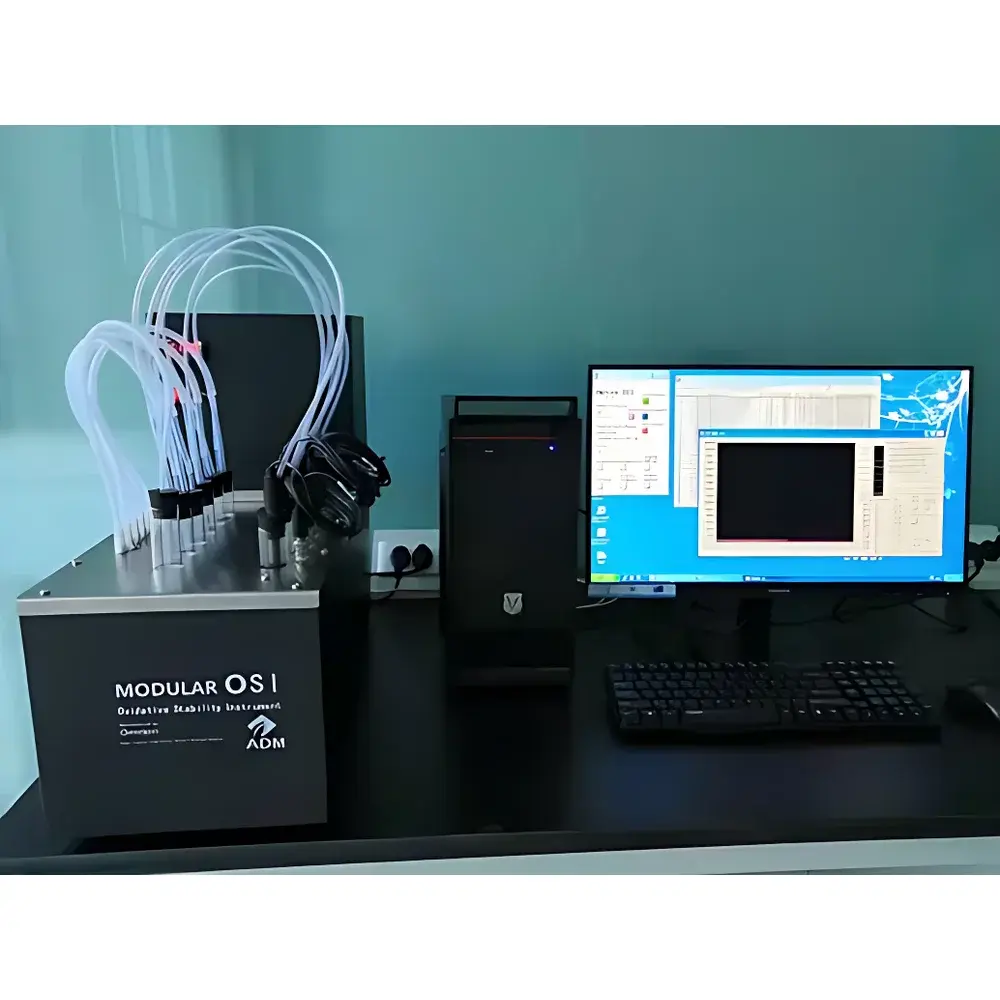
OmniOn OSI-6 Oil Oxidation Stability Analyzer
| Origin | USA |
|---|---|
| Manufacturer Type | Authorized Distributor |
| Origin Category | Imported |
| Model | OSI-6 |
| Price Range | USD 27,000 – 68,000 |
Overview
The OmniOn OSI-6 Oil Oxidation Stability Analyzer is a precision-engineered instrument designed to quantify the oxidative stability of fats, oils, and lipid-containing materials using the standardized Rancimat (OSI) method—also known as the Oil Stability Index test. It operates on the principle of accelerated oxidation under controlled elevated temperature and constant airflow, measuring the induction period (IP) via conductometric detection of volatile oxidation products (primarily formic acid) formed during thermal-oxidative degradation. Unlike classical AOM (Active Oxygen Method) or peroxide value titration—which reflect only instantaneous oxidative status—the OSI-6 delivers predictive, time-to-failure data essential for shelf-life modeling, antioxidant efficacy screening, and process validation. As the original equipment manufacturer (OEM) designated by AOCS (American Oil Chemists’ Society) for Cd 12b-92, it serves as the reference platform for international standard compliance including ISO 6886:2006, EN 14112, JIS K 2501 (JOCS), and GB/T 21121–2007.
Key Features
- Six independent, parallel reaction channels with individual airflow control and real-time conductivity monitoring—ensuring high-throughput, statistically robust comparative analysis.
- Precisely regulated heating block with ±0.1 °C temperature accuracy across the full operating range (40–250 °C); inter-channel thermal deviation <0.1 °C.
- Dedicated temperature programming for AOCS-standard test conditions (110 °C, 130 °C) and JOCS-compliant 120 °C protocols—fully configurable via embedded controller.
- Automated endpoint detection: integrated software calculates induction period (hours) directly from conductivity slope inflection without manual intervention or subjective endpoint judgment.
- Robust mechanical architecture with corrosion-resistant sample tube holders, inert gas-compatible inlet manifold, and sealed airflow path to prevent ambient interference.
- Rapid thermal ramping: 30 minutes from ambient to 110 °C; 40 minutes to 130 °C—optimized for laboratory workflow efficiency without compromising thermal equilibrium stability.
Sample Compatibility & Compliance
The OSI-6 accommodates a broad spectrum of lipid matrices, including but not limited to: edible oils (soybean, palm, sunflower, peanut, canola), animal fats (lard, tallow, butterfat), cocoa butter, margarines, snack coatings, pet food lipids, biodiesel (FAME), PVC stabilizers, cosmetic emollients, and feed-grade antioxidants. Its design supports sample volumes of 3–10 g (solid/semi-solid) or 3–10 mL (liquid), with minimal preparation requirements. Regulatory alignment includes full traceability to AOCS Cd 12b-92, ISO 6886:2006 (determination of oxidative stability—Rancimat method), EN 14112 (oxidation stability of fatty acid methyl esters), and GB/T 21121–2007 (oil stability index determination). The system meets GLP documentation requirements when paired with validated software; raw conductivity logs and timestamped IP outputs support audit readiness per FDA 21 CFR Part 11 if used in regulated environments.
Software & Data Management
Data acquisition and analysis are managed through the proprietary OmniOn Control Suite, a Windows-based application supporting real-time multi-channel visualization, automated IP calculation, baseline correction, and export to CSV, Excel, or PDF. Each run generates a complete metadata package—including temperature setpoint, airflow rate (10 L/h default), start/end timestamps, conductivity curve, and statistical confidence intervals for replicate runs. Audit trails record all parameter changes, user logins, and report generation events. Exported datasets are compatible with LIMS integration and statistical platforms (e.g., JMP, Minitab) for ANOVA, dose-response modeling, and shelf-life regression analysis. No cloud dependency: all processing occurs locally, preserving data sovereignty and cybersecurity integrity.
Applications
- Shelf-life prediction: Accelerated oxidation kinetics enable quantitative estimation of product expiration under defined storage conditions—critical for formulation optimization and regulatory dossier submission.
- Antioxidant screening: Comparative evaluation of natural (tocopherols, rosemary extract) and synthetic (BHA, BHT, TBHQ) antioxidants, including synergistic interactions and metal-chelating efficacy (e.g., Cu²⁺ challenge testing).
- Frying oil management: Monitoring degradation onset in commercial deep-frying operations to establish discard thresholds and validate filtration/replacement schedules.
- Raw material qualification: Incoming inspection of oilseeds, crude oils, and fat blends to reject batches with substandard oxidative resilience prior to refining.
- Regulatory compliance testing: Generation of ISO- or AOCS-compliant reports for food labeling claims (e.g., “high-oleic”, “naturally stable”), feed additive registration, and pharmaceutical excipient qualification.
- Research into oxidation mechanisms: Investigation of pro-oxidant catalysis (e.g., transition metals), polymerization pathways in biodiesel, and thermal degradation thresholds in functional lipids.
FAQ
What standards does the OSI-6 officially comply with?
AOCS Cd 12b-92, ISO 6886:2006, EN 14112, JIS K 2501 (JOCS), and GB/T 21121–2007.
Can the instrument operate at non-standard temperatures?
Yes—temperature is fully programmable between 40 °C and 250 °C in 0.1 °C increments, enabling method development beyond published standards.
Is calibration required before each analysis?
No routine calibration is needed; the system relies on factory-traceable thermal and conductivity references. Annual verification using certified reference oils (e.g., AOCS-certified stability standards) is recommended for ISO/IEC 17025 labs.
How is sample carryover prevented between runs?
Each channel uses disposable glass reaction tubes; airflow purges residual volatiles for ≥5 minutes post-run, and conductivity cells are self-cleaning via continuous electrolyte flow.
Does the OSI-6 support 21 CFR Part 11 compliance?
When deployed with validated software configuration, electronic signatures, and audit-trail-enabled operation, it satisfies core Part 11 requirements for electronic records and signatures in FDA-regulated settings.





