
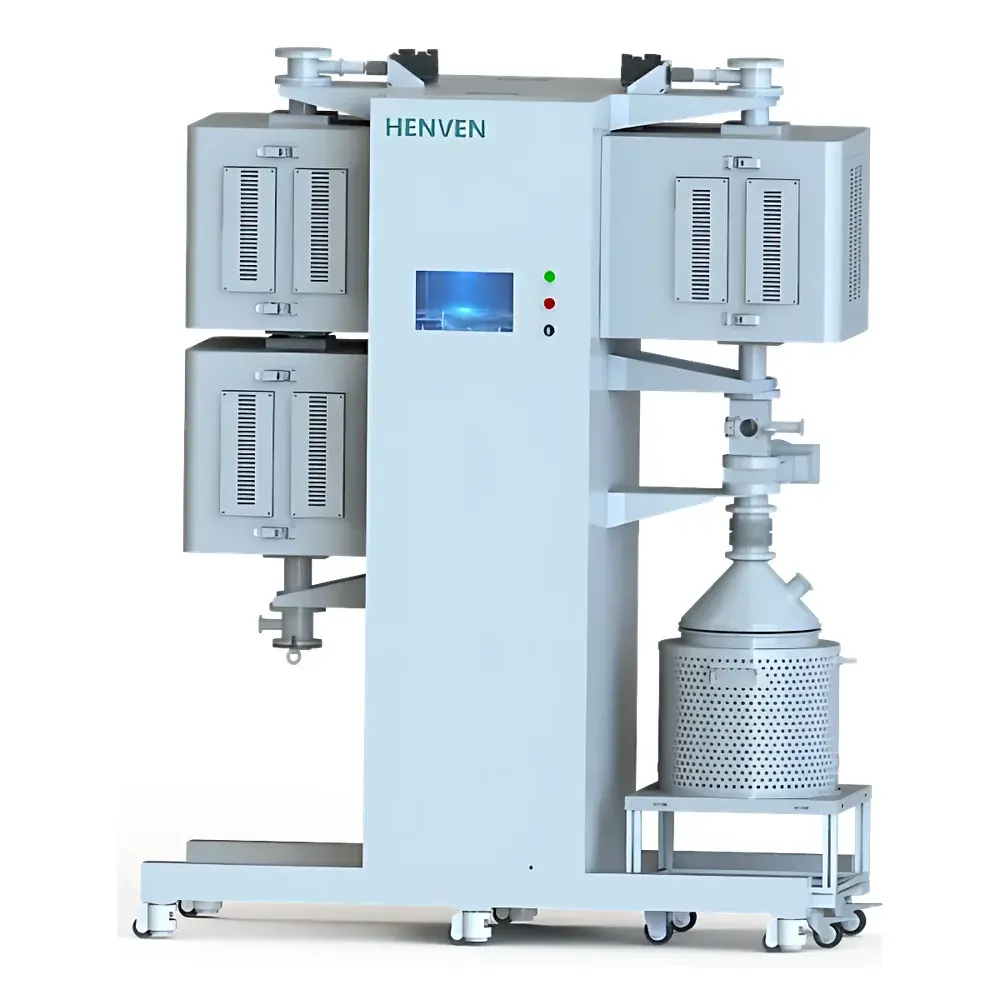
Henven HTS-1400 Thermal Shock Testing System
| Brand | Henven |
|---|---|
| Origin | Beijing, China |
| Manufacturer Type | Direct Manufacturer |
| Model | HTS-1400 |
| Temperature Range | Ambient to 1400 °C (High-Temp Zone), –20 °C to 100 °C (Liquid Quench Zone) |
| Max Ramp Rate | 40 °C/min |
| Control Precision | ±0.5 °C (Furnaces), ±0.1 °C (Water Bath) |
| Transfer Time | ≤2 s |
| Vacuum System | ≤10 Pa (4 L/s pumping speed) |
| Gas Control | 3-channel MFC (0–100 mL/min, N₂/Ar/He) |
| Sample Capacity | ≤30 mm cube, any geometry, compatible up to 1400 °C |
Overview
The Henven HTS-1400 Thermal Shock Testing System is an engineered platform for quantitative evaluation of thermal shock resistance in advanced ceramics, refractories, composites, and high-temperature structural materials. It operates on the principle of controlled, rapid thermal transients—subjecting specimens to repeated, deterministic transitions between extreme temperature domains (e.g., 1400 °C → –20 °C or 1400 °C → ambient water) under atmospherically regulated or vacuum conditions. The system implements dual-furnace (high–low temperature) and furnace–liquid quench configurations, enabling compliance with standardized test methodologies including ASTM C1525, ISO 10545-9, and GB/T 33872–2017. Its architecture supports both static thermal gradient assessment and dynamic cyclic shock protocols, delivering reproducible thermal stress profiles essential for failure mode analysis, lifetime prediction, and qualification of materials for aerospace, energy, and metallurgical applications.
Key Features
- Dual independent high-temperature furnaces (left/right configuration), each equipped with SiC heating elements capable of continuous operation from ambient to 1400 °C, with ±0.5 °C temperature stability and ≤±2 °C axial uniformity over a 90 mm hot zone.
- Integrated cryo–thermal liquid quench unit featuring a 20 L 304 stainless steel bath with active heating/cooling, precise ±0.1 °C temperature control across –20 °C to 100 °C, and flow-regulated circulation ensuring ≤5 °C inlet–outlet thermal deviation during immersion.
- Automated sample transfer mechanism with ≤2 s transit time between zones; mechanical design eliminates contact-induced fracture via non-contact positioning and guided linear motion, preserving specimen integrity pre- and post-shock.
- Multi-domain environmental control: 3-channel mass flow controllers (MFCs) for inert gas (N₂, Ar, He) delivery at 0–100 mL/min per line, electromagnetic valve sequencing, and programmable gas switching synchronized with thermal cycles.
- Integrated vacuum subsystem (≤10 Pa ultimate pressure, 4 L/s scroll pump, ±3% relative accuracy vacuum gauge) supporting oxidation-sensitive testing and controlled atmosphere ramping.
- Full programmable logic controller (PLC) with HMI interface enabling storage and execution of multi-step protocols—including vacuum evacuation, gas purging, temperature ramping, dwell timing, zone switching, cycle counting, and emergency interlock activation.
Sample Compatibility & Compliance
The HTS-1400 accommodates specimens up to 30 mm in all dimensions (cuboidal, cylindrical, or irregular geometries), fabricated from any material stable below 1400 °C—such as silicon carbide, alumina, zirconia, mullite, carbon–carbon composites, and metallic superalloys. Sample holders are modular and thermally isolated to minimize parasitic heat loss during transfer. The system meets mechanical and thermal safety requirements per IEC 61000-6-2 (EMC immunity) and GB 5226.1–2019 (electrical safety for machinery). Test outputs are traceable to NIST-traceable thermocouples (Type S, ±0.25% t accuracy) positioned within 8 mm of the specimen surface. Data acquisition supports GLP-compliant audit trails, including timestamped parameter logging, operator ID tagging, and event-driven alarm records—facilitating FDA 21 CFR Part 11 readiness when paired with validated software modules.
Software & Data Management
Control firmware resides on an industrial-grade PLC with real-time OS, interfaced via Ethernet to a dedicated Windows-based supervisory station running custom SCADA software. The interface permits full sequence programming: vacuum hold duration, gas composition ramp rates, dual-zone temperature setpoints, dwell times (1 s to 999 min), total cycle count (1 to 9999), and conditional branching (e.g., terminate on first fracture detection via optional acoustic emission module). All operational parameters—including furnace voltage, thermocouple readings, MFC flow rates, vacuum pressure, bath temperature, and actuator status—are logged at user-defined intervals (100 ms to 10 s resolution) into encrypted CSV or SQLite databases. Export functions support ASTM E1452-compliant reporting templates, with metadata embedding for ISO/IEC 17025 laboratory accreditation workflows.
Applications
- Quantification of thermal shock parameter (TSP) and thermal stress fracture resistance (R‴) in ceramic matrix composites used in turbine shrouds and brake rotors.
- Accelerated life testing of refractory linings for electric arc furnaces and glass melting tanks under simulated slag–metal thermal cycling.
- Evaluation of coating adhesion and interfacial delamination thresholds in thermal barrier systems (e.g., YSZ–bond coat–superalloy substrates).
- Development validation of additive-manufactured metal parts subjected to rapid solidification gradients and post-build heat treatment quenching.
- Research into phase-transition-induced microcracking in ferroelectric and piezoelectric oxides under pulsed thermal loading.
FAQ
What temperature ranges does the HTS-1400 support for thermal shock testing?
The high-temperature zone operates from ambient to 1400 °C; the low-temperature zone supports ambient cooling or integration with the –20 °C to 100 °C liquid quench bath.
Can the system perform tests under inert or reducing atmospheres?
Yes—three independently controlled gas lines (N₂, Ar, He) with mass flow controllers and automated valve sequencing enable programmable atmosphere switching and purge cycles.
Is vacuum capability standard or optional?
Vacuum operation (≤10 Pa) is fully integrated and standard, including scroll pump, capacitance manometer, and real-time pressure feedback in the control loop.
How is thermal uniformity verified across the furnace hot zone?
Each furnace is factory-calibrated using a 5-point axial thermocouple mapping procedure; certificate of uniformity (≤±2 °C over 90 mm) is supplied with system commissioning.
Does the system support automated data export for regulatory submission?
Yes—raw and processed datasets export in timestamped, audit-ready formats compatible with LIMS integration and 21 CFR Part 11 electronic signature workflows when configured with validated software licensing.



