
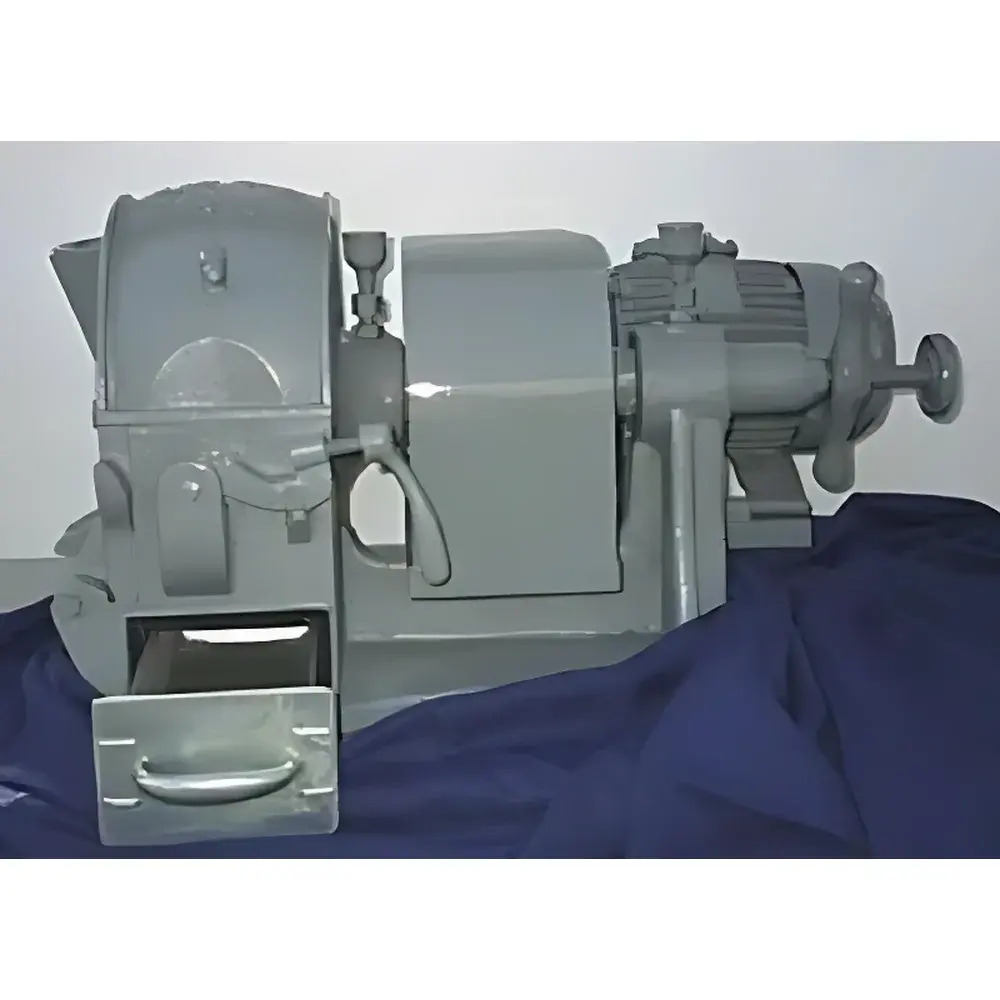
UA Series Disc Grinder
| Origin | USA |
|---|---|
| Manufacturer Type | Authorized Distributor |
| Origin Category | Imported |
| Model | UA Series |
| Pricing | Available Upon Request |
Overview
The UA Series Disc Grinder is a precision-engineered, direct-drive laboratory disc mill designed for consistent, high-efficiency size reduction of dry, brittle materials. Operating on the principle of shear and compressive forces between two parallel, counter-rotating or stationary/rotating discs—typically one fixed and one rotating—the UA grinder delivers controlled particle size distribution through adjustable disc gap geometry and optimized rotational dynamics. This mechanical comminution method ensures minimal heat generation and low contamination risk, making it especially suitable for quality control laboratories, geological sample preparation, mineralogical analysis, and pharmaceutical raw material pre-processing where reproducibility and traceability are critical.
Key Features
- Direct-drive motor configuration eliminates belt slippage and power loss, ensuring stable torque delivery across operating speeds (900–1000 rpm) and enhancing long-term calibration stability.
- Selectable motor power options—2 HP, 3 HP, or 5 HP—support scalable throughput requirements while maintaining compatibility with standard three-phase industrial power supplies (220 V / 440 V, 50 Hz).
- Standard 8-inch (203 mm) ferroalloy grinding plates are fully adjustable and mechanically lockable to precisely define the grinding gap, enabling fine-tuned control over final particle size (75–100 µm, equivalent to 150–200 mesh).
- Modular plate design permits rapid interchange of grinding surfaces made from alternative materials—including hardened steel, tungsten carbide, and ceramic composites—to accommodate varying hardness, abrasiveness, and cross-contamination sensitivity of feedstock.
- Open-access grinding chamber allows complete visual inspection and tool-free disassembly for thorough cleaning—critical for GLP-compliant environments and multi-sample workflows requiring strict carryover prevention.
- Compact footprint (1118 mm × 387 mm × 648 mm L×W×H) optimizes benchtop or integrated lab layout without compromising structural rigidity or vibration damping performance.
- No external safety enclosure required per OSHA 1910.212 and ANSI B11.1 guidelines when operated within designated laboratory zones—integrated interlock sensors and guarded feed hopper meet baseline mechanical safeguarding criteria.
Sample Compatibility & Compliance
The UA Series is validated for use with non-fibrous, low-moisture (<5% w/w), and inherently brittle solids—including quartz, feldspar, limestone, coal, ceramics, and certain polymer granules. It is not recommended for elastomeric, fibrous, oily, or hygroscopic materials due to potential clogging or thermal degradation. The system complies with ISO 17025:2017 requirements for equipment suitability in testing laboratories and supports audit-ready documentation for FDA-regulated environments under 21 CFR Part 11 when paired with validated data capture protocols. All electrical components conform to UL 508A and CE machinery directive standards (2006/42/EC).
Software & Data Management
While the UA Series operates as a stand-alone mechanical unit without embedded digital controls, it integrates seamlessly with third-party laboratory information management systems (LIMS) via analog 4–20 mA output signals (optional add-on module). Motor runtime, feed rate consistency, and maintenance logs can be tracked using configurable SCADA interfaces or Excel-based SOP templates aligned with ISO/IEC 17025 clause 6.4.2 (Equipment Records). Calibration verification records—including gap setting repeatability tests and throughput validation runs—are maintained per ASTM D2974 and USP grinding uniformity guidance.
Applications
- Preparation of geochemical reference materials for XRF and ICP-MS analysis.
- Homogenization of cement clinker and slag samples prior to Blaine fineness testing (ASTM C204).
- Routine particle size reduction in QC labs supporting ASTM D4294 (Sulfur in Petroleum) sample prep protocols.
- Production of standardized calibration standards for laser diffraction particle analyzers (e.g., Malvern Mastersizer).
- Feedstock conditioning for binder jetting additive manufacturing powder beds requiring narrow PSD distributions.
FAQ
What is the maximum feed size the UA Series can accept?
Dry, brittle feed material must be ≤6.35 mm (¼ inch) in largest dimension to ensure uniform entry and avoid jamming.
Can the UA grinder process wet or sticky samples?
No—this model is strictly intended for dry, free-flowing, non-adhesive materials; moisture content exceeding 5% w/w may cause plugging and inconsistent grinding action.
Is the grinding plate wear compensated automatically?
No automatic wear compensation is built-in; however, the manual gap adjustment mechanism includes vernier-scale indicators and repeatable locking positions to restore original settings after plate replacement.
Does the UA Series support GMP documentation packages?
Yes—upon request, IQ/OQ documentation templates, preventive maintenance schedules, and traceable calibration certificates (NIST-traceable micrometer gauges) are available for regulated pharmaceutical and medical device manufacturing facilities.
What electrical configurations are supported beyond the standard three-phase option?
Single-phase variants (e.g., model 242-53X2S) are offered for facilities with limited infrastructure, though rated throughput is reduced by ~30% compared to equivalent HP three-phase units.
Related Products



