
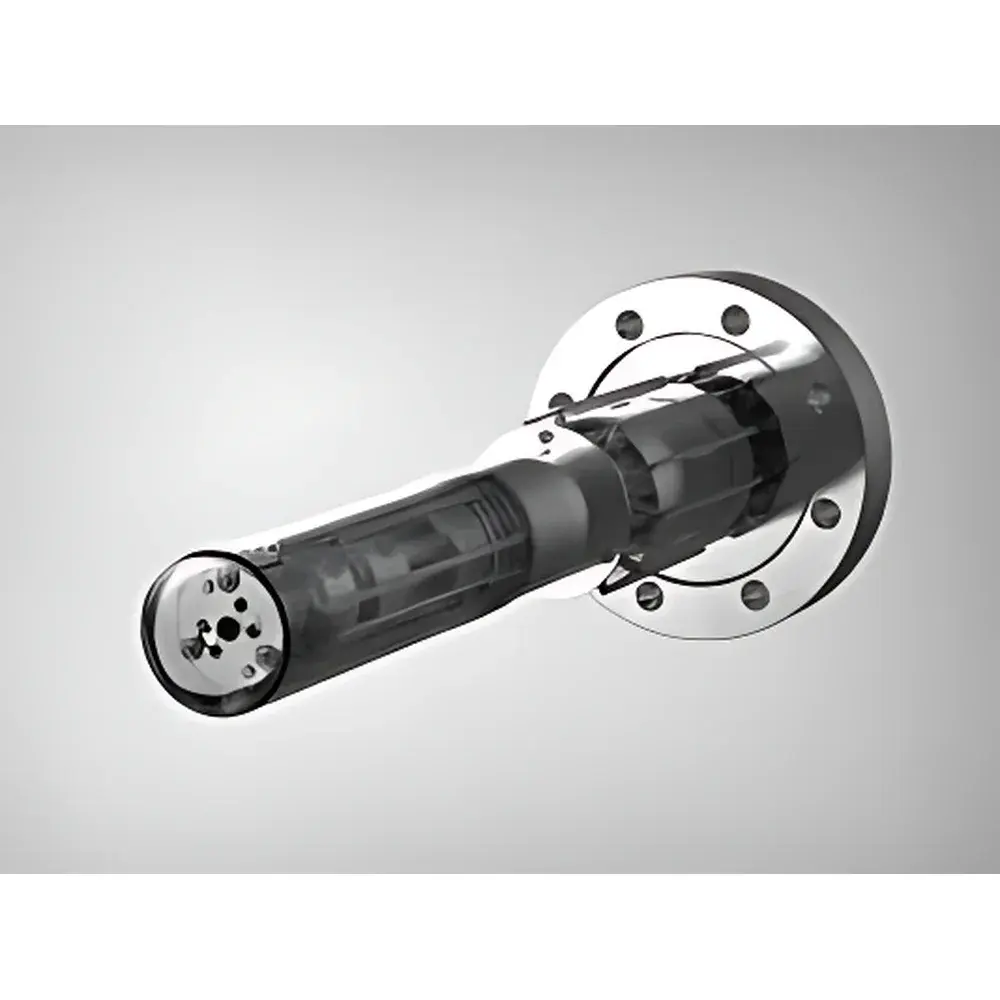
Hiden 3F 1000/2000 Series Triple-Filter High-Resolution Quadrupole Mass Spectrometer
| Brand | Hiden |
|---|---|
| Origin | United Kingdom |
| Model | 3F 1000/2000 Series |
| Mass Range | 1–300 amu (standard), up to 2500 amu (optional) |
| Detection Speed | 500 points/s |
| Resolution | 0.1% valley, 1% valley |
| Dynamic Range | 10⁷ |
| Minimum Detectable Partial Pressure | 2 × 10⁻¹⁴ mbar |
| Electron Energy Control | 0–150 eV (fully programmable) |
| Stability | < ±0.5% peak height drift over 24 h |
| Quadrupole Rod Diameters | 6 mm, 9 mm, or 12 mm (user-selectable) |
| Detector Options | SEM, PIC, dual Faraday/SEM, or Faraday/PIC |
| Interface | RS232, USB, Ethernet |
| Software | MASsoft Professional |
Overview
The Hiden 3F 1000/2000 Series Triple-Filter High-Resolution Quadrupole Mass Spectrometer is an engineered solution for demanding real-time gas-phase composition analysis in ultra-high vacuum (UHV), controlled-atmosphere reactors, catalytic test systems, and residual gas analysis (RGA) environments. Based on a three-stage quadrupole mass filtering architecture—comprising a pre-filter quadrupole, main mass-analyzing quadrupole, and post-filter quadrupole—the instrument achieves exceptional ion transmission selectivity and background suppression. Each quadrupole operates at independently optimized RF/DC voltage ratios and frequencies, enabling precise control over ion kinetic energy and trajectory. This triple-filter configuration significantly attenuates scattered ions, neutral species-induced secondary electrons, and metastable ion contributions—thereby improving mass peak fidelity, signal-to-noise ratio, and long-term measurement reproducibility. The system is fundamentally designed for quantitative trace gas detection, isotope ratio monitoring, and kinetic studies requiring sub-ppb sensitivity and high mass resolution under dynamic process conditions.
Key Features
- Triple-quadrupole mass filtering architecture with independent RF/DC tuning per stage to suppress non-resonant ion transmission and enhance mass resolution
- Selectable rod diameters (6 mm, 9 mm, 12 mm) to optimize resolution–sensitivity trade-offs for specific application requirements
- Fully programmable electron ionization source with 0–150 eV electron energy control, supporting both hard and soft ionization modes—including TIMS-compatible operation
- Integrated temperature-synchronized thermal desorption readout for direct correlation between heating profiles and evolved gas signals
- RF-enhanced pre-filter stage to reduce contamination-induced signal drift during extended operation in reactive or hydrocarbon-rich environments
- Dual-mode detector options: secondary electron multiplier (SEM), photon ion counting (PIC), or hybrid Faraday/SEM and Faraday/PIC configurations for optimal dynamic range coverage
- Real-time data acquisition at up to 500 mass points per second, enabling high-fidelity transient response capture in fast-evolving processes
Sample Compatibility & Compliance
The 3F 1000/2000 Series interfaces directly with vacuum manifolds via standard CF or ISO-K flanges and supports continuous sampling from pressures ranging from 10⁻¹⁰ mbar to atmospheric (with appropriate inlet restriction). It accommodates corrosive, condensable, and reactive gases—including H₂, CO, CO₂, NH₃, H₂O, hydrocarbons, and halogenated compounds—when used with chemically resistant ion source materials (e.g., stainless steel, Inconel, or quartz-lined variants). The instrument meets essential electromagnetic compatibility (EMC) and safety standards per CE marking directives (2014/30/EU, 2014/35/EU). Its hardware architecture and MASsoft software support audit-trail-enabled operation compliant with GLP and GMP frameworks; full 21 CFR Part 11 readiness is available via optional software licensing and user access control modules.
Software & Data Management
Control, calibration, and data acquisition are managed through MASsoft Professional—a Windows-based platform developed specifically for Hiden analytical instrumentation. MASsoft provides real-time spectral visualization, multi-channel time-trace logging, automated sequence scripting, and customizable report generation. All instrument parameters—including lens voltages, electron energy, detector gain, and quadrupole scan functions—are fully scriptable and timestamped. Raw data files (.mas) retain complete metadata (calibration history, hardware configuration, operator ID, and environmental context), ensuring traceability across laboratory or production environments. Export formats include CSV, ASCII, and HDF5 for integration with MATLAB, Python-based analytics pipelines, or LIMS platforms. Remote operation and diagnostics are supported via Ethernet interface with secure TLS-enabled communication protocols.
Applications
- In-situ catalytic reaction monitoring in fixed-bed and fluidized-bed reactors
- Residual gas analysis (RGA) and leak detection in UHV systems (e.g., semiconductor fabrication tools, synchrotron beamlines)
- Thermal desorption spectroscopy (TDS) and temperature-programmed desorption (TPD) experiments
- Plasma process characterization (etching, deposition, surface modification)
- Gas purity verification in high-purity industrial gas supply lines (e.g., electronics-grade N₂, Ar, He)
- Isotopic ratio tracking in tracer studies (e.g., ¹³CO₂, D₂, ¹⁵N-labeled compounds)
- Real-time emissions monitoring in combustion and pyrolysis research
FAQ
What mass resolution specifications does the 3F series achieve, and how is resolution validated?
Resolution is defined per ASTM E749 and IUPAC recommendations using the 10% valley method: 0.1% valley resolution at unit mass spacing (e.g., distinguishing 28.000 and 28.028 amu for N₂⁺ vs CO⁺), and 1% valley for broader peaks. Resolution is verified using calibrated perfluorotributylamine (PFTBA) spectra and confirmed during factory certification.
Can the system operate continuously for extended periods without recalibration?
Yes—under stable vacuum and temperature conditions, the instrument demonstrates < ±0.5% peak height drift over 24 hours, meeting ISO 11843-7 requirements for stability in quantitative RGA applications. Daily zero-point verification is recommended; full mass calibration is typically required only after major maintenance or environmental perturbation.
Is the MASsoft software compatible with modern Windows OS versions and networked lab infrastructures?
MASsoft Professional v6.2+ supports Windows 10/11 (64-bit), including domain-authenticated login and integration with Active Directory. It supports OPC UA server functionality for seamless connection to SCADA and MES systems in Industry 4.0 environments.
How does the triple-filter design improve performance compared to conventional single-quadrupole RGA systems?
The pre- and post-quadrupole stages act as bandpass ion optics that reject off-mass ions before and after the main analyzer, reducing chemical noise, space charge effects, and detector saturation—particularly critical when measuring low-abundance analytes adjacent to dominant background peaks (e.g., detecting CH₄ at ppb levels in H₂-rich streams).






