
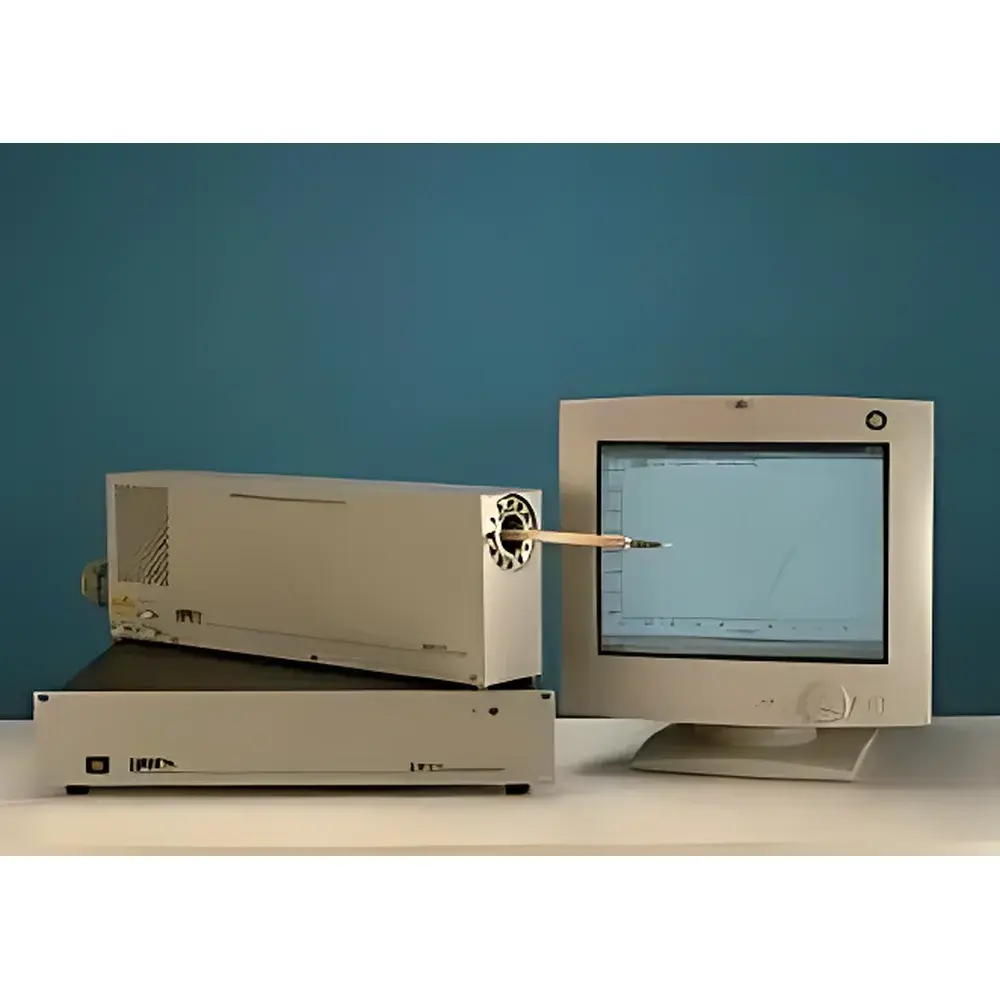
Hiden ESPion Advanced Langmuir Probe System
| Brand | Hiden |
|---|---|
| Origin | United Kingdom |
| Model | ESPion |
| Probe Type | Electrically Compensated, RF-Shielded Langmuir Probe |
| Operating Frequency Range | DC to 13.56 MHz |
| Maximum Scan Rate | 15 sweeps per second |
| Probe Drive Options | 300 mm / 600 mm / 915 mm motorized linear actuators, optional linear-rotary combi-drive |
| Cooling | Gas-cooled multi-sensor chain for high-temperature plasma operation |
| Compensation | Passive RF compensation (4.25 MΩ @ 13.56 MHz), reference probe for low-frequency drift & noise rejection |
| Data Interface | RS232, RS485, Ethernet LAN |
| Software | ESPsoft v5.x with pulse-gating, EEDF reconstruction, and automated plasma parameter extraction |
| Compliance | Designed for GLP-compliant plasma diagnostics |
Overview
The Hiden ESPion Advanced Langmuir Probe System is a precision-engineered diagnostic platform for real-time, in-situ electrical characterization of low- to medium-pressure plasmas. Based on the fundamental principles of single- or double-probe current–voltage (I–V) characteristic analysis, the ESPion applies controlled voltage sweeps to an emissive or non-emissive metallic tip immersed in plasma and measures resulting ion and electron currents. From these raw I–V curves, key plasma parameters—including electron temperature (Te), electron density (ne), ion density (ni), plasma potential (Vp), floating potential (Vf), Debye length (λD), and the full electron energy distribution function (EEDF)—are extracted using numerically robust differentiation and second-derivative methods. Unlike optical emission spectroscopy (OES) or microwave interferometry, Langmuir probing provides direct, localized, and quantitative measurements of charged particle populations—making it indispensable for process development, endpoint detection, and fundamental plasma physics studies in reactive ion etching (RIE), plasma-enhanced chemical vapor deposition (PECVD), sputtering, and surface functionalization systems.
Key Features
- High-speed acquisition: Up to 15 complete I–V sweeps per second, enabling time-resolved monitoring of transient plasma states during pulsed RF operation.
- Industry-leading passive RF compensation: 4.25 MΩ shielding impedance at 13.56 MHz—over 40× higher than conventional commercial probes—minimizing RF rectification artifacts and improving measurement fidelity in capacitively coupled plasmas (CCP).
- Dual-compensation architecture: Combines passive RF shielding with an auxiliary reference probe to suppress low-frequency drift (e.g., chamber wall charging, anodization-induced potential shifts) and power supply–related noise.
- Thermally robust design: Gas-cooled multi-sensor probe chain allows stable operation in plasmas exceeding 5000 K electron temperatures without thermal desorption or tip oxidation.
- Modular mechanical integration: Optional motorized linear drives (300 mm, 600 mm, 915 mm stroke), interlocked isolation valves, 90° angled probes, and linear–rotary combi-drives accommodate diverse vacuum chamber geometries and port constraints.
- Self-cleaning protocol: Programmable in-situ thermal cycling and bias reversal sequences mitigate carbon or metal film buildup on the probe tip—extending calibration stability and operational lifetime.
Sample Compatibility & Compliance
The ESPion is compatible with DC, RF (13.56 MHz, 27.12 MHz, 60 MHz), pulsed-DC, and VHF plasma sources operating from 0.1 mTorr to 10 Torr. It supports conductive, semi-conductive, and dielectric substrates via adjustable probe biasing and guard-ring configurations. All hardware and firmware are designed to meet electromagnetic compatibility (EMC) standards IEC 61326-1 and safety standard IEC 61010-1. When configured with validated ESPsoft installation packages and audit-trail enabled, the system supports data integrity requirements under FDA 21 CFR Part 11 and EU Annex 11 for regulated plasma process development in semiconductor fabrication and medical device coating applications.
Software & Data Management
ESPsoft v5.x provides a unified interface for instrument control, real-time visualization, and post-acquisition analysis. The software implements standardized algorithms per IEEE Std 1340–2020 for Langmuir probe data reduction—including orbital-motion-limited (OML) ion current correction, Druyvesteyn EEDF reconstruction, and Te/ne uncertainty propagation. Raw sweep data are stored in HDF5 format with embedded metadata (timestamp, pressure, RF power, gas composition). Export options include CSV, MATLAB .mat, and ASCII-compatible formats. Role-based user access, electronic signatures, and tamper-evident audit logs ensure traceability in GLP/GMP environments.
Applications
- Process optimization in RIE and ICP etch tools: Correlating ne and Te transients with etch rate and selectivity.
- PECVD reactor commissioning: Mapping radial and axial plasma uniformity for SiNx, a-Si:H, and DLC film growth.
- Pulsed plasma diagnostics: Gating synchronized to pulse envelope for cycle-resolved analysis of afterglow chemistry.
- Plasma–surface interaction studies: Quantifying ion flux asymmetry and sheath potential gradients near biased electrodes.
- Fundamental plasma research: Validation of kinetic simulations (e.g., Particle-in-Cell) using experimentally derived EEDFs and collisional transport coefficients.
FAQ
What plasma pressures and powers is the ESPion rated for?
The ESPion operates across a pressure range of 1 × 10⁻⁴ to 10 Torr and supports RF forward powers up to 3 kW (with appropriate matching network integration). Probe tip temperature is actively managed via regulated cooling gas flow.
Can ESPion be used in corrosive process gases (e.g., Cl2, SF6)?
Yes—tungsten, molybdenum, and iridium probe tips are available as standard or custom options. Optional ceramic insulator coatings (Al2O3, Y2O3) enhance resistance to halogen-based chemistries.
Is remote operation supported?
Full Ethernet-based control is implemented via TCP/IP protocol; ESPsoft can be operated over secure LAN or VPN connections with latency < 50 ms for real-time sweep triggering.
How often does calibration verification require?
Hiden recommends quarterly verification using certified reference plasmas (e.g., argon DC glow discharge with known ne and Te) or NIST-traceable voltage/current standards. Drift compensation routines are embedded in ESPsoft.
Does the system support third-party data integration?
Yes—ESPsoft exposes RESTful API endpoints and OPC UA server functionality for bidirectional integration with MES, SCADA, and LabVIEW-based control architectures.



