
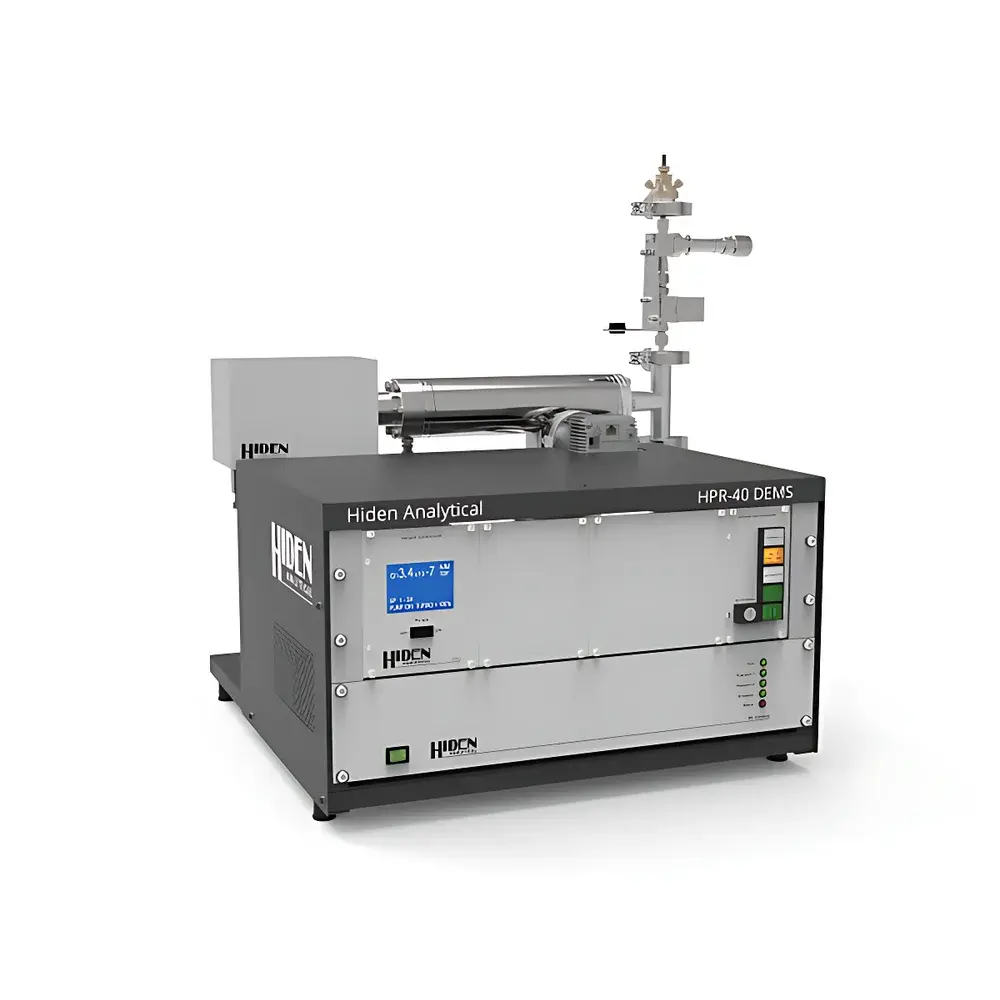
Hiden HPR-40 DEMS Differential Electrochemical Mass Spectrometer
| Brand | Hiden |
|---|---|
| Origin | United Kingdom |
| Model | HPR-40 DEMS |
| Mass Range | 50–300 amu |
| Resolution | < 1 amu |
| Sensitivity | 0.1 ppm (standard quadrupole) or 5 ppb (triple-filtered quadrupole option) |
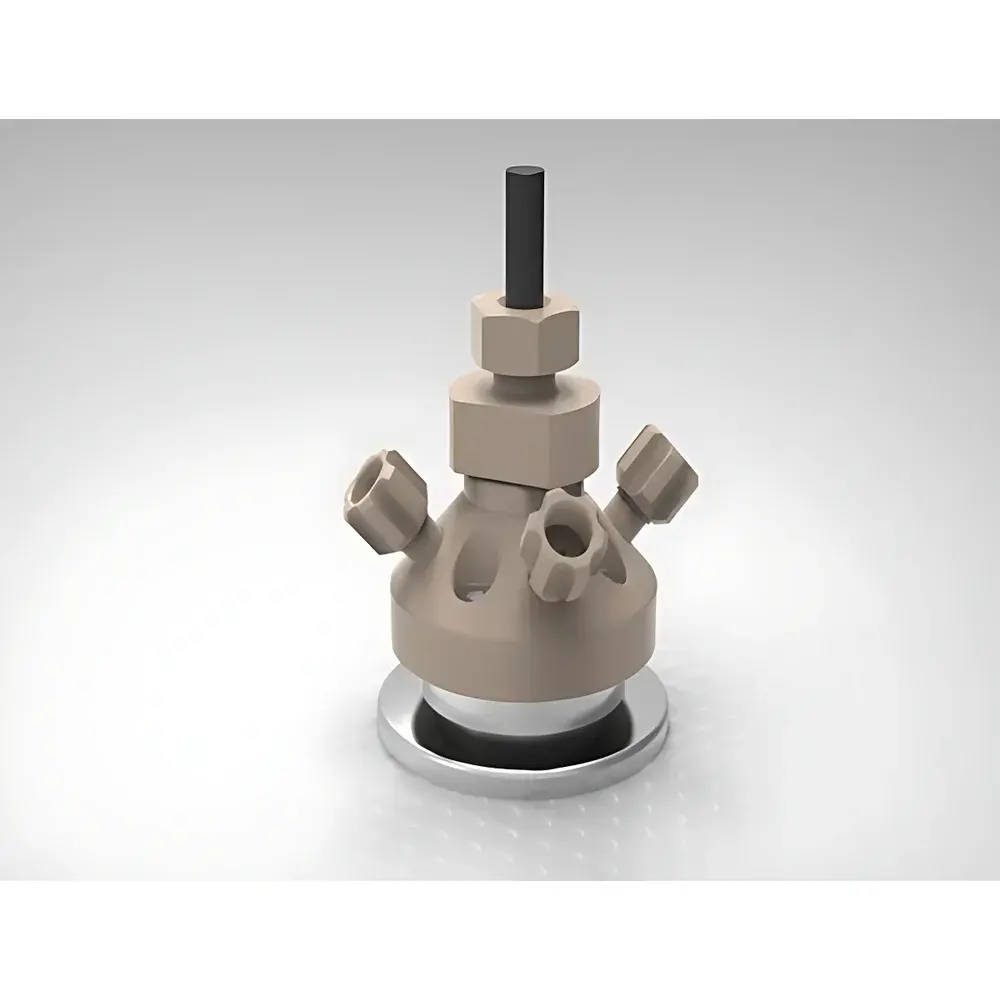
| Electrode Interface | User-coatable Pt/C working electrode + 4 additional electrode ports |
| Membrane | Replaceable nanoscale hydrophobic membrane |
| Ionization | Soft ionization capability |
Overview
The Hiden HPR-40 DEMS Differential Electrochemical Mass Spectrometer is a purpose-engineered analytical platform that integrates controlled-potential electrochemistry with high-sensitivity quadrupole mass spectrometry for real-time, in situ detection of volatile species generated at electrode interfaces. Operating on the principle of differential electrochemical mass spectrometry, the system couples an electrochemical half-cell—where reactions occur under potentiostatic or galvanostatic control—with a differentially pumped, ultra-high-vacuum-compatible mass spectrometer via a gas-permeable membrane interface. This configuration enables quantitative correlation between Faradaic current and evolved gaseous products (e.g., CO2, H2, O2, C2H4, CH4, CO) with millisecond temporal resolution. Unlike conventional ex situ analysis methods, the HPR-40 DEMS eliminates sample transfer artifacts and preserves reaction intermediates susceptible to decomposition or adsorption, making it indispensable for mechanistic studies in electrocatalysis, battery research, CO2 reduction, fuel cell development, and corrosion science.
Key Features
- First commercially available, fully integrated DEMS system engineered specifically for electrochemical interface analysis
- Differential pumping architecture with dual-stage vacuum system (base pressure <1×10⁻⁷ mbar), ensuring stable ion transmission and minimizing background interference during dynamic electrochemical experiments
- Gas-permeable nanoscale hydrophobic membrane (e.g., PTFE or polypropylene) enabling selective, rapid transfer of volatile electrogenerated species from aqueous or non-aqueous electrolytes into the mass spectrometer while retaining liquid phase integrity
- Configurable soft ionization mode (electron energy tunable down to ≤10 eV) to suppress fragmentation and preserve molecular ion signals—critical for identifying unstable intermediates such as hydroperoxides or carbonyl-containing radicals
- Modular electrode interface with user-coatable Pt/C working electrode and four auxiliary ports supporting reference, counter, and auxiliary electrodes—including compatibility with rotating disk electrodes (RDE) and flow cells
- Triple-filtered quadrupole option available for enhanced signal-to-noise ratio and sub-ppb detection limits in demanding applications such as trace gas evolution kinetics
Sample Compatibility & Compliance
The HPR-40 DEMS supports a broad range of electrochemical environments, including aqueous electrolytes (e.g., H2SO4, KOH, LiPF6 in carbonate solvents), ionic liquids, and polymer electrolyte membranes. Its membrane interface accommodates both static and flowing electrolyte configurations, enabling compatibility with standard three-electrode cells, microfluidic electrochemical reactors, and solid-state battery half-cells equipped with gas-evolution chambers. The system conforms to key international standards for electroanalytical instrumentation, including ASTM D7218 (for gas evolution quantification in batteries), ISO 16739 (electrochemical sensor terminology), and supports GLP/GMP-compliant workflows through audit-trail-enabled data acquisition software. While not inherently 21 CFR Part 11 certified, its software architecture permits integration with validated LIMS platforms for regulated pharmaceutical or battery QC laboratories.
Software & Data Management
Hiden’s QGA (Quantitative Gas Analysis) software provides synchronized acquisition of mass spectral data (m/z 1–300), electrochemical parameters (potential, current, charge), and time-stamped experimental metadata. Real-time mass chromatograms are generated per selected m/z channel, with automatic background subtraction and peak deconvolution algorithms optimized for overlapping isotopic envelopes (e.g., 13CO vs. 12C18O). Quantitative calibration is performed using certified gas standards and Faradaic efficiency calculations derived from simultaneous current integration. Raw data files (.qga) are stored in vendor-neutral HDF5 format, supporting third-party analysis in Python (via h5py), MATLAB, or Origin. Export options include CSV, ASCII, and XML formats compliant with FAIR (Findable, Accessible, Interoperable, Reusable) data principles.
Applications
- Mechanistic elucidation of CO2 electroreduction pathways—distinguishing formate, CO, ethylene, and ethanol evolution with concurrent Faradaic efficiency mapping
- Proton exchange membrane (PEM) and alkaline water electrolysis—quantifying O2/H2 crossover and detecting peroxide byproducts linked to membrane degradation
- Lithium-ion and lithium-metal battery anode SEI formation—tracking C2H4, CH4, and CO evolution during initial lithiation cycles
- Electrocatalyst stability screening—correlating transient gas release (e.g., Cl2 from chloride oxidation, NOx from nitrate reduction) with catalyst dissolution metrics
- Fundamental studies of oxygen evolution reaction (OER) intermediates—identifying *OOH and O2 evolution kinetics via 18O isotopic labeling experiments
FAQ
What electrochemical techniques are compatible with the HPR-40 DEMS?
Cyclic voltammetry, linear sweep voltammetry, chronoamperometry, chronopotentiometry, and pulse techniques—all synchronized with mass spectral acquisition at user-defined scan rates up to 100 Hz.
Can the system analyze non-volatile intermediates?
No—the HPR-40 DEMS detects only volatile or semi-volatile species that permeate the membrane; non-volatile intermediates (e.g., adsorbed radicals, surface oxides) require complementary techniques such as in situ Raman or XAS.
Is the membrane interface compatible with organic electrolytes?
Yes—membrane selection (e.g., expanded PTFE thickness, pore size) is tailored to solvent vapor pressure and surface tension; validated operation includes EC/DMC/LiPF6, PC, and acetonitrile-based systems.
How is quantification calibrated?
Using certified gas standards introduced via a precision leak valve, coupled with Faradaic efficiency validation against integrated current; sensitivity varies by m/z and membrane type, with typical RSD <3% across triplicate runs.
Does the system support automated potential-step sequences with mass spectral triggering?
Yes—QGA software allows event-triggered acquisition, where mass spectral scans initiate automatically upon reaching user-defined potential thresholds or current transients.



