
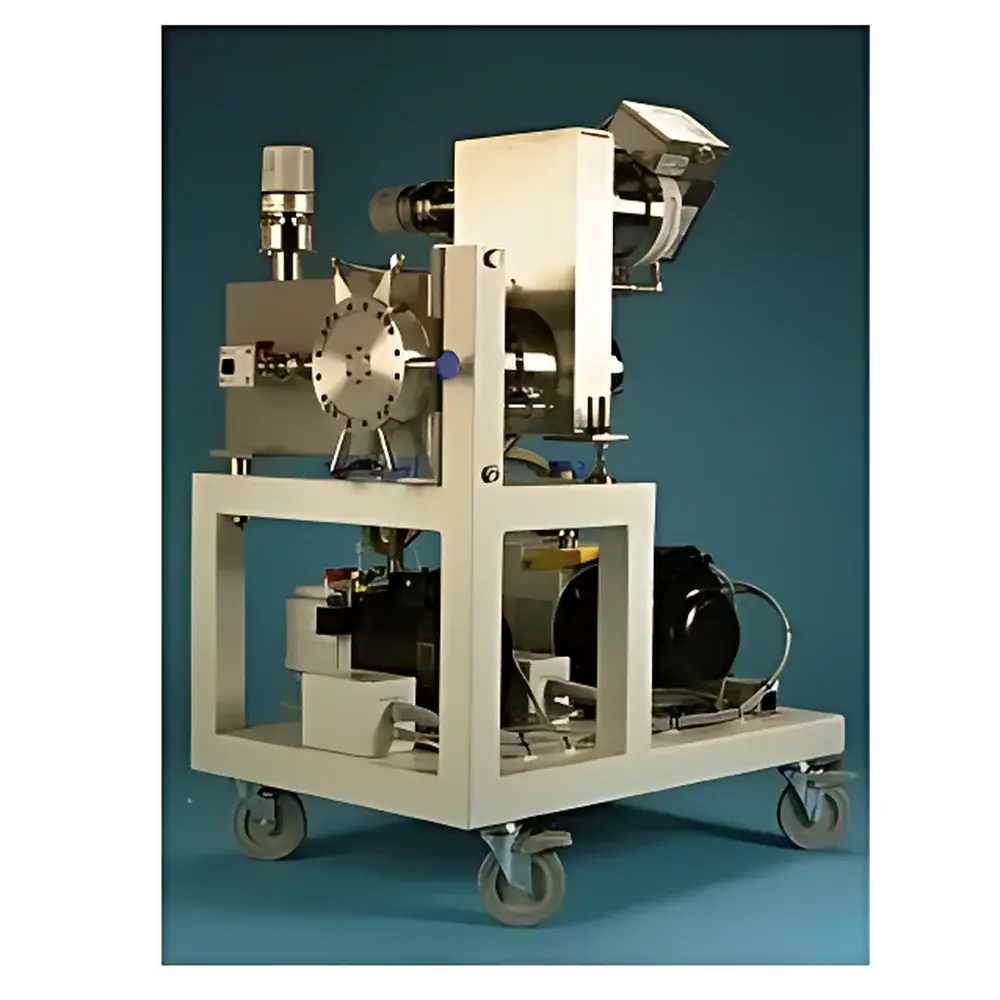
Hiden HPR60 Atmospheric-Pressure Molecular Beam Sampling Mass Spectrometer
| Brand | Hiden |
|---|---|
| Origin | United Kingdom |
| Model | HPR60 |
| Mass Range | 1–2500 amu |
| Sampling Pressure | 20 mbar to 1 bar |
| Detection Limit | 5 ppb to 100% |
| Response Time | <300 ms |
| Stability | ±0.5% peak height over 24 h |
| Data Acquisition Rate | 500 points/s |
| Electron Energy | 100–1000 eV |
| Dynamic Range | 7 decades (pulse-counting detector) |
| Interface | RS232 / RS485 / Ethernet LAN |
| Ion Source Cooling | Liquid nitrogen cryo-panel (optional water-cooled variant) |
| Vacuum Architecture | Integrated vacuum manifold with dedicated backing pump |
| Safety | Built-in Penning gauge and interlock system for overpressure protection |
Overview
The Hiden HPR60 Atmospheric-Pressure Molecular Beam Sampling Mass Spectrometer is a purpose-engineered analytical platform designed for real-time, quantitative gas-phase composition monitoring under near-ambient pressure conditions. Unlike conventional vacuum-integrated mass spectrometers, the HPR60 employs a multi-stage differential pumping system that extracts a supersonic, collision-free molecular beam directly from environments operating between 20 mbar and 1 bar. This beam is transported through a series of skimmer apertures into the high-vacuum ion source region without thermalization or reactive quenching—preserving the integrity of short-lived intermediates such as radicals, metastable species, and weakly bound complexes. The instrument integrates a triple-filter quadrupole mass analyzer with high mass resolution and low background noise, enabling unambiguous identification and quantification across a broad mass range (1–2500 amu). Its core architecture supports both electron impact (EI) and soft ionization modes, making it suitable for applications ranging from plasma chemistry diagnostics to catalytic reaction mechanism studies.
Key Features
- Atmospheric-pressure molecular beam sampling with minimal perturbation to reactive species transport
- Dual-energy electron ionization capability (100–1000 eV), configurable for hard or soft ionization depending on analyte stability and fragmentation requirements
- Sub-millisecond signal gating (1 µs resolution) for time-resolved mass or energy-selected detection
- Liquid nitrogen-cooled ion source cryo-panel to suppress water cluster formation and reduce spectral interference; optional water-cooled panel available for extended operation
- Integrated vacuum manifold with dedicated scroll or turbomolecular backing pump—enabling direct axial sampling via precision-aligned orifice
- Robust safety architecture including Penning vacuum gauge feedback and hardware interlocks to prevent overpressure events in the ion source region
- Pulse-counting detector with seven-decade linear dynamic range, supporting simultaneous trace-level and bulk-gas quantification
Sample Compatibility & Compliance
The HPR60 interfaces seamlessly with diverse process environments—including atmospheric-pressure plasma reactors, fluidized-bed catalytic systems, combustion chambers, and electrochemical gas evolution cells—via customizable flanged or conflat adapters. Its molecular beam inlet design minimizes residence time (<100 µs) and eliminates wall collisions, ensuring representative sampling of transient neutral and ionic species. The system complies with fundamental requirements for GLP-compliant gas analysis workflows, and its digital control architecture supports audit-trail generation when operated under MASsoft software with appropriate configuration. While not certified to specific ISO/IEC 17025 or FDA 21 CFR Part 11 out-of-the-box, the HPR60’s deterministic timing, calibrated response stability (±0.5% over 24 h), and traceable mass scale make it suitable for validation protocols aligned with ASTM D7504 (standard test method for gas analysis by mass spectrometry) and ISO 13877 (gas analysis — mass spectrometric methods).
Software & Data Management
Control, acquisition, and post-processing are managed through Hiden’s MASsoft Professional software suite, accessible via RS232, RS485, or Ethernet LAN. MASsoft provides real-time mass spectral display, multi-point calibration management, automated sequence scripting, and time-synchronized data logging at up to 500 spectra per second. Raw data files are stored in vendor-neutral formats (e.g., .csv and .txt) alongside metadata-rich binary archives (.mas), facilitating integration with third-party chemometrics tools or LIMS platforms. The software supports user-defined alarm thresholds, event-triggered acquisition, and export of fully annotated reports compliant with internal QA documentation standards.
Applications
- In situ monitoring of heterogeneous catalysis—tracking surface-adsorbed intermediates, desorption kinetics, and coke formation pathways
- Plasma process diagnostics—quantifying radical densities (e.g., OH, O, N, CH₃), excited-state species, and VUV-induced dissociation products
- Electrochemical gas evolution analysis—real-time detection of O₂, H₂, CO₂, and volatile organic side-products during battery cycling or electrolyzer operation
- Thermal decomposition and pyrolysis studies—capturing labile fragments and condensable vapors before secondary reactions occur
- Environmental emission profiling—continuous measurement of ppb-level VOCs, NOₓ precursors, and halogenated compounds in stack gases
FAQ
What types of reactive species can the HPR60 detect reliably?
The HPR60 is optimized for detection of neutral radicals (e.g., OH, CH₃, HCO), atomic species (O, H, N), stable molecules (CO, CO₂, NH₃), and low-energy ions—particularly those preserved via soft ionization and rapid beam transit.
Is calibration required for quantitative analysis?
Yes—quantitative accuracy requires periodic sensitivity calibration using certified gas standards; MASsoft includes tools for multi-point partial pressure calibration and drift correction.
Can the HPR60 be integrated into an existing PLC-controlled process line?
Yes—its Ethernet and serial interfaces support Modbus TCP/RTU protocols, enabling bidirectional communication with industrial automation systems for synchronized start/stop triggering and setpoint feedback.
What vacuum performance is needed for continuous operation?
The integrated vacuum manifold maintains ion source pressure below 1×10⁻⁶ mbar during sampling; no external high-vacuum pump is required beyond the included backing pump.
How is maintenance access designed for long-term operational reliability?
All critical components—including skimmers, ion source electrodes, and detector assembly—are modular and field-replaceable without breaking main vacuum; service intervals exceed 6 months under typical usage.





